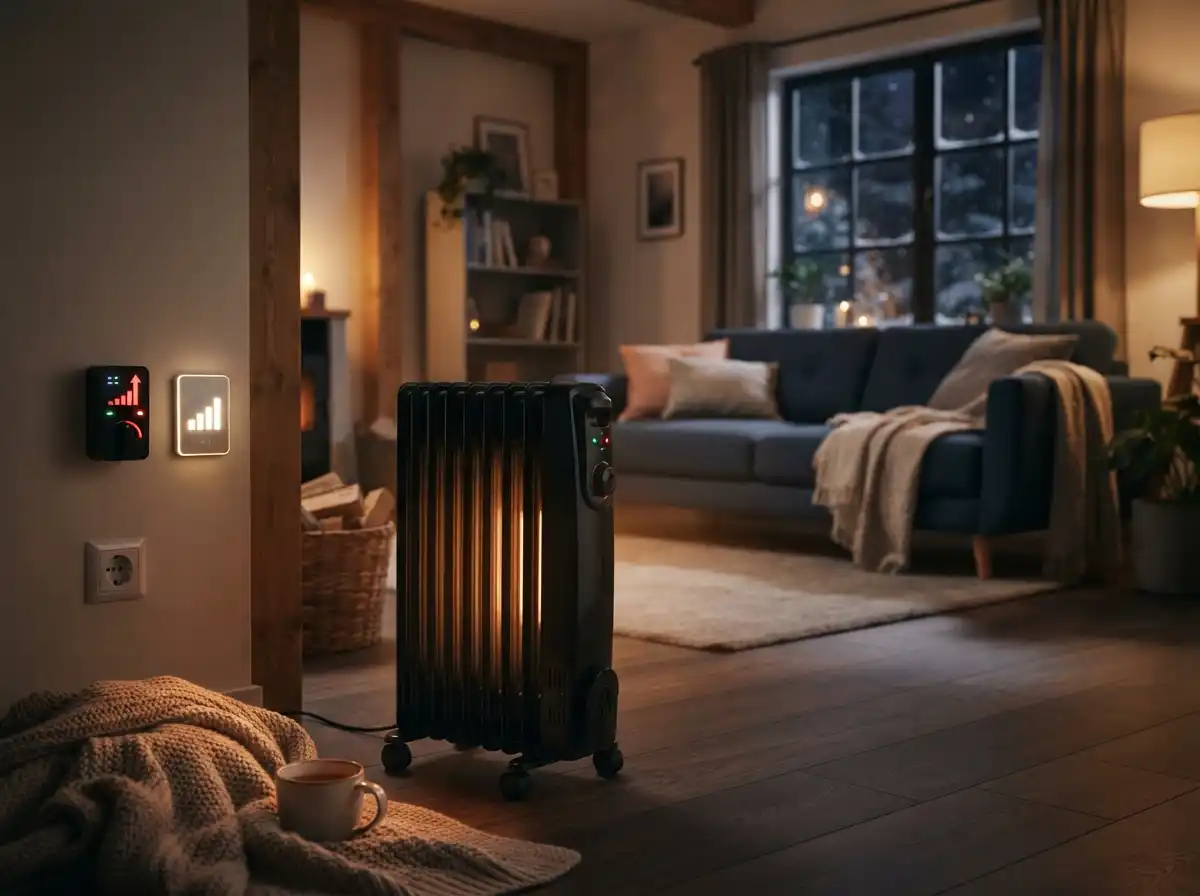
Running an electric heater costs about $0.26 per hour for a standard 1500-watt unit at the average U.S. electricity rate of $0.17 per kilowatt-hour. That might not sound like much until you multiply it by 8 hours a day for a month. Suddenly you’re looking at over $60 added to your electricity bill just from one heater.
I spent weeks analyzing electricity bills, reading forum discussions from real users, and calculating actual costs to help you understand exactly what to expect. Electric heater running cost depends on three key factors: your heater’s wattage, your local electricity rate, and how many hours you run it.
In this guide, you’ll learn how to calculate your exact costs, understand why your actual bill might differ from the math, and discover proven ways to stay warm without breaking the bank.
Understanding Electric Heater Wattage
Electric heaters typically range from 750 watts to 3000 watts. A 750W heater is designed for small spaces like bathrooms or personal heating. A 1500W unit covers most bedrooms and offices up to 150 square feet. The powerful 3000W models can heat larger rooms but draw significantly more electricity.
The wattage directly translates to heat output measured in BTUs (British Thermal Units). A 1500W heater produces roughly 5,100 BTUs per hour. This is enough to raise the temperature in a well-insulated 12×12 room by several degrees.
Most residential space heaters you find at hardware stores max out at 1500 watts. This is not a coincidence. Standard household outlets handle 15-20 amps, and 1500W at 120 volts pulls about 12.5 amps. Higher wattage risks tripping breakers.
Here’s the critical part: higher wattage always means higher running costs. A 3000W heater costs exactly twice as much per hour as a 1500W model. Before buying, check our guide to the best space heaters to find efficient models matched to your room size.
The Cost Calculation Formula
Calculating electric heater running cost follows a simple three-step formula. First, convert watts to kilowatts by dividing by 1000. Second, multiply by your electricity rate in dollars per kilowatt-hour. Third, multiply by the number of hours you run the heater.
The complete formula looks like this: (Watts ÷ 1000) × Rate per kWh × Hours = Total Cost.
Let me walk through a real example. Say you have a 1500-watt heater, pay $0.17 per kWh (the U.S. average), and run it for 5 hours. Here’s the math: 1500 ÷ 1000 = 1.5 kW. Then 1.5 × $0.17 = $0.255 per hour. Finally, $0.255 × 5 hours = $1.28 for that session.
Your electricity rate appears on your utility bill, usually listed as “$/kWh” or “cents per kilowatt-hour.” Rates vary dramatically by location. Louisiana residents might pay $0.12 while California homeowners face $0.25 or higher. Check your latest bill to get your exact rate for accurate calculations.
A kilowatt-hour represents using 1000 watts of power for one hour. Think of it like a speedometer. Watts measure power draw at any moment. Kilowatt-hours measure total energy consumed over time. Your utility company bills based on kilowatt-hours, not watts.
Cost Tables by Wattage and Time
Sometimes you just want a quick reference without pulling out a calculator. Here are comprehensive cost tables showing what you’ll actually pay based on common scenarios.
Cost Per Hour by Wattage
These figures assume the U.S. average electricity rate of $0.17 per kWh. If your rate differs, multiply the cost by (Your Rate ÷ 0.17) to adjust.
750W heater: $0.13 per hour. 1000W heater: $0.17 per hour. 1500W heater: $0.26 per hour. 2000W heater: $0.34 per hour. 3000W heater: $0.51 per hour.
Daily Cost at 8 Hours of Use
Most people run space heaters during evening hours or while working from home. Here’s what 8 hours of daily operation costs:
750W heater: $1.02 per day or $30.60 per month. 1000W heater: $1.36 per day or $40.80 per month. 1500W heater: $2.04 per day or $61.20 per month. 2000W heater: $2.72 per day or $81.60 per month. 3000W heater: $4.08 per day or $122.40 per month.
Cost at Different Electricity Rates
Your location dramatically impacts running costs. Here’s the hourly cost for a 1500W heater at various common rates:
At $0.12/kWh (cheap Midwest rates): $0.18 per hour. At $0.17/kWh (U.S. average): $0.26 per hour. At $0.25/kWh (California, Northeast): $0.38 per hour. At $0.35/kWh (Hawaii, some peak rates): $0.53 per hour.
A homeowner in Hawaii running a 1500W heater 8 hours daily pays about $127 per month. The same usage in Louisiana costs only $43. Location matters as much as wattage when calculating electric heater running cost.
Understanding Heater Duty Cycle
Here is where most cost calculations go wrong. Heaters with thermostats do not run continuously at full power. They cycle on and off to maintain your set temperature. This duty cycle dramatically reduces actual costs compared to theoretical maximums.
A heater in a well-insulated room might only run 30-40% of the time once the room reaches temperature. In a drafty space with poor insulation, that same heater might run 70% of the time or more. The difference between these scenarios can double or halve your actual electricity bill.
Forum users consistently report confusion about this. One Reddit user from the Midwest calculated their 1500W heater should cost $0.12 per hour. Their actual winter bills only increased by about $40 monthly instead of the predicted $90. The reason? The thermostat cycled the heater off for roughly half the time.
Another user running a heater 24/7 in a poorly insulated garage saw their bill jump from $90 to $250. That is nearly $1000 per month if the heater ran continuously at full power. Understanding duty cycle explains why real-world costs vary so much from simple calculations.
To estimate your duty cycle, time how long your heater runs during a 10-minute period once the room reaches temperature. If it runs for 3 minutes, your duty cycle is 30%. Multiply your theoretical cost by 0.30 for a more realistic estimate.
Factors That Affect Your Actual Running Costs
Several variables beyond wattage and electricity rates influence what you actually pay. Understanding these helps explain why your neighbor’s bill might differ wildly from yours despite using the same heater model.
Room Insulation and Heat Loss
Insulation acts like a thermos for your room. Good insulation keeps heat inside, reducing how hard your heater must work. Poor insulation lets heat escape through walls, windows, and ceilings. Old single-pane windows can lose heat 10 times faster than modern double-pane units.
Heat loss calculations involve complex formulas with R-values and temperature differentials. For practical purposes, remember this: a room with poor insulation requires 50-100% more heating energy than a well-insulated space of the same size. Your heater runs longer, increasing electric heater running cost proportionally.
Check for drafts around windows and doors. Seal gaps with weatherstripping. Close curtains at night to add an insulation layer. These simple steps can reduce your heating costs by 10-20% without touching the thermostat.
Temperature Differential
The gap between outdoor and indoor temperatures affects heater runtime dramatically. Maintaining 70°F when it is 60°F outside requires minimal energy. Maintaining that same 70°F when it is 20°F outside forces your heater to work much harder.
Every degree you raise the thermostat increases energy consumption by approximately 3-5%. Setting your heater to 68°F instead of 72°F can reduce running costs by 15-20%. Wear a sweater and save money.
Heater Type and Efficiency
Different heater technologies distribute heat differently but all electric resistance heaters convert 100% of electricity to heat. A $50 ceramic heater and a $300 oil-filled radiator with the same wattage rating cost exactly the same to operate per hour.
Where they differ is heat distribution and comfort. Radiant heaters warm objects and people directly, feeling warmer even at lower air temperatures. Convection heaters warm the air, which feels more consistent but may require higher thermostat settings for comfort. Oil-filled models retain heat longer after cycling off, smoothing temperature fluctuations.
For recommendations on efficient heater types, see our guide to the best space heaters available this year.
Space Heater vs Central Heating Cost Comparison
The big question: will a space heater actually save money compared to running your central heat? The answer depends entirely on your specific situation.
Zone heating works when you heat one or two occupied rooms while turning down the central thermostat for the rest of the house. If your central heating bill is $300 monthly and you can drop the thermostat 10 degrees while heating just your home office with a space heater, you might save $50-100 monthly during winter.
However, space heaters rarely make sense as primary heating for an entire home. Running multiple units in several rooms simultaneously often costs more than efficient central heating. Electric resistance heating is inherently expensive compared to gas furnaces or heat pumps.
Forum users report mixed results. One user saved about $20 monthly using a space heater in their bedroom while lowering the house thermostat. Another tried heating their entire apartment with space heaters and saw bills exceed $400 monthly. The key is strategic zone heating, not replacement heating.
Heat pumps offer the best of both worlds, providing 2-4 times more heat per unit of electricity than resistance heaters. If you have a heat pump, stick with it. Space heaters only make sense for heat pump users during extreme cold when heat pump efficiency drops.
Safety Tips for Using Electric Heaters
Staying warm only matters if you stay safe. Electric heaters cause thousands of house fires annually. Following these guidelines keeps your family protected.
Maintain three feet of clearance around your heater. Keep curtains, furniture, bedding, and papers well away. Never place a heater on carpet if the manufacturer specifies hard surfaces only. Never leave a heater running unattended in an unoccupied room.
Inspect cords before each use. Frayed wires cause fires. Never use extension cords with high-wattage heaters. The cord can overheat before the breaker trips. Plug directly into wall outlets.
Choose heaters with safety certifications from UL, ETL, or CSA. Look for models with tip-over shutoff switches and overheat protection. These features automatically turn off the heater if knocked over or if internal components overheat.
Respiratory health matters too. Some heaters, particularly older models or those with exposed elements, can dry air excessively or circulate dust. COPD patients and those with asthma should ensure adequate ventilation and consider humidifiers alongside heating. For permanent heating solutions with better air quality, explore best baseboard heaters which often include better filtration.
Never use outdoor heaters like patio heaters indoors. They produce carbon monoxide and other combustion byproducts designed to dissipate in open air. Indoor use can kill you.
Money-Saving Strategies
Now that you understand electric heater running cost, here are proven ways to reduce it without shivering through winter.
Use programmable timers or smart plugs. Set your heater to turn on 30 minutes before you arrive home rather than running all day. A $15 timer can pay for itself in a week. Smart plugs let you control heating remotely and set schedules from your phone.
Lower your thermostat by one degree. You will barely notice the difference, but you will cut costs by 3-5%. Combine this with dressing warmer and using blankets. The cumulative savings matter over a full heating season.
Heat only occupied rooms. Close doors to unused spaces. Block vents in guest rooms. Focus your heating dollars where people actually spend time. This zone heating approach is the primary advantage space heaters offer over central systems.
Improve your space. Add weatherstripping to drafty doors. Caulk windows. Hang thermal curtains. These one-time improvements reduce heat loss permanently, lowering heating costs for years. A $50 weatherproofing kit can save $100+ annually.
Consider your electricity rate timing. Some utilities offer time-of-use rates with cheaper power during off-peak hours. If your rate drops at night, pre-heat your bedroom before bed during cheaper hours, then let residual heat carry you through the night.
Maintenance matters. Clean dust from heater grilles and filters. Dust accumulation reduces efficiency and creates fire hazards. A clean heater transfers heat better, reaching thermostat setpoint faster and cycling off sooner.
Frequently Asked Questions
How much does it cost to run an electric heater for 5 hours?
At the average U.S. electricity rate of $0.17 per kWh, running a 1500W heater for 5 hours costs approximately $1.28. A 750W heater costs about $0.64 for the same period. Multiply these figures by your actual electricity rate and heater wattage for precise costs.
How much does it cost to have an electric heater on for 1 hour?
A standard 1500-watt electric heater costs approximately $0.26 per hour at average U.S. electricity rates. Lower wattage models cost less: 750W costs $0.13/hour, 1000W costs $0.17/hour. Higher wattage heaters like 3000W models cost $0.51 per hour.
How much does it cost to run a 1500 watt heater for 5 hours?
Running a 1500-watt heater for 5 hours costs exactly $1.28 at $0.17 per kWh. The calculation is: 1500W ÷ 1000 = 1.5 kW, then 1.5 kW × $0.17 × 5 hours = $1.28. If your electricity rate differs, adjust accordingly.
Is a room heater good for COPD patients?
Electric room heaters can benefit COPD patients by maintaining warm, stable temperatures. Cold air triggers bronchospasm and breathing difficulties. However, ensure heaters do not dry air excessively. Use humidifiers alongside heating, ensure proper ventilation, and avoid heaters that circulate dust. Consult your doctor about optimal room temperatures for your condition.
Will running a space heater 24/7 break the bank?
Running a 1500W space heater continuously 24/7 costs approximately $122 monthly at average rates. However, thermostats cycle heaters off periodically, so actual costs are typically 30-70% of this maximum. In well-insulated rooms, expect $40-85 monthly for continuous heating. In drafty spaces, costs approach the full theoretical amount.
How much does a space heater add to electric bill monthly?
Using a 1500W space heater 8 hours daily adds roughly $61 monthly at average U.S. electricity rates. Actual amounts vary by location, heater wattage, usage hours, and room insulation. Users report increases ranging from $30 to $250 monthly depending on these factors. Check your electricity rate and calculate using: (Watts ÷ 1000) × Your Rate × Hours Used.
Conclusion
Understanding electric heater running cost empowers you to make smart heating decisions. The formula remains simple: divide watts by 1000, multiply by your electricity rate, then multiply by hours used. A 1500W heater at average rates costs roughly $0.26 per hour or $61 monthly at 8 hours daily.
Remember that duty cycles reduce actual costs below theoretical maximums. Well-insulated rooms, lower thermostat settings, and strategic zone heating can cut your heating expenses significantly. Real users report savings of $20-100 monthly when using space heaters intelligently rather than heating empty rooms.
Before you buy, calculate your specific situation using your actual electricity rate and expected usage hours. Factor in your room’s insulation quality and local climate. Armed with these numbers, you can decide whether a space heater makes financial sense for your 2026 heating season.