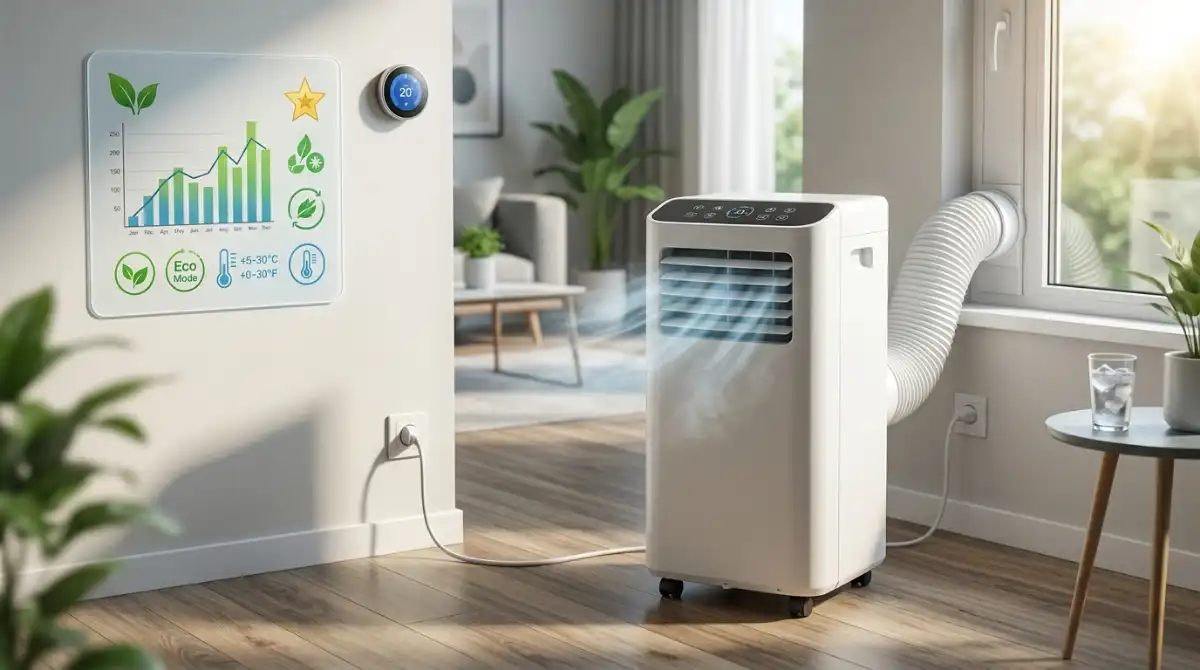
Last summer, my electric bill jumped from $47 to $138 after running a portable air conditioner in my home office. That surprise spike got me wondering: what is the actual cost to run portable air conditioner units, and could I have avoided that shock?
If you are considering buying a portable AC or already own one, understanding your running costs helps you budget properly and avoid sticker shock when your summer electricity bill arrives. I have spent weeks analyzing real user experiences from Reddit forums, reviewing electricity rate data across all 50 states, and calculating precise cost estimates based on actual wattage figures.
This guide breaks down exactly how much you will pay to run your portable AC by the hour, day, and month. You will learn the simple formula for calculating costs yourself, discover why BTU size matters more than you think, and pick up practical tips that could save you $30-50 on your monthly bill.
How to Calculate the Cost to Run Portable Air Conditioner?
Calculating your portable AC running costs takes three simple steps. You need to know your unit’s wattage, how many hours you run it daily, and your local electricity rate per kilowatt-hour (kWh).
Step 1: Find your unit’s wattage on the label or manual. Most portable ACs use between 900 and 1,500 watts per hour depending on BTU size.
Step 2: Calculate kilowatt-hours (kWh) using this formula: (wattage x hours used) / 1000 = kWh. For example, a 1,200-watt unit running for 8 hours uses 9.6 kWh per day.
Step 3: Multiply kWh by your electricity rate. At the national average of $0.16 per kWh, that 9.6 kWh costs $1.54 per day.
Quick Reference Formula:
(Wattage x Hours) / 1000 x Electricity Rate = Daily Cost
A kilowatt-hour represents using 1,000 watts of power for one hour. Your electricity bill shows your rate per kWh, which varies significantly by location. The U.S. national average sits around 16 cents per kWh, but rates range from 10 cents in Idaho to 42 cents in Hawaii.
Monthly Cost Estimates by BTU Size
Your portable air conditioner’s BTU (British Thermal Unit) rating directly determines its power consumption and your operating costs. Larger units cool bigger spaces but draw more electricity.
8,000 BTU Units:
Small 8,000 BTU portable ACs typically draw 900-1,000 watts. Running one for 8 hours daily at the national average electricity rate costs approximately $38-43 per month. These units work best for rooms up to 200 square feet.
10,000 BTU Units:
Mid-sized 10,000 BTU units consume 1,100-1,200 watts. Expect monthly costs of $50-57 for 8 hours daily operation. These handle rooms up to 300 square feet effectively.
12,000 BTU Units:
Popular 12,000 BTU models use 1,200-1,400 watts. Monthly costs run $54-63 for standard 8-hour daily use. These cool spaces up to 400 square feet.
14,000+ BTU Units:
Large 14,000 BTU portable ACs draw 1,400-1,600 watts. Running costs reach $63-73 monthly for 8-hour operation. These powerful units handle rooms up to 500-550 square feet.
Real User Cost Examples from Reddit:
A user in Edmonton reported paying $51 monthly for a 1,000-watt unit running 10 hours daily, while a 1,500-watt unit cost them $76.50 monthly. A Toronto user saw their bill jump from $30-40 in winter to $90-100 in summer after adding portable AC usage. Bay Area residents using PG&E reported paying around 54 cents per hour to run their units due to higher regional electricity rates.
Factors That Affect Portable AC Energy Consumption
Several variables influence how much electricity your portable air conditioner actually uses in real-world conditions. Understanding these factors helps you optimize performance and minimize costs.
Room Size and Insulation:
An undersized unit running constantly in a large room consumes far more electricity than a properly sized unit cycling normally. Poor insulation, single-pane windows, and drafty doors force your AC to work harder and run longer. I learned this lesson when my 8,000 BTU unit struggled to cool a poorly insulated 350-square-foot room, running non-stop and spiking my bill.
Outdoor Temperature:
When outdoor temperatures exceed 95°F, your portable AC works significantly harder to maintain indoor comfort. Each degree above your target temperature requires more compressor runtime, increasing electricity consumption by 5-10%.
Thermostat Settings:
Setting your portable AC to 72°F instead of 78°F can increase energy use by 15-25%. Every degree lower requires more compressor runtime. Using programmable timers or smart features to raise temperatures when you are away saves substantial money.
SACC vs ASHRAE Ratings:
Pay attention to SACC (Seasonally Adjusted Cooling Capacity) ratings rather than older ASHRAE ratings. SACC accounts for real-world factors like heat infiltration and provides a more accurate cooling capacity measurement. A unit rated 12,000 BTU under ASHRAE might only deliver 7,000-8,000 BTU under SACC testing. Buying based on SACC ensures you get adequate cooling without overspending on electricity.
Regional Electricity Rate Variations
Your location dramatically affects portable AC operating costs. Electricity rates vary by over 400% across the United States, meaning identical usage patterns produce vastly different bills depending on where you live.
National Average Costs:
The U.S. national average electricity rate sits at approximately 16 cents per kWh as of 2026. Using this average, running a 1,200-watt portable AC for 8 hours daily costs about $46 monthly.
High-Cost Regions:
California residents pay 28-35 cents per kWh depending on their utility provider and tiered pricing structure. A portable AC that costs $46 monthly at national average rates costs $80-100 in California. Hawaii tops the nation at 42 cents per kWh, making portable AC operation expensive year-round. Massachusetts, Connecticut, and New York also feature high rates between 24-28 cents per kWh.
Low-Cost Regions:
Idaho, Washington, and Louisiana offer the cheapest electricity at 10-12 cents per kWh. Running the same 1,200-watt portable AC costs only $29-35 monthly in these states. Other affordable regions include North Dakota, Nebraska, and Utah at 12-14 cents per kWh.
Why Regional Rates Matter:
A Reddit user in the Bay Area calculated their portable AC cost at 54 cents per hour due to PG&E’s high rates and tiered pricing. Meanwhile, a user in the Pacific Northwest reported minimal bill impact because of low regional rates. Before buying, check your local electricity rate on your most recent bill to calculate accurate expectations.
Energy-Saving Tips to Lower Your Portable AC Costs
Smart usage habits and proper maintenance can reduce your portable AC operating costs by 20-40% without sacrificing comfort. Here are proven strategies from energy experts and real user experiences.
Follow the 3-Minute Rule:
The 3-minute rule protects your portable AC’s compressor and prevents energy waste. After turning off your unit, wait at least 3 minutes before restarting it. This allows refrigerant pressures to equalize, preventing compressor strain and electrical spikes. Restarting immediately forces the compressor to work against uneven pressure, drawing extra power and potentially damaging the unit over time.
Optimize Your Thermostat Settings:
Set your portable AC to 78°F when home and 85°F when away. Each degree below 78°F increases energy consumption by about 8%. Using programmable timers to raise temperatures during sleeping hours or when away saves significant money. Many modern units offer eco modes that automatically optimize compressor cycling for efficiency.
Improve Your Room’s Efficiency:
Close blinds or curtains during peak sunlight hours to reduce heat gain by up to 30%. Seal window gaps around the exhaust hose installation to prevent hot air infiltration. Use weatherstripping on doors leading to uncooled areas. These simple steps reduce the cooling load on your portable AC, allowing it to cycle off more frequently.
Combine with dehumidifiers or fans:
Running a ceiling fan or box fan alongside your portable AC allows you to raise the thermostat setting by 2-3 degrees while maintaining comfort. In humid climates, reducing moisture with a dehumidifier helps your portable AC work more efficiently since dry air feels cooler.
Maintain Your Unit Properly:
Clean or replace filters every 2-4 weeks during heavy use. Dirty filters restrict airflow, forcing the unit to run longer. Check the exhaust hose for kinks or blockages that reduce efficiency. Empty water collection tanks promptly if your unit lacks auto-evaporative functionality.
Time Your Usage Strategically:
Run your portable AC during off-peak electricity hours if your utility offers time-of-use pricing. Many utilities charge 30-50% less for electricity between 10 PM and 6 AM. Pre-cooling your bedroom before sleep and using sleep mode overnight takes advantage of lower rates.
Choosing the Right BTU Size for Your Space
Selecting the correct BTU capacity prevents both inadequate cooling and unnecessary electricity costs. An undersized unit runs constantly without reaching target temperatures, while an oversized unit cycles inefficiently and wastes energy.
BTU-to-Room-Size Guidelines:
For rooms up to 200 square feet, choose an 8,000 BTU unit. Rooms between 250-300 square feet need 10,000 BTU capacity. Spaces measuring 350-400 square feet require 12,000 BTU units. For rooms up to 500 square feet, select 14,000 BTU models. Add 10% capacity for rooms with high ceilings over 9 feet. Add another 10% for rooms with direct sunlight exposure or poor insulation.
Consequences of Wrong Sizing:
An undersized portable AC runs continuously, consuming maximum electricity while failing to cool properly. Users on Reddit report bills increasing $75-100 monthly when undersized units struggle through hot afternoons. Oversized units cool too quickly without proper dehumidification, creating clammy conditions while wasting energy through short, inefficient cycles.
Focus on SACC Ratings:
Always check the SACC rating when comparing units. This newer testing standard better reflects real-world performance. A unit advertised as 14,000 BTU under the old ASHRAE standard might only deliver 9,000-10,000 BTU under SACC. The SACC rating more accurately predicts cooling performance and electricity costs.
Ready to buy? Check out our picks for the best portable air conditioners based on SACC ratings, efficiency, and real user feedback.
Frequently Asked Questions
How much does it cost to run a portable air conditioner for 24 hours?
Running a typical 1,200-watt portable AC for 24 hours costs approximately $4.60 at the national average electricity rate of 16 cents per kWh. This calculates as (1,200 watts x 24 hours) / 1000 = 28.8 kWh, multiplied by $0.16 = $4.61. Actual costs range from $2.90 in low-rate states like Idaho to $12.10 in high-rate areas like Hawaii.
Do portable AC units make your electric bill go up?
Yes, portable AC units increase electric bills significantly during summer months. Real user reports from Reddit show monthly increases ranging from $25 for efficient 8,000 BTU units running occasionally to $100+ for larger units used daily in hot climates. A typical 12,000 BTU unit running 8 hours daily adds $50-65 to monthly bills at average electricity rates.
What is the 3 minute rule for air conditioners?
The 3-minute rule requires waiting at least 3 minutes after turning off a portable AC before restarting it. This waiting period allows refrigerant pressures inside the system to equalize. Restarting immediately forces the compressor to work against uneven pressure, causing an electrical spike that wastes energy and can damage the compressor over time. Following this rule protects your unit and prevents unnecessary power draw.
Is it better to leave portable AC on all day?
No, leaving a portable AC on all day wastes electricity and increases costs unnecessarily. Instead, use programmable timers to run the unit only when needed. Set temperatures higher when away (85°F) and cool only when home (78°F). Modern portable ACs cool rooms within 15-20 minutes, making it more efficient to turn them on when entering a room rather than maintaining temperature continuously. This strategy typically saves 30-40% on operating costs.
Conclusion
Understanding the cost to run portable air conditioner units helps you budget accurately and make informed decisions. Based on my research and real user experiences, expect to pay $38-73 monthly depending on your unit’s BTU size, local electricity rates, and daily usage hours.
Key takeaways: calculate costs using the (wattage x hours) / 1000 x rate formula, choose BTU size based on SACC ratings and your room dimensions, follow the 3-minute rule to protect your unit, and use programmable timers to avoid cooling empty rooms. If you are shopping for a new unit, our guide to the best portable air conditioners highlights efficient models that minimize operating costs while delivering reliable cooling performance.


![12 Best Prime Day Air Conditioner Deals [cy]: Top SACC Picks](https://www.guidespot.com/wp-content/uploads/2026/06/featured-update-97366-1782326625199-370x245.webp "12 Best Prime Day Air Conditioner Deals 2026: Top SACC Picks")