Choosing the right window air conditioner size is the single most important decision you will make when cooling a room. Get it wrong and you will either sweat through summer with an undersized unit running nonstop, or shiver in a clammy room with an oversized unit that never removes humidity properly. This guide walks you through everything you need to know about BTU ratings, room measurements, and the hidden factors that change your cooling needs.
After helping hundreds of readers find their perfect cooling solution, I have seen every sizing mistake possible. I have also tested the methods that actually work in real homes, not just on paper. Whether you are cooling a 10×10 bedroom or a 500-square-foot studio, this guide gives you the exact formulas and adjustment factors to find your ideal window AC size.
Once you know your size requirements, check out our top-rated window air conditioner picks for units that match your BTU needs.
What Is a BTU and Why Does It Matter?
BTU stands for British Thermal Unit, the standard measurement for cooling capacity. One BTU represents the amount of heat required to raise one pound of water by one degree Fahrenheit. In air conditioning terms, it measures how much heat your unit can remove from a room per hour.
Window air conditioners range from 5,000 BTU (smallest standard size) up to 25,000+ BTU for commercial units. Most residential window ACs fall between 5,000 and 12,000 BTU. The key is matching that cooling capacity to your specific room conditions.
An undersized unit runs constantly without reaching your target temperature. Your electricity bill skyrockets while you still feel uncomfortable. An oversized unit blasts cold air for short bursts, cooling the room too quickly to properly dehumidify. You end up cold and damp, with a unit that cycles on and off excessively, wasting energy and wearing out faster.
Window Air Conditioner Size Chart: BTU to Square Footage
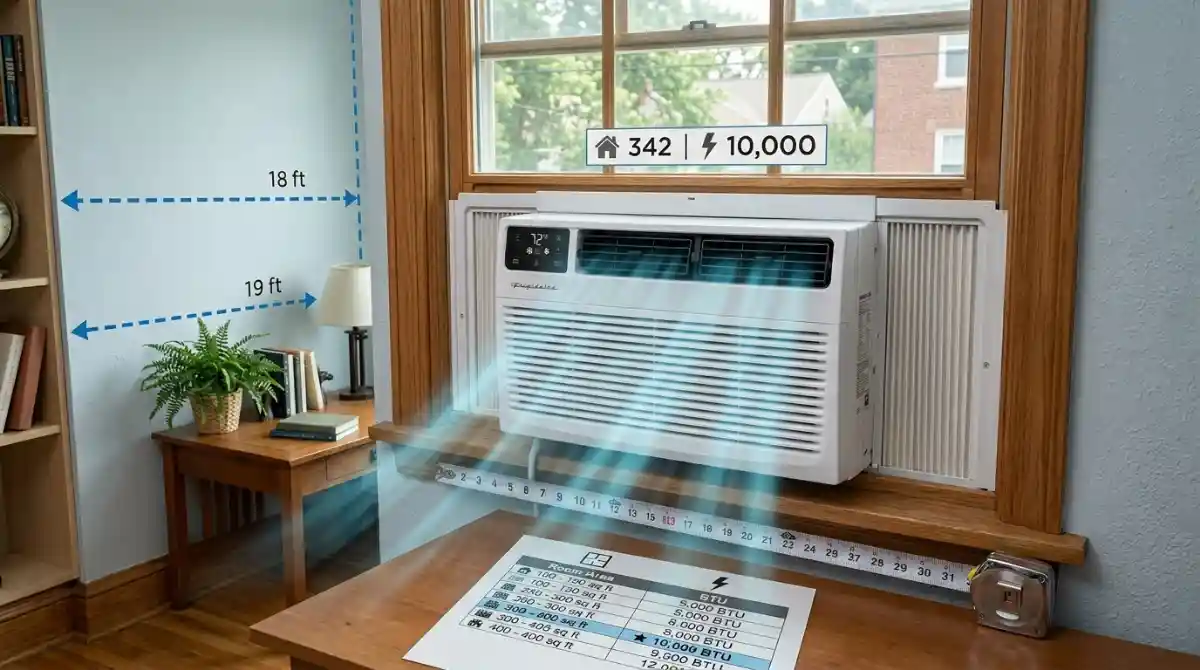
The quickest way to estimate your needs is matching room square footage to BTU rating. This table shows the standard recommendations that appear in most manufacturer guidelines and contractor estimates.
| Room Size (Square Feet) | Recommended BTU | Typical Room Type |
|---|---|---|
| 100 – 150 sq ft | 5,000 BTU | Small bedroom, home office, dorm room |
| 150 – 250 sq ft | 6,000 BTU | Medium bedroom, guest room |
| 250 – 300 sq ft | 7,000 BTU | Large bedroom, small living room |
| 300 – 350 sq ft | 8,000 BTU | Studio apartment, living room |
| 350 – 400 sq ft | 9,000 BTU | Large living room, open kitchen |
| 400 – 450 sq ft | 10,000 BTU | Large studio, small one-bedroom |
| 450 – 550 sq ft | 12,000 BTU | Large apartment, great room |
| 550 – 700 sq ft | 14,000 BTU | Open floor plan, large loft |
| 700 – 1,000 sq ft | 18,000 – 25,000 BTU | Whole small house, large loft |
This chart provides your starting point, but it assumes standard 8-foot ceilings, moderate sun exposure, and typical insulation. Read on to learn the adjustment factors that will refine your calculation.
How to Calculate Window Air Conditioner Size for Your Room
The professional formula for sizing window air conditioners starts with a simple square footage calculation. Measure your room length and width, multiply them together, then apply the BTU-per-square-foot rule. Here is the step-by-step process I use for every room assessment.
Step 1: Measure Your Room
Grab a tape measure and record the length and width of your room in feet. Multiply these numbers to get your square footage. For example, a 12-foot by 15-foot room equals 180 square feet. If your room has alcoves or irregular shapes, measure each section separately and add them together.
For open floor plans or adjoining rooms without doors, measure the entire connected space. Your window AC will cool any area that shares open airflow. Add the square footage of connected spaces to your total.
Step 2: Apply the BTU Formula
Multiply your square footage by 20 to 30 BTU per square foot depending on your climate and conditions. Hot, humid regions like the southern United States need closer to 30 BTU per square foot. Moderate climates can use 20-25 BTU per square foot.
A 300-square-foot room in Miami needs roughly 9,000 BTU (300 x 30). That same room in Seattle might only need 6,000 BTU (300 x 20). This base calculation gives you a starting point before applying the adjustment factors below.
Step 3: Calculate Your Adjusted BTU
Add or subtract BTU based on the five adjustment factors explained in the next section. The standard formula looks like this: Base BTU + Sun Exposure Adjustment + Occupant Adjustment + Kitchen Adjustment + Ceiling Height Adjustment = Final Recommended BTU.
Let us walk through a real example. You have a 400-square-foot living room in Chicago (moderate climate). Base calculation: 400 x 25 = 10,000 BTU. The room faces south with full afternoon sun, so add 10% (1,000 BTU). You have 10-foot ceilings, so add another 10% (1,000 BTU). No kitchen heat, just two occupants. Final recommendation: approximately 12,000 BTU.
5 Adjustment Factors That Change Your BTU Needs
The standard BTU-per-square-foot formula works for average conditions. Most rooms are not average. These five factors can increase or decrease your cooling requirements by 10% to 40%. Apply every factor that applies to your space.
1. Sun Exposure
Rooms with direct sunlight need more cooling power. South-facing and west-facing windows absorb intense afternoon heat. Add 10% to your BTU calculation for heavily sun-exposed rooms. North-facing rooms or heavily shaded spaces can subtract 10% since they stay naturally cooler.
If your room has large picture windows or sliding glass doors facing the sun, consider the extreme sun exposure category. Add up to 20% for floor-to-ceiling south-facing windows. Trees, awnings, or exterior shades reduce this factor significantly.
2. Ceiling Height
The standard BTU calculations assume 8-foot ceilings. Higher ceilings mean more air volume to cool. For 9-foot ceilings, add 5% to your BTU needs. For 10-foot ceilings, add 10%. Cathedral ceilings or lofts over 12 feet may need 15-20% additional capacity.
Heat rises and accumulates in vaulted spaces. Your window AC must counteract this heat stratification. Some users install tower fans to improve air circulation and distribute cool air more effectively in high-ceiling rooms.
3. Number of Occupants
Every person generates body heat. Standard BTU calculations assume two occupants per room. Add 600 BTU for each additional person regularly using the space. A home office with one occupant needs less cooling than a family room with four people watching TV.
Consider peak usage, not average occupancy. If your living room hosts weekly gatherings of six people, size for that maximum load. You can always use a higher fan setting when fewer people are present.
4. Kitchen Heat Load
Kitchens generate significant heat from cooking appliances. If your window AC cools a kitchen or open-concept space including the kitchen, add 4,000 BTU to your calculation. This compensates for stove, oven, and refrigerator heat output.
Even in open floor plans, kitchen heat affects adjacent rooms. Size your AC for the combined space if the kitchen air flows freely into the cooled area. Consider using range hoods and exhaust fans to reduce this heat load during cooking.
5. Insulation and Air Leakage
Well-insulated rooms with modern windows and sealed gaps need less cooling. Poorly insulated spaces with single-pane windows and drafty doors need more. Add 10-15% for older homes with minimal insulation. Subtract 10% for energy-efficient new construction with tight building envelopes.
Before buying an oversized AC, consider fixing insulation issues. Weatherstripping windows, sealing gaps, and adding thermal curtains can reduce your BTU needs significantly. This saves money on both the AC purchase and ongoing electricity costs.
Window Size Requirements by BTU Rating
Physical dimensions matter as much as cooling capacity. Your window must accommodate the AC unit with room for side panels and proper support. Each BTU range has standard width and height requirements. Measure your window before falling in love with a specific unit.
| BTU Rating | Minimum Window Width | Maximum Window Width | Minimum Window Height |
|---|---|---|---|
| 5,000 – 6,000 BTU | 23 inches | 36 inches | 14.5 inches |
| 8,000 BTU | 23 inches | 36 inches | 15 inches |
| 10,000 BTU | 26 inches | 39 inches | 16.5 inches |
| 12,000 BTU | 26 inches | 39 inches | 17 inches |
| 15,000+ BTU | 28 inches | 42 inches | 18 inches |
Most residential windows are double-hung style with vertical opening sashes. The minimum height measurement ensures the lower sash opens far enough to accept the AC unit. Casement windows (side-opening) and sliding windows require special adapter kits or portable air conditioner alternatives.
Window AC units come with expandable side panels to fill gaps between the unit and window frame. These panels work for the range listed above. If your window is narrower than the minimum, the unit will not fit. If wider than the maximum, you will have an unsealable gap requiring custom solutions.
Electrical Requirements by AC Size
Your electrical circuit must handle the unit’s power draw. Most window ACs use standard 115V outlets, but larger units require 220V or dedicated circuits. Check your outlet type and circuit capacity before purchasing.
| BTU Range | Voltage | Amperage | Circuit Requirements |
|---|---|---|---|
| 5,000 – 8,000 BTU | 115V | 5 – 7 amps | Standard household circuit |
| 8,000 – 12,000 BTU | 115V | 8 – 12 amps | Standard circuit, no other high-draw devices |
| 12,000 – 15,000 BTU | 115V | 12 – 15 amps | Dedicated 15-amp circuit recommended |
| 15,000 – 25,000 BTU | 220V | 15 – 20 amps | 220V outlet required |
Never assume your outlet can handle the load. Check the breaker rating for your intended circuit. A 15-amp breaker should not continuously carry more than 12 amps. Sharing a circuit with a refrigerator, microwave, or other high-draw appliance can cause tripped breakers.
Units over 15,000 BTU typically require 220V outlets like those used for electric dryers. These are not standard in most rooms. If you need this size category, verify your outlet type or budget for electrical installation.
Installation Tips for Optimal Cooling
Even the perfectly sized window AC performs poorly if installed wrong. Placement, sealing, and airflow management affect your actual cooling experience. Follow these guidelines to maximize your unit’s effectiveness.
Choose the Right Window
North-facing or shaded windows provide the most efficient cooling. The unit itself generates heat that radiates back into your room. When the exterior side sits in shade, that heat dissipates faster. South-facing windows in direct sun force your AC to work against radiant heat from both inside and outside.
If possible, install on the shadiest side of your home. The unit will run less frequently, last longer, and use less electricity. This placement can effectively reduce your needed BTU by 5-10%.
Ensure Proper Tilt
Window ACs need a slight backward tilt (about 1-2 degrees) toward the outside. This allows condensate water to drain properly rather than pooling inside the unit. Most modern units have built-in sloped trays, but check your installation manual for specific requirements.
Use the included sill brackets and support brackets for heavy units. A 12,000 BTU unit weighs 60-80 pounds. Without proper support, the weight can damage your window frame or cause the unit to fall.
Seal Gaps Completely
Every gap around your AC unit lets hot outside air in and cool inside air out. Use the included foam strips, side curtains, and weatherstripping thoroughly. For larger gaps, consider adding removable caulk or foam rope insulation.
Check the seal between the upper and lower window sash. Many installers forget to seal this gap. Cut foam strips to fit the space where the window meets the frame above the unit.
Common Sizing Mistakes to Avoid
After analyzing forum discussions and reader questions, I see the same sizing errors repeatedly. Avoid these pitfalls to save money and stay comfortable.
Mistake 1: Buying Based on Room Type Alone
A “bedroom AC” label means nothing. A master bedroom in Arizona with south-facing windows needs double the cooling of a shaded basement bedroom in Maine. Always calculate your specific square footage and adjustment factors.
Mistake 2: Ignoring Ceiling Height
Forum users consistently report that their 8,000 BTU unit “should cool 350 square feet” but fails in their room. Often the ceiling is 10 or 12 feet high, adding 25-50% more air volume than the standard calculation assumes.
Mistake 3: Choosing Oversized Units for Faster Cooling
Bigger is not better. An oversized unit cools the air temperature quickly but shuts off before removing sufficient humidity. You feel cold and clammy. The frequent on/off cycling also wastes energy and wears components faster. Size correctly for balanced temperature and humidity control.
Mistake 4: Forgetting About Heat Sources
Home offices with multiple monitors, gaming setups, or servers generate extra heat. Kitchens add cooking heat. Sunrooms add solar heat. Factor in every heat source when calculating your BTU needs.
Mistake 5: Not Measuring the Window
Buyers frequently select the right BTU but discover their window is too narrow or short for the unit. Measure window width, maximum opening height, and sill depth before purchasing. Compare these to the manufacturer’s installation requirements.
Frequently Asked Questions
What is the standard size of window AC?
Window air conditioners typically range from 5,000 BTU for small rooms up to 12,000 BTU for large spaces. The most common residential sizes are 5,000, 6,000, 8,000, 10,000, and 12,000 BTU. Physical dimensions vary by BTU, with standard widths ranging from 14 inches to 26 inches.
What size window air conditioner do I need?
Calculate your room’s square footage (length x width), then apply 20-30 BTU per square foot depending on climate. For a 300 sq ft room, you need roughly 6,000-9,000 BTU. Adjust upward for sun exposure (+10%), high ceilings (+10% per 2 feet above 8), additional occupants (+600 BTU each beyond two), and kitchen heat (+4,000 BTU).
How big of a room will a 12000 BTU window air conditioner cool?
A 12,000 BTU window air conditioner effectively cools rooms between 450 and 550 square feet under standard conditions. This covers large living rooms, family rooms, or open studio apartments. With high ceilings or heavy sun exposure, effective coverage drops to 400-450 square feet.
What size room is a 5000 BTU air conditioner?
A 5,000 BTU air conditioner properly cools rooms up to 150 square feet. This size works for small bedrooms approximately 10×12 feet, home offices, or dorm rooms. It is the smallest standard window AC size and performs best in shaded, well-insulated spaces with standard 8-foot ceilings.
What happens if my AC is too big for the room?
An oversized AC cools the air temperature too quickly without running long enough to remove humidity. You end up with a cold, clammy room and higher electricity bills from frequent cycling. The constant on/off operation also wears out components faster than proper sizing would.
How many BTU per square foot do I need?
The standard recommendation is 20-30 BTU per square foot depending on your climate. Hot, humid regions need 25-30 BTU per sq ft. Moderate climates can use 20-25 BTU per sq ft. Apply adjustment factors for sun exposure, ceiling height, occupants, and kitchen heat after this base calculation.
Conclusion
Getting your window air conditioner size right makes the difference between a comfortable summer and a frustrating one. Start with the square footage calculation, apply the five adjustment factors for your specific conditions, and verify that your window and electrical setup can accommodate your chosen unit.
Remember the core formula: square footage multiplied by 20-30 BTU per square foot, then adjusted for sun exposure (+10%), ceiling height (+10% per 2 feet over 8), extra occupants (+600 BTU each), and kitchen heat (+4,000 BTU). This method has helped countless readers find their perfect cooling solution.
Now that you know exactly what size you need, visit our top-rated window air conditioner picks to find the best units in your BTU range. With proper sizing and installation, you will stay cool and comfortable all season long while keeping energy costs under control.