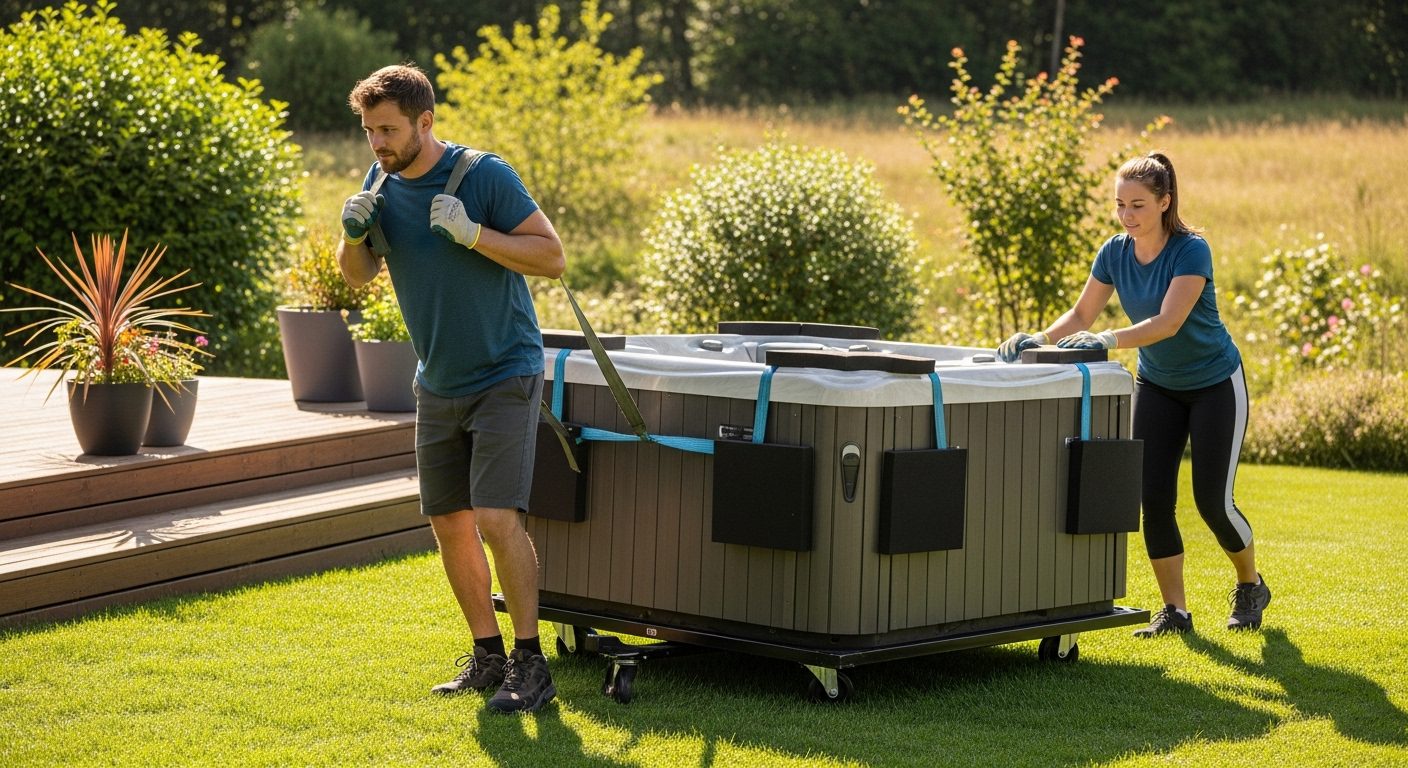
Learning how to move a hot tub safely is one of those home projects that punishes shortcuts. A typical six-seat spa weighs between 500 and 1,000 pounds empty, and a fully loaded unit can push past 4,000 pounds. That kind of weight on an awkward, top-heavy shape turns a “quick weekend move” into one of the most injury-prone tasks a homeowner can take on in 2026.
I’ve helped relocate dozens of hot tubs over the years, and the lesson I keep relearning is simple: planning beats strength. The teams that succeed aren’t the strongest ones. They’re the ones who drained early, recruited enough help, rented the right equipment, and respected the weight from the first lift.
This 2026 guide walks through every stage of moving a hot tub, from draining and electrical disconnect to choosing between a DIY effort and hiring professional hot tub movers. I’ve included current equipment rental rates, terrain-specific tips for grass, stairs, and decks, and direct answers to the questions that come up most in moving forums and the “People Also Ask” box on Google.
Before you commit to either path, work through three questions. Can you round up at least four capable adults for the entire move window? Do you have a clear path free of stairs, gates, and tight corners? Is your hot tub’s replacement value high enough that a single mistake would wipe out the savings of doing it yourself? Your answers to those three will tell you whether DIY makes sense or whether professional spa movers are worth the cost.
Essential Preparation Steps Before Moving
Preparation is where hot tub moves are won or lost. Most injuries and shell cracks I’ve seen trace back to skipped prep steps, not weak lifting. Start this checklist at least 48 hours before move day so nothing gets rushed.
Draining Your Hot Tub Completely
Water weight is the silent killer of hot tub moves. A standard six-person spa holds roughly 400 gallons, adding more than 3,300 pounds to the empty shell. Even a small residual amount in the plumbing lines can shift during transport, throwing off balance and cracking fittings.
Shut off power at the home’s main circuit breaker before touching any plumbing. Never disconnect electrical components while the unit is energized. Once powered down, hook a submersible pump or garden hose to the drainage valve and let it run. A pump finishes the job in 1 to 2 hours; gravity drainage through a hose can take 3 to 4 hours.
After the main tub reads empty, the work isn’t done. Water hides inside the jets, plumbing lines, and heater manifold. Run a shop vacuum or air blower through the lines until no moisture comes out. Leftover water that freezes during a winter move can split pipes and ruin pumps, turning a $400 move into a $4,000 repair.
Electrical Disconnection Safety Protocol
Hot tubs run on 220-240 volt circuits with 50-60 amp breakers and GFCI protection. That’s enough current to cause fatal shock if a wire is mishandled. In most jurisdictions, code requires a licensed electrician to perform the disconnect, and your warranty may require it too.
The electrician will disconnect the spa from the panel, cap the wires, label them, and document the connection so reinstallation matches the original setup. Take clear photos of the wiring before anything is touched. If you’re hiring professional movers, many coordinate directly with electricians as part of a full-service package.
Securing and Protecting Components
Strip every loose component off the tub before move day. Remove the cover, steps, filter cartridges, pillows, and any accessories. Wrap the cover in moving blankets and move it separately—replacements cost $300 to $600. Bag the filters in sealed plastic so debris doesn’t contaminate them.
Lock down the cabinet panels with heavy-duty tape or shrink wrap so they don’t rattle loose on the trailer. Pad every corner and edge with furniture pads held in place by stretch wrap. This protects both the acrylic shell from cosmetic chips and your crew from sharp edges during the lift.
Pre-Move Checklist (Print This)
Run through this list the night before the move. Each item you skip adds real risk to the operation.
- Power shut off at the breaker and confirmed with a voltage tester
- Tub fully drained, including jets and plumbing lines blown out
- Cover, steps, filters, and accessories removed and packed separately
- Electrical disconnected by a licensed electrician (if required locally)
- Cabinet panels taped or shrink-wrapped
- Path measured: every gate, doorway, and corner cleared of at least 1 inch of slack
- Underground utilities (sprinklers, septic, gas lines) marked and routed around
- Equipment staged: dolly, straps, plywood, lumber, blankets, gloves, boots
- Transport vehicle reserved with a weight-rated ramp
- Four to six committed helpers confirmed with exact arrival time
- Photos taken of tub condition for insurance documentation
- Weather checked; backup date picked if rain or freeze is forecast
Required Equipment and Tools
The right equipment does the work that muscle can’t. Hot tubs are too heavy and too awkward to muscle through with household gear—specialized tools spread the load and prevent the sudden shifts that cause injuries and shell cracks.
Essential Moving Equipment
A heavy-duty appliance dolly rated for 1,000 pounds or more is your primary tool. Standard furniture dollies collapse under hot tub weight. Two-wheeled appliance dollies handle stairs and rough terrain, while four-wheeled furniture dollies shine on flat, smooth surfaces.
Pick up at least four ratchet straps rated to 1,500 pounds or higher. These strap the tub to the dolly during the move and to the truck bed or trailer during transport. Rope and bungee cords are not acceptable substitutes—they snap under load.
Stock several 2×4 or 4×4 lumber pieces for leverage bars, pivot points, and temporary rails. Plywood sheets (at least half-inch thick) protect grass and soft ground from dolly wheels sinking under 1,000-plus pounds of pressure. A car jack or bottle jack is useful for safely raising one side of the tub so you can slide dollies underneath without manual lifting.
Spa Sleds and Hot Tub Dollies
A spa sled (sometimes called a hot tub sled) is a specialty piece of equipment built specifically for moving spas. It’s a low-friction platform with reinforced corners that supports the entire underside of the tub while you slide or roll it across flat ground. Spa sleds shine for short, flat moves where you can’t easily tip the tub onto dollies—like repositioning a tub on a concrete pad or moving one across a smooth patio.
Spa sleds and dedicated spa dollies rent for roughly $40 to $80 per day at Home Depot, Lowe’s, and local tool rental shops. Some rental outlets include them as part of a hot tub moving kit bundled with straps, plywood, and a furniture dolly for around $120 to $180 per day. If your local Home Depot doesn’t carry a spa sled specifically, ask about appliance dollies with pneumatic tires—they handle most of the same jobs.
A dedicated hot tub dolly typically has wider axle supports, padded contact points, and ratcheting strap anchors built in. It distributes weight across the underside rather than concentrating force at one edge, which protects the acrylic shell. For a one-time move, rental almost always beats the $400 to $800 purchase price.
Safety Equipment Requirements
Every person on the crew needs steel-toed boots or heavy-duty work boots. Crush injuries to feet are the leading medical event in hot tub moves, and sneakers offer zero protection. Pair the boots with grip-heavy work gloves so hands don’t slip on a shifting shell.
Back support belts reduce strain on the lower back, but they don’t replace good lifting technique. For routes with stairs or steep slopes, rent a stair-climbing dolly with built-in brakes—these typically run $75 to $150 per day and dramatically cut accident risk on inclines.
Equipment Rental vs Purchase Analysis
Renting wins for nearly every one-time move. A full equipment package rents for $100 to $300 per day, while buying the same kit runs $400 to $800. Quality ratchet straps ($30-$50 per set) and moving blankets are the only items worth purchasing—they’re useful for other projects and store easily.
Purchase makes sense only if you run multiple moves, operate a side business, or have other heavy items like gun safes or pianos to relocate regularly. For everyone else, the math favors rental every time.
Step-by-Step Hot Tub Moving Process
With prep done and equipment staged, execution is everything. Follow these phases in order—skipping ahead is how tubs get dropped and people get hurt.
Phase 1: Lifting and Loading
Station your crew around the tub before anyone touches it. You need at least four adults positioned at each corner, with one person designated as the coordinator who calls every lift and every step. Miscommunication during the lift causes most injuries.
Slide 4×4 lumber under the base to create leverage points. Use a car jack or bottle jack to lift one side just enough—usually 4 to 6 inches—to slide the dolly underneath. Never lift higher than necessary; extra height adds instability and injury risk. Lower the tub slowly onto the dolly once it’s centered.
Strap the tub to the dolly with an X-pattern across the top for maximum stability. A properly secured tub shouldn’t shift or wobble at all. Rock the dolly gently to test—if anything moves, retighten before proceeding.
Phase 2: Navigation and Transport
Clear the entire route before the tub moves an inch. Roll up garden hoses, move potted plants, secure loose paving stones, and prop open gates. A loaded hot tub dolly builds momentum fast, and sudden stops cause tip-overs.
Move slowly with one person guiding from the front and others stabilizing from the sides. Maintain steady forward motion on flat ground—no jerky stops or sharp direction changes. For corners, pivot gradually using the dolly wheels as the rotation point rather than muscling the tub around.
Elevation changes need extra caution. Going downhill, the front guide controls descent speed while rear assistants provide braking. Uphill reverses those roles: rear assistants push while the front guide steers. Communicate constantly—if anyone says “stop,” everyone stops immediately.
Phase 3: Loading for Vehicle Transport
If you’re moving the tub to a new address, you’ll need a transport vehicle with a loading ramp rated for at least 1,500 pounds. A flatbed trailer, large box truck, or pickup truck with a heavy-duty ramp all work for the right size tub. Verify the ramp’s weight capacity before rental—generic moving truck ramps sometimes max out at 800 pounds.
Roll the tub up the ramp using the same slow, coordinated approach as ground transport. Position the tub against the front wall of the truck bed to distribute weight, then strap it down with multiple ratchet straps anchored to the vehicle’s tie-down points. Check strap tension after the first 10 miles of driving—road vibration always loosens the initial setup.
Critical Tilt Safety Warning
Never tip a hot tub onto its equipment side. This is the single most important safety rule cited by manufacturers including Sundance Spas, and it’s the warning the AI Overview at the top of Google surfaces most prominently. The equipment side holds the heater, pumps, control panel, and plumbing manifold—none of which are designed to bear the tub’s full weight.
If you must tilt the tub to fit through a gate or load it onto a trailer, rest it only on the opposite structural “flat” side. The flat side is built to support the shell’s weight evenly. Tilting onto the equipment side crushes pumps, cracks the control housing, and bends plumbing connections—often causing thousands of dollars in damage that the warranty won’t cover.
Before tilting, photograph the equipment side and identify the structural flat side by checking your manufacturer’s manual. If you’re not sure which side is which, don’t tilt—find another route or hire a pro with a crane.
Moving a Hot Tub on Different Terrains
Terrain dictates technique. What works on a concrete driveway fails on a wet lawn, and what’s safe on a flat patio can drop a tub down a flight of stairs. These terrain-specific tips are where most DIY guides go thin—here’s how to handle each surface.
On Grass
Grass is the trickiest common surface for hot tub moves. Loaded dollies sink into soft lawns, especially after rain, and the tub can tip when one wheel drops farther than the others. Lay down half-inch plywood sheets to create a temporary roadway from start to finish.
Overlap plywood edges by at least 6 inches so wheels never catch a seam. Move the rear sheets to the front as you advance—this “leapfrog” technique covers any distance with a limited number of sheets. Avoid moving on wet grass at all costs; even with plywood, damp soil gives way under 1,000-plus pounds.
Down or Up Stairs
Stairs are the highest-risk terrain and the most common reason homeowners call professional movers. A loaded hot tub on a flight of stairs generates enormous downhill force that no crew of four can safely arrest if it breaks loose.
If you must take stairs, rent a stair-climbing dolly with motorized tracks or built-in brakes. Position your strongest crew members downhill with the dolly, and station spotters on both sides. Take one step at a time with full stops between each. If the stairs have more than four risers, hire a professional—this is exactly the scenario where injuries and tub losses cluster.
Across a Deck
Wooden decks often look sturdy but weren’t built for concentrated point loads. A 1,000-pound tub on a dolly puts all that weight on four small contact patches, which can crack deck boards or even collapse older structures.
Have a structural engineer or experienced contractor verify the deck’s load rating before rolling anything across it. Most residential decks are built for 40 pounds per square foot of distributed load—a hot tub on a dolly far exceeds that in the square footage under each wheel. Reinforce with temporary joists or plywood distribution pads if there’s any doubt.
On Dirt or Gravel
Dirt and gravel surfaces are more forgiving than grass but still unstable. Rake the path smooth and lay plywood or thick planks across soft spots. Gravel pits are especially prone to burying small dolly wheels—use dollies with the largest pneumatic tires you can rent.
Watch for hidden hazards: buried sprinkler heads, shallow irrigation lines, and septic tank lids. A loaded dolly that punches through a buried lid will tip the tub instantly. Mark every known utility before move day and route around anything suspicious.
How to Move a Hot Tub a Few Feet
Not every move involves a trailer and a cross-town trip. One of the most common hot tub questions in moving forums is how to relocate a tub just a few feet—usually to reposition it on a pad, slide it away from a fence for service, or shift it into a better spot in the yard. The good news: short moves are far more manageable than full relocations.
For a move of 10 feet or less on flat, hard ground, the furniture dolly method works well. Tilt one side of the tub just enough to slide two or three four-wheeled furniture dollies underneath—Harbor Freight and Home Depot rent these for $20 to $30 each. Lower the tub onto the dollies, strap it down, then roll it slowly to the new position. This is the technique one Reddit user in r/hottub described using successfully: “Me, my wife, and two teenage kids moved our 6-person tub. Tilted it down onto Harbor Freight furniture dollies one side at a time, wheeled it.”
The “tarp method” works for solo movers on smooth concrete or asphalt. Slide a heavy-duty tarp under the tub, then drag it slowly across the smooth surface. This only works for short distances on truly flat, slick surfaces, and only for tubs under 700 pounds. Don’t attempt it on grass, gravel, or any surface where the tarp can catch.
For repositioning on the same concrete pad—say, rotating a tub to face a different direction—use PVC pipes as rollers. Lift one end slightly, slide three or four 1-inch PVC pipes underneath, and rotate the tub by walking it around. Replace rollers from the rear to the front as they roll out. This technique is gentle on the shell and works with just two people.
Can You Move a Hot Tub in a Pickup Truck?
Yes, you can move a hot tub in a pickup truck, but only certain tubs and only with the right truck. This is one of the most-asked questions on the SERP, and Home Depot currently owns the featured snippet with a short answer. Here’s the full breakdown.
Compact two-person hot tubs weighing 500 pounds or less can ride in a full-size pickup bed (long-bed F-150, Silverado, or Ram 1500) without much trouble. You’ll need a heavy-duty ramp rated for at least 800 pounds, four ratchet straps, and at least four adults to load and unload. Pad every contact point between the tub and the truck bed to protect both surfaces.
Standard and larger hot tubs (six-person, eight-person, or any model over 600 pounds) should not go in a pickup bed. The bed floor isn’t rated for that concentrated weight, the ramp angle becomes dangerously steep, and the high center of gravity makes the truck top-heavy and prone to tipping on turns. Use a flatbed trailer or a 16-to-20-foot box truck with a proper loading ramp instead.
Whenever you load a hot tub into any vehicle, secure it against the front wall of the bed or trailer, run straps in an X-pattern to four separate anchor points, and re-check tension after the first 10 miles. Drive under 55 mph and avoid sudden stops. A loose hot tub in a pickup bed isn’t just property damage—it’s a road hazard.
When (and When Not) to Move a Hot Tub on Its Side
“Can a hot tub be transported on its side?” shows up in the People Also Ask box, and the answer is more nuanced than a yes or no. The short version: only on the structural flat side, only for short distances, and only if your manufacturer’s manual permits it.
Many acrylic spa shells tolerate being tipped onto the structural flat side for short periods—this is how professional movers slide tubs through narrow gates and over fences. The critical rule, repeated from earlier: never tip the tub onto the equipment side (the side with the heater, pumps, control panel, and plumbing manifold). That side cannot support the tub’s weight and will fail catastrophically.
Some manufacturers, including certain Bullfrog, Hot Spring, Caldera, and Jacuzzi models, explicitly prohibit side-transport and will void the warranty if you attempt it. Check your owner’s manual or call the manufacturer’s service line before tilting the tub. If the manual doesn’t address it, assume it’s not allowed and find another route.
For moves requiring the tub to travel on its side—like fitting through a narrow gate—pad the contact edge heavily with moving blankets, keep the trip short, and reset the tub upright as soon as possible. Never leave a hot tub on its side overnight or for any extended period, even on the correct side.
Professional Moving Services vs DIY Comparison
The choice between hiring professional hot tub movers and doing it yourself comes down to more than cost. Risk, complexity, and the value of your time all factor in.
Professional Moving Service Benefits
Professional spa movers bring the equipment, the experience, and the insurance that DIY teams lack. They carry commercial liability coverage for property damage and injury—protection you do not have when a neighbor throws out their back helping you. That coverage becomes the entire ballgame if something goes wrong.
Most professional crews finish a hot tub move in two to three hours, versus the full day a DIY team often needs. Many handle electrical disconnect, transport, and reconnection at the new location as a single package. Quality companies guarantee their work, returning for free if their move causes a problem.
Pros also solve problems that stop DIY efforts cold. Tight corners, narrow gates, fences, and overhead obstacles are routine for them—they carry specialized dollies, sleds, and access to crane service when needed. For valuable or vintage tubs where one crack means a $5,000 replacement, the professional premium pays for itself the moment it prevents a single mishap.
When DIY Makes Sense
DIY makes sense for short, flat moves with clear access and plenty of help. Moving a tub across a level backyard patio with four adults, the right equipment, and a clear path is realistic. Anything with stairs, tight corners, or a long transport distance tips the math toward professionals.
You need at least four physically capable adults committed for the entire move window—three people is the absolute minimum only in ideal conditions. Anyone with back problems, joint issues, or physical limitations should not be lifting. Honesty about your crew’s capability is what prevents the emergency room visits.
Also weigh the tub’s value. A 15-year-old basic model might justify DIY risk; a $12,000 Hot Spring or Caldera warrants professional handling. And remember: many manufacturer warranties require professional installation and moving. A DIY move can void your coverage permanently—check the warranty language first.
True Cost Analysis
Here’s how the costs stack up in 2026. These ranges reflect current rental rates and professional quotes from national moving companies.
Professional hot tub moving ranges from $200 to $400 for local moves under 10 miles, $300 to $600 for moves of 30-plus miles, and $800 to $1,500 for full-service jobs that include disconnect and reinstallation. Crane service for moves over fences or buildings adds $750 to $2,000 on top.
DIY looks cheaper at first—equipment rental runs $100 to $300—but the true total is higher. Add truck rental ($50-$150), fuel ($20-$60), helper compensation if you hire labor ($200-$400), and an emergency reserve ($500-$1,000). Realistic DIY cost lands at $350 to $850, and that’s before any accident-related expense.
One emergency room visit or one cracked acrylic shell wipes out every dollar of DIY savings. The hidden cost of DIY is the risk you’re shouldering without insurance—and that risk is exactly what professional movers are charging you to absorb.
Safety Considerations and Risk Management
Safety drives every decision in a hot tub move. The weight, the awkward shape, and the team-lift dynamic create injury risks that no amount of strength can fully offset.
Common Injury Risks
Back injuries top the list. Heavy weight plus awkward lifting angles strain muscles and spinal discs. Use proper technique: bend at the knees, keep the back straight, lift with the legs, and never twist—pivot your whole body with small steps instead.
Crush injuries to hands and feet happen when the tub shifts or slips. Steel-toed boots and proper strapping prevent most of these. Maintain verbal communication at all times, especially during the set-down—most crush injuries happen in the last 6 inches.
Shoulder, arm, and leg strains build up over a long move. Take a break every 15 to 20 minutes. Fatigued muscles lose coordination, and that’s when accidents happen. If anyone on the crew looks visibly exhausted, stop and rest—no exceptions.
Property Damage Prevention
Hot tubs destroy lawns, decks, and pathways during moves. Lay plywood across grass and soft ground. For wooden decks, confirm the structure can hold 1,500-plus pounds in a concentrated area—most residential decks cannot without reinforcement.
Doorways and gates suffer frequent damage. Measure every passage first, remembering that a tub on a dolly needs extra clearance for wheels and straps. Remove doors from hinges if needed rather than forcing a tight fit. Pad door frames and walls with cardboard or moving blankets.
Mark underground utilities before rolling equipment across the yard. A loaded dolly can crush septic lines, sprinkler heads, and shallow irrigation pipes. Route around known utilities even if the path gets longer.
Seasonal and Weather Considerations
Timing the move right reduces both difficulty and risk. Weather has a bigger impact on hot tub moves than almost any other home project.
Optimal Moving Seasons
Spring and early fall are the sweet spots for hot tub moves in most climates. Mild temperatures reduce heat exhaustion, dry conditions keep footing stable, and professional movers tend to have better availability and pricing outside peak summer.
Summer works if you start at dawn and finish before peak heat. Hot weather increases fatigue and dehydration—schedule more breaks and add an extra helper. The payoff is long daylight hours that give you flexibility on a complex move.
Winter Moving Challenges
Winter is the toughest season for hot tub moves. Freezing temperatures make complete drainage mandatory—any water left in the plumbing expands as it freezes, splitting pipes and ruining pumps. Run non-toxic antifreeze through the system if the tub will sit in cold storage.
Ice and snow make every surface treacherous. Shovel and salt all pathways before the move, and seriously consider professional help—winter conditions are exactly where DIY accidents spike. Cold also makes acrylic shells brittle, so handle every contact point gently and never force a movement that resists.
Installation at the New Location
Getting the tub to the new spot is half the job—installing it properly keeps it running for years.
Site Preparation Requirements
The new location needs a perfectly level, stable base rated for 5,000-plus pounds when filled. A 4-inch reinforced concrete pad is the gold standard. Existing patios work if they’re level, crack-free, and thick enough. Reinforced decks are an option but require sign-off from a structural engineer.
Compacted gravel pads work if built to a 6-inch depth with proper edging to prevent spreading. Never set a hot tub on grass or bare soil—it will settle unevenly and stress the shell until it cracks. Leave 2 to 3 feet of clearance on all sides for service access, with extra room near the equipment panel.
Electrical and Plumbing Reconnection
Reconnection requires a licensed electrician in most jurisdictions. They’ll verify your panel can handle the tub’s 50-to-60 amp load, confirm GFCI protection, and bring the install up to local code. Budget $500 to $1,500 for electrical work depending on the distance from the panel and local rates.
Before filling, inspect every plumbing connection for damage from the move. Tighten loose fittings and replace worn seals. Run water briefly through the system before the full fill so leaks are easy to spot and fix while the tub is still mostly empty.
Follow the manufacturer’s startup procedure precisely. Most involve a specific filling sequence, chemical balancing, and an initial heating cycle. Skipping steps can damage pumps or heating elements and void the warranty.
Cost Breakdown and Budget Planning
Understanding the full cost structure prevents budget surprises. Here’s where your money goes on each path.
Professional Moving Service Costs
Local professional moves under 10 miles average $200 to $400 for a straightforward load, transport, and unload in two to three hours. Add $50 to $100 for stairs or tough access, and $100 to $200 for distances over 30 miles. Full-service moves that include electrical disconnect and reconnection typically run $800 to $1,500.
Crane service for fence or building obstacles adds $750 to $2,000 depending on equipment size and rental duration. Some moving companies bundle crane service into premium packages; others subcontract it. Ask explicitly when getting quotes.
Cross-country hot tub moving gets expensive fast—typically $1,500 to $3,500 once long-haul transport, multiple crews, and reinstallation are factored in. For older tubs worth under $4,000, replacement at the destination often beats moving.
DIY Moving Expenses
Equipment rental is your main DIY expense. Appliance dollies rent for $40 to $60 per day, furniture dollies for $20 to $30, spa sleds for $40 to $80, and ratchet straps for $10 to $15 per set. Truck rental adds $50 to $150 depending on size and distance, plus fuel—larger trucks get only 8 to 10 miles per gallon.
Hired helpers run $25 to $40 per hour per person, with most moves needing four to six hours of work. Experienced temporary labor costs more but brings know-how that prevents accidents. Set aside a $500 to $1,000 emergency fund for unexpected issues—this is critical for uninsured DIY moves.
Here’s a side-by-side comparison of the three main paths, based on 2026 rates:
- Basic DIY (short, flat move): $150 to $400 — equipment rental, truck, fuel, helper compensation
- Standard professional move (local, under 10 miles): $200 to $400 — load, transport, unload in 2 to 3 hours
- Full-service professional (disconnect + reinstall): $800 to $1,500 — electrical, moving, reconnection
- Crane-assisted move (over fence or building): $750 to $2,000 added on top of base move cost
- Cross-country move: $1,500 to $3,500 — often not worth it for older tubs
Insurance and Liability Considerations
Protecting yourself financially means understanding what’s covered and what isn’t before anyone lifts a finger.
Homeowner’s Insurance Coverage
Standard homeowner’s policies usually cover hot tub damage during a move, but exclusions vary. Some policies exclude DIY moves or require professional handling to keep coverage valid. Read the personal property section and any specific spa exclusions before move day.
Liability coverage matters most if someone gets hurt during a DIY move. Your homeowner’s policy may cover medical and legal costs, but coverage limits apply. Verify those limits and consider an umbrella policy for additional protection.
Photograph the tub’s condition thoroughly before moving. Include serial numbers, existing damage, and overall state. This documentation is essential if you need to file a claim.
Professional Mover Insurance
Legitimate movers carry general liability insurance covering property damage and injuries during the move. Ask for proof of insurance before hiring anyone, and confirm the coverage amount meets your tub’s value. Quality movers typically carry $1 million to $2 million in liability.
Understand the difference between mover’s basic liability (often just $0.60 per pound) and full replacement coverage. Basic liability pays out maybe $500 for an 800-pound tub—nowhere near replacement cost. Buy additional declared-value coverage if your tub exceeds the basic limit.
Frequently Asked Questions
Are hot tubs difficult to move?
Yes. Hot tubs weigh 500 to 1,000 pounds empty and have an awkward, top-heavy shape that resists casual lifting. They require specialized equipment, at least four adults, and careful planning. Most homeowners underestimate the difficulty until they attempt it.
How many people does it take to move a hot tub?
You need at least four physically capable adults for a safe move. Three is the absolute minimum only in ideal conditions with flat ground and the right equipment. For tubs over 800 pounds or moves involving stairs, plan on five or six helpers. Professional crews often use two or three experienced workers, but they compensate with specialized equipment and technique.
Can you move a hot tub in a pickup truck?
Yes, but only small two-person tubs weighing 500 pounds or less. Standard and larger hot tubs (over 600 pounds) should not go in a pickup bed because the bed floor cannot handle the concentrated weight and the high center of gravity makes the truck unstable. Use a flatbed trailer or a 16-to-20-foot box truck with a heavy-duty ramp for full-size hot tubs.
Can a hot tub be transported on its side?
Only on the structural flat side, never on the equipment side. The equipment side holds the heater, pumps, control panel, and plumbing manifold, none of which can support the tub’s weight. Some acrylic models tolerate short-distance side transport on the correct side, but check your manufacturer’s manual first—many brands void the warranty for side-transport.
Can I move a hot tub with water still in it?
Never. Even 50 gallons adds over 400 pounds and the shifting water destabilizes the load, risking cracks and serious accidents. Drain the tub completely 24 to 48 hours before the move, including water trapped in jets and plumbing lines.
What is the best type of dolly for moving a hot tub?
A heavy-duty appliance dolly rated for at least 1,000 pounds with pneumatic tires works best for most moves. Four-wheeled furniture dollies are ideal for short, flat moves. A dedicated spa sled distributes weight evenly across the underside and protects the acrylic shell. Stair-climbing dollies with built-in brakes are the safest option for any move involving steps.
How much does it cost to move a hot tub?
Professional local moves under 10 miles typically cost $200 to $400. Full-service moves including electrical disconnect and reinstallation run $800 to $1,500. Crane-assisted moves over fences or buildings add $750 to $2,000. DIY moves cost $150 to $850 once equipment, truck, helpers, and an emergency reserve are factored in.
Will moving my hot tub void the warranty?
Possibly. Many manufacturers, including some Bullfrog, Hot Spring, Caldera, and Jacuzzi models, require professional installation and moving to maintain warranty coverage. DIY moves may void coverage for structural damage and component failures. Review your warranty documentation or call the manufacturer before moving.
How do I move a hot tub just a few feet?
For short moves on flat, hard ground, slide four-wheeled furniture dollies under the tub and roll it. For repositioning on the same concrete pad, use PVC pipes as rollers. The tarp method works for solo movers on smooth concrete, but only for tubs under 700 pounds.
How long does it take to move a hot tub?
Professional crews typically finish in two to three hours. DIY moves with four adults and the right equipment usually take most of a full day, including prep, loading, transport, and unloading. Plan for the full day even if you hope it goes faster.
Conclusion
Here’s the takeaway I want every reader to leave with in 2026: moving a hot tub is less about strength and more about respecting the weight. The teams that succeed are the ones who drain early, recruit the full crew, rent the right spa dolly or sled, and never tip the tub onto its equipment side. The teams that fail are the ones who treat a 1,000-pound spa like a heavy couch.
Match the path to the job. Short, flat moves with four capable adults and rented equipment can absolutely be done DIY—and save you several hundred dollars in the process. Anything with stairs, tight gates, a long transport leg, or a high-value tub belongs in the hands of professional hot tub movers with insurance and crane access. The premium you pay them is the cost of not owning the risk.
One final, memorable note: the cheapest move is the one nobody gets hurt during. A single emergency room visit, a single cracked acrylic shell, or a single voided warranty wipes out every dollar of DIY savings. Plan like the weight is real, because it is—and your hot tub will arrive at its new home ready for years of soaking.

![Coleman vs Intex Hot Tubs: Best Backyard Addition [cy]](https://www.guidespot.com/wp-content/uploads/2026/07/featured-update-44938-1784438871777-370x245.jpg "Coleman vs. Intex: 3 Best Inflatable Hot Tubs Tested & Compared (2026)")