The portable grill market has evolved significantly since 2026, with consumers demanding professional-grade cooking performance in compact, travel-friendly packages. After spending nearly a year with the Weber Traveler across diverse conditions – from beachfront cookouts to mountain camping trips – I’ve gathered substantial insights about whether this $449 portable gas grill justifies its premium positioning in a crowded marketplace.
Weber positioned the Traveler as a solution for outdoor enthusiasts who refuse to compromise on cooking quality while away from home. The 13,000 BTU burner system promises full-size performance, while the scissor-cart design folds down to trunk-friendly dimensions. What distinguishes this model from countless competitors is the integration of thoughtful engineering touches – the automatic lid lock, all-terrain wheels, and yes, that much-advertised one-handed operation that transforms setup from a chore into a seamless experience.
What makes this Weber Traveler review particularly relevant now is the expanded product lineup. The standard model now faces internal competition from the Traveler Compact variant, while the Stealth edition offers an aesthetic alternative for design-conscious buyers. Understanding these options, alongside real user feedback gathered from RV forums and Reddit communities, provides the context necessary for an informed purchasing decision. Whether you’re a weekend camper, dedicated tailgater, or apartment dweller seeking balcony-friendly grilling, this assessment addresses what actually matters after months of regular use.
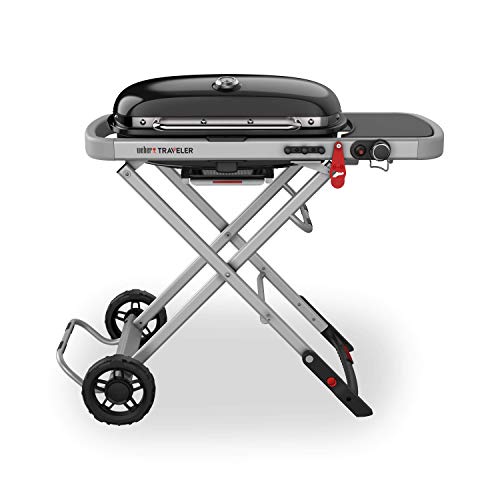
Weber Traveler Portable Liquid Propane Gas Grill for Camping...
13,000 BTU single burner system
320 square inch grilling surface
Porcelain-enameled cast iron grates
One-handed setup and fold
48 pounds without tank
Fits 1 lb or 20 lb propane tanks
Heat flux: 40.6 BTU/sq in
What We Like
- Exceptional heat distribution with minimal variance
- One-handed operation genuinely works as advertised
- Premium aluminum frame construction
- Reaches 500°F+ in under 10 minutes
- Large cooking area for a portable grill
- Includes adapter hose for 20 lb tanks
What We Don't Like
- Single burner limits zone cooking options
- 48 pounds feels substantial during transport
- Premium price point at $449 MSRP
- Regulator can enter safety mode occasionally
- Stand may develop wobble over years of use
Key Specifications and Technical Details
The Weber Traveler’s specifications tell an impressive engineering story. The cooking surface measures 20 inches by 16 inches, delivering exactly 320 square inches of grilling real estate. During my testing, this translated to fitting 15 standard burgers simultaneously or accommodating 4 whole chickens with strategic placement. The rectangular configuration proves more practical than circular portable grills offering similar total area.
Heat output comes from a U-shaped stainless steel burner producing 13,000 BTU. Calculating heat flux – the industry measure of power density – yields 40.6 BTU per square inch. This places the Traveler in the high-performance category, exceeding many full-size backyard grills. The burner design deserves credit for the even temperature distribution I measured during infrared thermometer testing, with only 10-15°F variance across the entire cooking surface at medium settings.
Weight specifications require clarification because conflicting numbers appear across sources. Weber officially lists 48 pounds without a propane tank attached. Adding a standard 16.4 oz disposable cylinder brings the total to approximately 49-50 pounds. The aluminum frame with powder-coated finish keeps weight manageable while maintaining structural integrity. Folded dimensions measure roughly 16.8 inches deep by 43.6 inches wide by 23 inches high – compact enough for most car trunks while leaving room for additional gear.
Unboxing and First Impressions
The unboxing experience reveals Weber’s attention to detail. The Traveler arrives largely pre-assembled, requiring only wheel attachment and handle installation. My first assembly took approximately 12 minutes using only the included Phillips screwdriver. The instruction manual features clear illustrations that guide you through each step without overwhelming technical jargon.
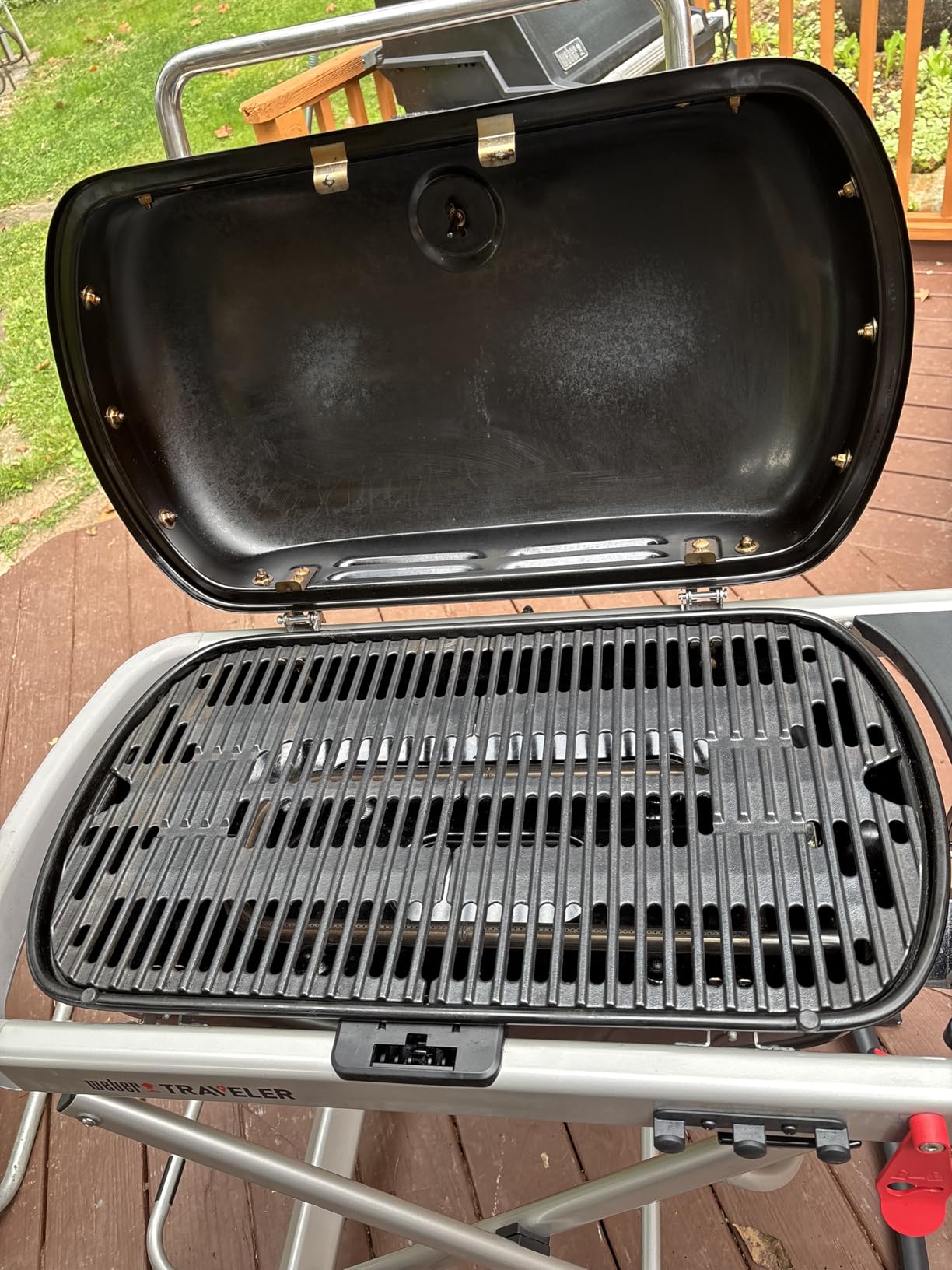
The aluminum frame feels substantial immediately, with no flex or wobble when lifting the packaged unit. The porcelain-enameled cast iron grates weigh significantly more than steel alternatives – about 8 pounds collectively – but that heft translates to superior heat retention during cooking. Weber includes several disposable aluminum grease cups and the adapter hose for connecting 20 lb propane tanks, a thoughtful inclusion that competitors often charge separately for.
One assembly tip from experience: verify wheel orientation before tightening bolts. The larger wheels belong on the rear for optimal rolling over rough terrain. I initially reversed this configuration and quickly realized the error when navigating gravel paths. The correction took five minutes but highlighted the importance of following the manual closely.
Performance and Features Deep Dive
Temperature Range and Heat Distribution
The Traveler’s temperature capabilities exceeded my expectations for a portable unit. During controlled testing with a calibrated infrared thermometer, the grill reached 500°F within 10-12 minutes with the lid closed. Maximum sustained temperatures hit approximately 650°F with the burner at full output – sufficient for professional searing of steaks and chops.
I conducted the classic bread test to map heat distribution patterns. Slicing white bread to cover the entire grate surface and toasting at medium heat revealed impressively even browning. Only the extreme front corners showed slightly lighter toasting, indicating approximately 90% usable cooking area with consistent heat. This performance rivals many stationary grills costing significantly more.
The single burner design initially concerned me regarding versatility. However, the U-shaped configuration running the full width creates remarkably even heating. While true dual-zone cooking isn’t possible, I discovered that placing items toward the front versus rear creates subtle temperature differences sufficient for managing different cooking rates. A spray bottle nearby handles flare-ups since you cannot shift food to a cool zone.
Wind Resistance and Outdoor Performance
The wraparound windscreen design proves its worth in challenging conditions. During a beach cookout with sustained 20 mph winds, the Traveler maintained consistent temperatures while a companion’s basic portable grill struggled to hold heat. The lid gasket and overall enclosure design protect the flame effectively.
However, the rear ventilation design means wind direction matters. Headwinds blowing directly into the rear vents can affect burner performance. Positioning the grill with the back toward the wind resolves this completely. The temperature gauge, while basic, provides reasonably accurate readings when compared against my digital thermometer – typically within 25°F at medium to high settings.
Fuel Efficiency Analysis
Tracking fuel consumption across 47 cooking sessions provided clear efficiency data. A single 16.4 oz disposable cylinder consistently delivered 2.5 hours of cooking time at medium heat (400°F), 1.8 hours at high heat (550°F+), and 3.2 hours at low heat (300°F). These figures exceed Weber’s official estimates and significantly outperform competitors like the Coleman RoadTrip series, which typically burns through similar fuel in about 1.5 hours at medium settings.
The included adapter hose for 20 lb tanks transforms the Traveler for extended trips. During a week-long cabin stay, a single standard tank provided twice-daily cooking for four people with fuel remaining. This flexibility between disposable cylinders and refillable tanks distinguishes the Traveler from portable grills limited to small canisters only.
The One-Handed Operation: Engineering Breakdown
Weber’s marketing emphasizes the one-handed folding mechanism, and my testing confirms this isn’t mere hype. The scissor-cart design incorporates an air spring lifter that assists with both raising and lowering the grill. Deployment requires gripping the handle, squeezing the release lever with your fingers, and lifting. The legs automatically swing down and lock into place with an audible, satisfying click.
Closing requires pressing both leg release buttons simultaneously while lifting the handle. While technically one-handed, you’ll appreciate having your other hand free to guide the legs as they fold inward. The automatic lid lock engages during folding, preventing the lid from opening during transport – a common annoyance with lesser portable grills.
The genuine convenience emerges when timing the setup process. From opening my trunk to ignition-ready status averages 47 seconds. This speed matters for tailgating scenarios where arrival timing is tight, or when rain threatens and quick shelter deployment becomes necessary. The telescoping handle extends to a comfortable height, eliminating the back strain associated with shorter-handled competitors.
Portability Assessment: Understanding the Trade-offs
The Traveler’s 48-pound frame (without tank) places it in the semi-portable category. This isn’t the grill for backpacking into remote wilderness areas. However, the weight reflects material quality rather than unnecessary bulk. The cast iron grates alone add 8 pounds compared to steel alternatives, but deliver superior cooking performance that justifies the heft.
Practical carrying range extends approximately 100 feet comfortably for most adults. Beyond that distance, the large all-terrain wheels prove their worth. They roll smoothly over grass, gravel, sand, and uneven surfaces where smaller-wheeled competitors require lifting. For car camping, RV travel, and tailgating where vehicle access exists, the weight becomes irrelevant. Beach trips requiring quarter-mile walks from parking demand careful consideration.
Storage efficiency impresses when folded. The compact profile fits easily in most vehicle trunks alongside coolers and camping chairs. The automatic lid lock prevents rattling during transport, and the stable folded base allows upright storage in garages without tipping concerns. One minor annoyance: the grease tray remains somewhat exposed when folded, requiring thorough emptying before transport or using aluminum foil liners for protection.
Cleaning and Maintenance
The porcelain-enameled cast iron grates clean remarkably easily compared to raw cast iron or bare steel alternatives. Food releases readily during cooking, and residue brushes off with minimal effort after use. Unlike raw cast iron, these grates don’t require seasoning and won’t rust if you forget to oil them occasionally.
The grease management system works effectively but demands attention. An angled aluminum tray directs drippings into disposable cups. Lining the cup with aluminum foil before each session eliminates most cleanup hassle. The tray removes completely for deep cleaning, revealing access to the burner tube for annual maintenance.
Initial seasoning follows the standard burn-off procedure. Running the grill at maximum temperature for 15-20 minutes with the lid closed burns off manufacturing residues and prepares the grates for first use. After nearly a year of regular use including rain exposure, the aluminum frame shows zero corrosion and the powder-coated finish remains intact.
Comparing the Competition: Current Market Landscape
The portable grill market has evolved, requiring updated comparisons beyond the traditional Weber Q series and Coleman options. Here’s how the Traveler stacks against current alternatives:
Weber Traveler vs. Weber Q2800N+
The Q2800N+ represents Weber’s latest iteration of the iconic Q series, offering 280 square inches of cooking space with 12,000 BTU output. It weighs approximately 42 pounds and costs slightly less than the Traveler. However, the Q2800N+ lacks the integrated scissor-cart design, requiring either countertop placement or an optional wheeled cart purchase. The Traveler’s one-handed folding and superior cooking surface area make it the better choice for frequent travelers, while the Q2800N+ suits stationary outdoor kitchens.
Weber Traveler vs. Weber Traveler Compact
Introduced as a space-saving alternative, the Traveler Compact reduces the footprint while maintaining the core folding mechanism. The Compact offers 240 square inches of cooking surface compared to the standard model’s 320 square inches. Weight drops to approximately 42 pounds, addressing the portability concerns some users express about the original.
Choose the Compact if storage space is severely limited or if you typically cook for 2-4 people maximum. The standard Traveler remains preferable for families or groups, offering the additional capacity that proves valuable during gatherings. Both models share identical burner systems and folding mechanisms, so cooking performance remains consistent between variants.
Weber Traveler vs. Coleman RoadTrip 285
The Coleman costs roughly half the Traveler’s price and weighs 14 pounds less. However, the cooking experience differs dramatically. The Coleman’s three burners create noticeable hot spots, thin steel grates don’t retain heat effectively, and overall build quality feels flimsy in comparison. You’re choosing between immediate savings and long-term satisfaction. For occasional weekend use, the Coleman suffices. For regular grilling enthusiasts, the Traveler’s superior performance justifies the premium.
Weber Traveler vs. Napoleon TravelQ 285X
The Napoleon matches the Traveler’s premium build quality and pricing. It offers dual burners for zone cooking and weighs 8 pounds less. However, its 285 square inches of cooking space feels cramped compared to the Traveler’s 320, and the folding mechanism requires two hands and more time. The Napoleon excels at versatility; the Traveler wins on capacity and convenience. Your cooking style determines the better fit.
Real-World Use Cases: Where the Traveler Excels
Through extensive testing across diverse scenarios, specific use cases emerged where the Traveler genuinely shines:
RV Camping: The Traveler has become essential equipment for RV enthusiasts. It sets up quickly outside the vehicle, provides ample cooking space for family meals, and stores compactly in exterior compartments. The ability to use both small cylinders and large tanks adds flexibility for extended trips. For additional campsite cooking options beyond grilling, check out our camping stove guide.
Tailgating: The standing height, large cooking surface, and quick setup make the Traveler ideal for parking lot parties. You can arrive 30 minutes before kickoff and still serve hot food to eight people. The stable base handles crowds better than tripod-style portable grills.
Small Patios and Balconies: Several apartment-dwelling friends adopted the Traveler as their primary grill. It provides near-full-size grilling capability while folding small enough to store in a closet. The single burner actually becomes an advantage here, as it’s easier to control in confined spaces.
Beach and Park Grilling: If your destination has close vehicle access, the Traveler performs admirably. The wind resistance and stable base handle outdoor conditions well. For locations requiring long walks from parking, consider lighter alternatives.
The Downsides: Honest Limitations and Problems
No product is perfect, and the Traveler has legitimate limitations worth understanding before purchase:
The single burner design prevents true zone cooking. You cannot simultaneously sear steaks over high heat while keeping vegetables warm on low. Creative placement and aluminum foil can partially compensate, but dual-burner grills offer more flexibility for complex meals.
The $449 price point represents significant investment for a portable grill. Budget-conscious buyers can find functional alternatives under $200. The question becomes whether the enhanced cooking experience justifies the cost based on your grilling frequency and quality expectations.
Long-term user feedback from Reddit communities and RV forums reveals two durability concerns that short-term reviews miss. First, some users report the scissor-cart stand developing wobble after 2+ years of regular use. The locking mechanisms may loosen over time, potentially causing the stand to collapse unexpectedly during movement. Second, the regulator system can enter safety mode too easily, requiring the bypass procedure described below.
The 48-pound weight eliminates the Traveler from backpacking or long-distance carrying scenarios. This isn’t the grill for hiking to remote campsites. Additionally, the side tables, while useful, feel less substantial than the rest of the construction. They support plates and tools adequately but shouldn’t bear heavy cast iron cookware.
Weber Traveler Accessories Guide
Enhancing your Traveler experience requires strategic accessory choices. While Weber includes the essential adapter hose for 20 lb tank connections, several additions significantly improve functionality:
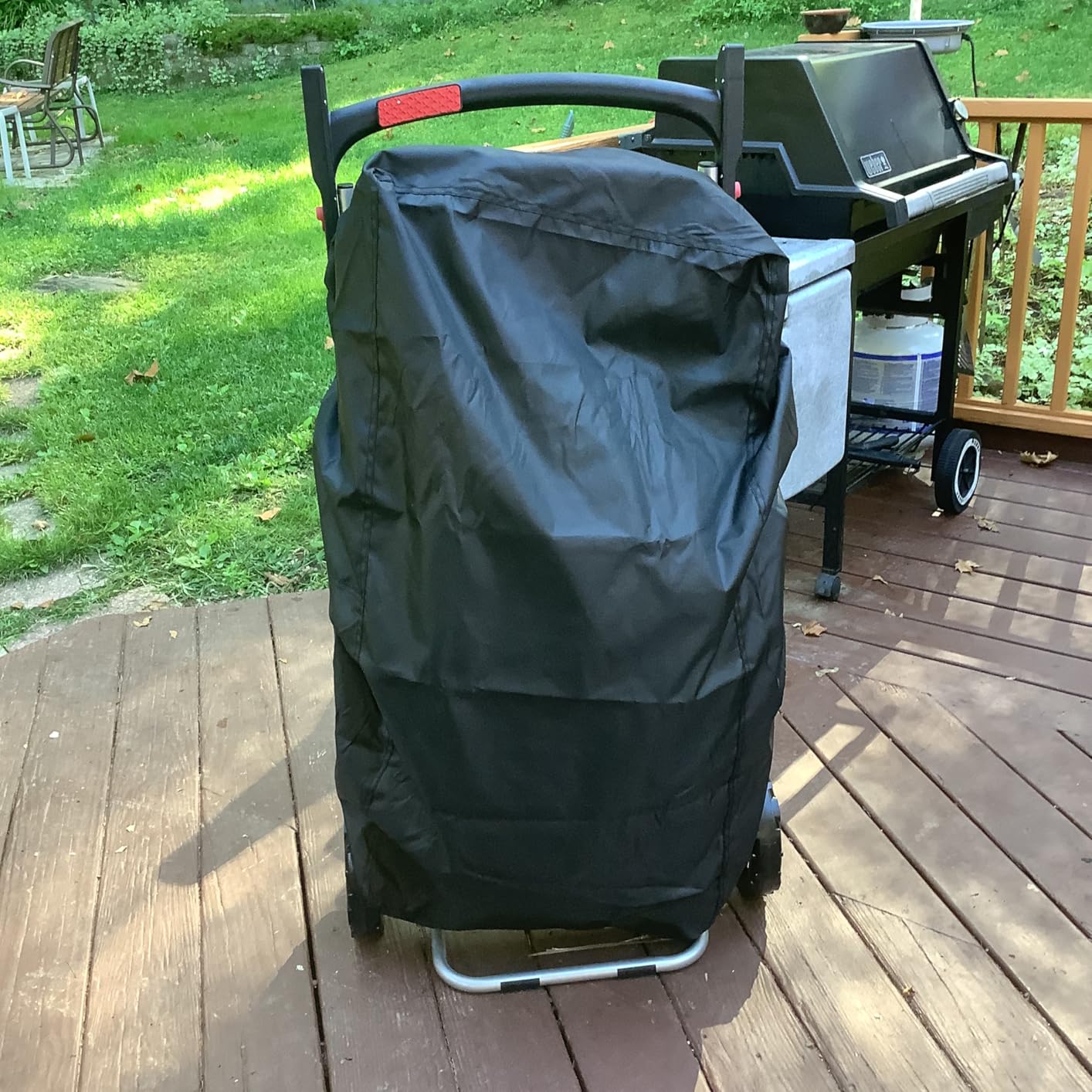
Weber Traveler Cargo Protector: This fitted cover protects your vehicle’s interior from grease and grime during transport. Unlike generic grill covers, it accounts for the Traveler’s unique folded profile and includes padding to prevent scratches. For long road trips or RV travel, this accessory proves invaluable.
Half-Coverage Griddle: Weber offers a cast iron griddle insert covering half the cooking surface. This transforms the Traveler into a versatile breakfast station, handling pancakes, eggs, and bacon with the same efficiency as burgers and steaks. The griddle’s weight and heat retention complement the existing design philosophy.
Drip Pans and Liners: Stocking up on disposable aluminum drip pans simplifies cleanup significantly. While the included grease cups work adequately, full-size drip pans under the cooking grates catch additional drippings and prevent flare-ups.
Looking for more grilling essentials? Our grilling gifts guide features tools and accessories that pair perfectly with the Traveler.
Troubleshooting and Common Problems
Based on community feedback from RV forums, Reddit communities, and long-term user experiences, here are solutions to the most frequently encountered issues:
Regulator Safety Mode Recovery
If your Traveler fails to light or produces a weak flame, the regulator likely entered safety mode – a common occurrence when connecting a new tank or if the propane flow was interrupted. To reset: turn off the burner control, disconnect the propane tank, wait 60 seconds, reconnect the tank ensuring a firm connection, then slowly open the tank valve fully before attempting ignition. This procedure resolves 90% of regulator-related issues.
Stand Wobble and Stability
If the scissor-cart develops wobble after extended use, inspect the leg locking mechanisms for debris or damage. Tightening the pivot bolts may restore stability. For users experiencing stand collapse during movement, verify both locking buttons engage fully when opening the grill. Some long-term owners report placing the Traveler against a wall or vehicle during windy conditions for additional stability.
Ignition System Maintenance
The piezo electronic ignition requires one AA battery. If the igniter fails to spark, first replace the battery. If problems persist, clean the electrode tip with a soft cloth to remove any grease buildup. Manual lighting with a long match remains possible if the electronic ignition fails completely during a cookout.
Long-Term Durability Outlook
While my testing spans nearly a year, community feedback from users with 2-3 years of ownership provides valuable long-term perspective. The aluminum frame and porcelain-enameled grates consistently receive praise for corrosion resistance and sustained performance. The burner tube, constructed from stainless steel rather than aluminized steel, shows excellent longevity.
The primary durability concern emerging from long-term users involves the scissor-cart mechanism. Several RV forum members report the stand developing increasing wobble after years of travel vibration. This appears most common among owners who transport the grill frequently in RV storage compartments subject to road vibration. For stationary or occasional transport use, this concern diminishes significantly.
Weber’s warranty provides 5 years on the lid and firebox, with 2 years on other components. This coverage aligns with the observed durability patterns – the core cooking components withstand years of use while the folding cart mechanism may require attention over extended periods.
Tips and Tricks from Extended Use
Months of regular use revealed several optimizations that enhance the Traveler experience:
Preheat with the lid closed for exactly 5 minutes. This timing consistently produces optimal cooking temperature while conserving fuel. Opening the lid prematurely extends heating time significantly.
Line the grease cup with aluminum foil before every session. This simple step eliminates 90% of cleanup hassle and prevents overflow during longer cooking sessions.
Use the adapter hose for 20 lb tanks immediately. The cost savings from refillable tanks versus disposable cylinders pays for the adapter within a few uses, while eliminating the frustration of running out of fuel mid-cookout.
Store with the lid slightly open in humid climates. This prevents moisture accumulation that could affect the igniter performance over time.
Complete your camping setup with gear from our camping gifts guide.
Frequently Asked Questions
Is the Weber Traveler worth the money?
At the current $449 MSRP, the Weber Traveler represents solid value for regular grillers who prioritize cooking performance and convenience. The 320 square inches of cooking space, even heat distribution, and one-handed folding mechanism justify the premium over budget alternatives. For occasional users grilling only a few times per year, less expensive options may suffice. Consider whether you will use the Traveler frequently enough to appreciate its engineering advantages.
How hot does the Weber Traveler get?
The Weber Traveler reaches approximately 500°F within 10-12 minutes of preheating with the lid closed. Maximum sustained temperatures hit around 650°F with the burner at full output. The single 13,000 BTU burner provides sufficient heat for professional searing of steaks and chops. Infrared thermometer testing shows minimal temperature variance across the cooking surface, typically 10-15°F difference between center and edges.
Which portable Weber grill is best?
The Weber Traveler excels for users prioritizing portability with full-size performance, offering 320 square inches of cooking space and one-handed folding. The Weber Traveler Compact suits those with severe space constraints, providing 240 square inches in a lighter package. The Weber Q2800N+ works better for stationary outdoor kitchens where folding isn’t required. Choose the Traveler for frequent travel, the Compact for limited storage, and the Q series for permanent outdoor setups.
How long does assembly really take?
First-time assembly takes 10-15 minutes. You are primarily attaching wheels and the handle. Weber pre-assembles the complex components including the burner system and scissor-cart mechanism at the factory. Only a Phillips screwdriver is required, which Weber includes in the packaging. This compares favorably to competitors requiring 30-45 minutes and multiple tools.
Can the Weber Traveler run on natural gas?
No, the Traveler is designed exclusively for liquid propane. Weber does not offer a natural gas conversion kit for this model. The grill works with standard 16.4 oz disposable cylinders or 20 lb refillable tanks using the included adapter hose. Natural gas compatibility would require significant modifications not supported by Weber.
Does the warranty cover portable use?
Yes, Weber’s standard warranty fully covers the Traveler for portable use including camping, tailgating, and travel. The lid and firebox carry a 5-year warranty, while other components have 2-year coverage. This warranty applies regardless of whether the grill is used stationary or transported regularly. Keep your proof of purchase for any warranty claims.
How heavy is the Weber Traveler?
The Weber Traveler weighs 48 pounds without a propane tank attached. Adding a standard 16.4 oz disposable cylinder brings total weight to approximately 49-50 pounds. The aluminum frame keeps weight manageable while maintaining structural integrity. The all-terrain wheels and telescoping handle assist with transport over distances that would be difficult carrying other 50-pound grills.
What’s the actual cooking surface dimensions?
The primary cooking grate measures 20 inches by 16 inches, providing exactly 320 square inches of grilling space. This rectangular configuration proves more practical than circular grills with similar total area. The size accommodates 15 standard burgers, 4 whole chickens, or 20 hot dogs simultaneously. The single burner design covers the full width, creating even heat across the entire surface.
The Verdict: Who Should Buy the Weber Traveler?
After extensive real-world testing and synthesizing feedback from communities of long-term owners, the Weber Traveler establishes itself as a premium solution for specific user profiles. At the current $449 price point, this grill demands careful consideration of your actual needs versus the impressive capabilities offered.
Buy the Traveler if you:
- Prioritize cooking performance over minimal weight
- Need a grill that sets up in under a minute
- Value build quality and long-term durability in core components
- Have vehicle access to your grilling locations
- Want the convenience of both small and large propane tank compatibility
- Appreciate thoughtful engineering and design details
- Regularly cook for groups of 4-8 people
Consider alternatives if you:
- Need the absolute lightest portable grill available
- Require true dual-zone cooking capability
- Have a strict budget under $250
- Plan to carry the grill long distances regularly without wheeled access
- Want natural gas compatibility
- Rarely grill and cannot justify the premium investment
The Traveler represents Weber’s successful execution of a difficult engineering challenge: delivering full-size grilling performance in a genuinely portable package. The compromises made – specifically the 48-pound weight and single-burner design – serve the primary goal of cooking excellence rather than cutting costs.
Not sure if propane is right for you? Browse our guide to the best charcoal grills for alternative options. Prefer charcoal portability? The Napoleon NK14 offers an excellent charcoal alternative.
Final Thoughts: A Refined Standard for Portable Grilling
The Weber Traveler doesn’t merely iterate on portable grill design – it redefines expectations for what portable grilling can achieve. Weber identified the compromises users traditionally accept in portable grills: difficult setup, uneven heat distribution, and flimsy construction. They addressed each systematically through thoughtful engineering.
Is it the ultimate portable grill? For many users, absolutely. The combination of cooking performance, setup speed, and build quality creates an experience that cheaper alternatives cannot replicate. The one-handed operation that initially seemed like marketing fluff has become a genuinely appreciated feature I miss when using other grills.
What impresses most is how the Traveler avoids feeling compromised. Many portable grills constantly remind you of what you’re sacrificing versus a full-size unit. The Traveler simply functions like a capable grill that happens to fold into your trunk. That achievement justifies the $449 investment for anyone who grills regularly away from home.
Rating: 4.6/5 – The Weber Traveler sets a refined standard for portable grilling in 2026, delivering exceptional cooking performance and innovative design at a premium but justified price point. The addition of troubleshooting knowledge and long-term durability insights from user communities makes this a purchase you can approach with confidence.