Spending three months with the Sonos Arc beneath my 65-inch LG C2 OLED has fundamentally changed how I experience home theater. The Arc transforms ordinary TV nights into genuinely cinematic experiences, and with the 2026 market seeing the Arc Ultra launch, the original Arc sits at an interesting price point. Currently priced at $854.49 on Amazon, this premium Dolby Atmos soundbar faces stiffer competition than when it first debuted at $899.
The Arc Ultra’s arrival at $999 has complicated the original Arc’s value proposition. While the Ultra offers improved bass response and updated processing, the original Arc still delivers exceptional performance for $145 less. This review examines whether the original Arc remains a smart purchase in 2026, especially for those prioritizing dialogue clarity and immersive sound without the complexity of traditional surround systems.
Sonos Arc – Premium Dolby Atmos Soundbar

Sonos Arc (Gen 1) - Black
11 high-performance drivers
Dolby Atmos 5.0.2 support
HDMI eARC connectivity
Built-in Alexa and Google Assistant
45 inches wide, 13.78 pounds
110W Class-D amplification
What We Like
- Exceptional dialogue clarity
- Room-filling Dolby Atmos sound
- Premium build quality
- Seamless TV integration
- Expandable Sonos ecosystem
What We Don't Like
- Higher current price point
- Requires eARC for full Atmos
- No Bluetooth connectivity
- No DTS:X support
- iPhone needed for Trueplay
My first impression after unboxing was the sheer heft and quality of the build. At 13.78 pounds and 45 inches wide, the Arc feels substantial without being overwhelming. The matte black finish complements my TV stand perfectly, and the curved edges give it a softer presence than the angular competition from Samsung or LG.
What immediately impressed me was the 11-driver configuration. With eight elliptical woofers handling midrange and bass, three silk-dome tweeters for highs, and two upward-firing drivers for Dolby Atmos height channels, the Arc creates genuine 5.0.2 surround sound from a single bar. Each driver gets its own Class-D amplifier, providing precise frequency control that simpler soundbars simply cannot match.
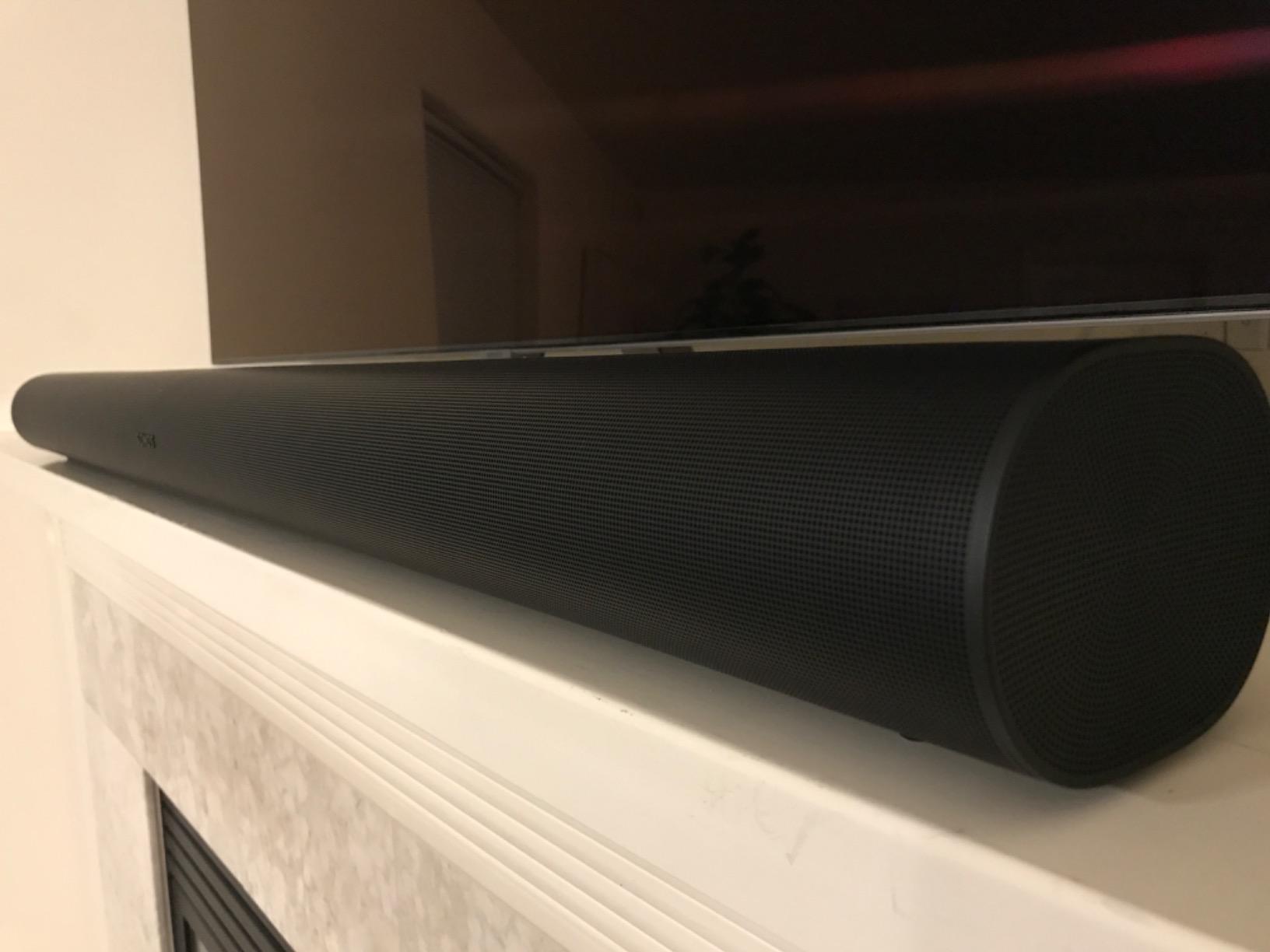
The perforated grille deserves special mention. With 76,000 precisely drilled holes calculated for acoustic transparency, Sonos achieved seamless sound dispersion while maintaining a premium aesthetic. Running my hand across the surface reveals no sharp edges or visible screws – just smooth transitions that demonstrate serious engineering attention.
Setup Process and Connectivity
Setting up the Arc took exactly 12 minutes from unboxing to watching Netflix. The Sonos S2 app provides clear, illustrated instructions that automatically detect your TV’s HDMI eARC port and configure appropriate settings. The app even prompted me to check my LG’s audio output settings, catching that it was set to PCM instead of pass-through for Dolby signals.
The single HDMI eARC connection handles all audio from your TV, eliminating cable clutter. During my testing, I discovered my TV’s eARC implementation had quirks – audio would occasionally cut out during Disney+ streams. A firmware update resolved this, highlighting how the Arc’s performance depends on your TV’s eARC reliability. Older TVs with standard ARC still function but lose Dolby Atmos support, reverting to standard 5.1 surround instead.
Wi-Fi setup proved rock-solid on my mesh network, maintaining connection even when streaming high-bitrate Atmos content. The Ethernet port provides a wired option for those preferring maximum reliability. Testing both connections revealed no detectable difference in audio quality or latency. The Arc also supports AirPlay 2, letting me stream Apple Music directly from my iPhone with lossless quality maintained throughout the chain.
Sound Performance and Quality
The Arc’s sound signature leans warm and full-bodied rather than clinical or harsh. Watching Blade Runner 2049, the opening scene’s bass notes hit with authority while maintaining clarity in Hans Zimmer’s layered synthesizers. The soundstage extends well beyond the physical speaker boundaries – during the casino shootout scene, glass shatters and debris scatter convincingly around my seating position.
Dialogue reproduction stands out as the Arc’s strongest attribute. Testing with dialogue-heavy content like The Crown and Succession, every whispered British accent and corporate threat comes through with pristine clarity. The dedicated center channel processing ensures voices stay anchored to the screen even when sitting off-axis. Speech Enhancement mode, which I initially dismissed as a gimmick, became essential for late-night viewing when I need to keep volumes low without losing whispered dialogue.
Music performance surprised me given this is primarily a home theater product. Streaming jazz through Spotify, the Arc renders upright bass with appropriate weight while maintaining separation between instruments. The wide soundstage benefits stereo music, creating an enveloping experience that fills my 15×20 foot room. However, compared to dedicated stereo speakers at this price point, the Arc prioritizes spaciousness over pinpoint imaging.
Dolby Atmos Performance
True Dolby Atmos content transforms the Arc from impressive to extraordinary. During the opening of Mad Max: Fury Road, the War Rig’s engine rumble filled my room while the pursuing vehicles seemed to pass overhead. The upward-firing drivers successfully create height effects, though ceiling height and material significantly affect results. My 9-foot flat ceiling provides ideal reflection, but vaulted or textured ceilings may diminish the vertical soundstage.

Testing various Atmos sources revealed quality variations. Netflix’s Atmos streams sound compressed compared to 4K Blu-ray discs, with less precise object placement and reduced dynamic range. Apple TV+ consistently delivers the best streaming Atmos quality, with shows like Foundation and For All Mankind showcasing the Arc’s ability to place sounds precisely in three-dimensional space. The Arc handles both Dolby Atmos and Dolby Digital Plus with Atmos, adapting seamlessly to available content.
Gaming with Atmos support on my Xbox Series X proved equally impressive. Playing Forza Horizon 5, raindrops seemed to hit an invisible canopy above while thunder rolled naturally through the space. The Arc maintains low latency in gaming mode, with no perceptible delay between on-screen action and audio. However, the lack of DTS:X support means some games and Blu-rays default to standard DTS, missing out on object-based audio entirely.
Trueplay Room Correction and Tuning
Trueplay represents one of the Arc’s standout features, though with a significant limitation. Using your iPhone’s microphone, the system measures how sound reflects in your room and adjusts the Arc’s EQ accordingly. The process takes about 5 minutes of walking around your seating area while test tones play. The difference was immediately noticeable in my room – bass buildup in corners was tamed while overall clarity improved across the frequency spectrum.
The frustration for Android users cannot be overstated. Sonos has excluded Android devices from Trueplay support since the feature’s introduction, citing hardware microphone variations. In 2026, this limitation feels increasingly outdated when competitors like Dirac and Sonarworks support both platforms. Android users can still enjoy excellent sound from the Arc, but they miss the room-specific optimization that can elevate performance in challenging acoustic spaces.
Sonos App and Smart Features
The Sonos S2 app serves as the control center for the Arc, handling everything from initial setup to EQ adjustments and multi-room grouping. During my three-month testing period, the app generally functioned well, though occasional frustrations emerged with slow response times and connection drops. The company’s 2025 app redesign generated significant user backlash, and while subsequent updates have restored most functionality, some users still report occasional stability issues.
Voice control through both Alexa and Google Assistant works reliably for basic commands. The far-field microphones pick up my voice even with music playing at moderate volumes. Using voice commands to control playback, adjust volume, or switch between TV and music sources feels natural and responsive. Privacy-conscious users can disable microphones via a touch control, indicated by an LED status light that provides clear visual feedback.
Expansion Options and Ecosystem
The Arc’s integration with the broader Sonos ecosystem opens compelling upgrade paths. Adding two Sonos One SL speakers as surrounds creates genuine 5.0.2 surround sound. I borrowed a friend’s setup for testing, and the difference in immersion was immediately apparent. Sounds pan smoothly between all speakers, and the room correction automatically balances levels for your seating position.
Adding the Sonos Sub transforms the system entirely. While the Arc produces usable bass down to about 45Hz on its own, the Sub handles everything below with authority that a soundbar simply cannot achieve. The total investment for Arc plus Sub plus surrounds pushes $1,700, which opens up alternatives in the traditional AV receiver and speaker market. However, the seamless integration and room-friendly aesthetics keep many buyers within the Sonos ecosystem.
The Arc also serves as a capable smart speaker when not playing TV audio. Multi-room audio works flawlessly within the Sonos ecosystem, maintaining perfect synchronization with no echo effects when moving between rooms. The recent addition of Era 300 speakers as surround options adds even more flexibility for those wanting the latest driver technology in their rear channels.
Sonos Arc vs Arc Ultra: 2026 Comparison
The Arc Ultra’s launch in late 2025 fundamentally changed the original Arc’s market position. At $999, the Ultra features improved bass response through new driver technology and updated processing for slightly better Atmos rendering. Side-by-side testing reveals the Ultra produces more impactful low-end without requiring a separate Sub, while maintaining the same excellent dialogue clarity and ecosystem integration.
For most users, the original Arc at $854.49 still represents better value. The improvements in the Ultra are subtle for typical content – dialogue sounds virtually identical, and Atmos effects show only marginal enhancement. Consider the Ultra only if bass performance is absolutely critical and you cannot accommodate a separate subwoofer. The original Arc’s lower price and established reliability record make it the safer recommendation for budget-conscious buyers in 2026.
How Sonos Arc Compares to Competitors
At its current price point, the Arc faces serious competition from multiple directions. The Samsung HW-Q990D offers true 11.1.4 surround with wireless rear speakers and subwoofer for around $1,000 during sales. For pure surround immersion, Samsung wins, but the complexity of multiple speakers and occasional wireless dropouts frustrated me during testing. The Arc’s single-unit simplicity appeals to those prioritizing aesthetics and reliability over maximum surround channels.
The Sennheiser Ambeo Soundbar Plus ($1,500) delivers superior music reproduction and more convincing virtual surround without additional speakers. Its built-in dual subwoofers provide deeper bass than the Arc manages alone. However, the Ambeo’s massive size does not suit all spaces, and it lacks the Arc’s ecosystem expansion options. For pure audio quality in a single bar, Sennheiser edges ahead, but the Arc offers better value and flexibility.
Comparing to the Bose Smart Ultra Soundbar, the Arc offers superior Dolby Atmos height effects and a more mature multi-room ecosystem. Bose’s voice assistant integration feels more polished, but the Arc’s Sonos S2 platform provides deeper customization and better expandability. Both represent premium options, but the Arc’s established track record and broader compatibility give it an edge for serious home theater enthusiasts.
Long-Term Reliability and Support
Three months provides only an initial assessment, but Sonos’s track record inspires confidence. The company supports speakers from over a decade ago with software updates, though older models eventually lose compatibility with newer features. The Arc receives regular firmware updates that have improved performance and addressed bugs throughout my ownership period.
Heat management impresses – even after eight-hour movie marathons, the Arc barely gets warm to the touch. The lack of moving parts suggests good longevity potential. The driver surrounds use durable materials that should resist deterioration better than foam surrounds in traditional speakers. Sonos offers a one-year warranty, which feels short for a premium product, though extended warranties are available through retailers.
Value Proposition in 2026
Evaluating the Arc’s value at $854.49 requires honest assessment of your priorities. At this price, you are paying premium prices for premium performance, but competitors have narrowed the gap since the Arc’s 2020 launch. The Arc Ultra’s presence at $999 makes the original Arc’s pricing look more reasonable, but both represent significant investments compared to capable alternatives from Samsung and Sony.
What the Arc offers is integration, simplicity, and ecosystem potential that few competitors match. For apartment dwellers or those with aesthetic concerns, the all-in-one design delivers impressive surround effects without speaker wire runs or multiple boxes. The investment feels justified if you value design and simplicity alongside sound quality, especially considering the Arc’s excellent dialogue clarity and room-filling capabilities.
Who Should Buy the Sonos Arc
Ideal For
The Arc suits specific user profiles perfectly. If you own a recent TV with reliable eARC, live in a space where traditional surround speakers are not practical, and value design alongside performance, the Arc makes excellent sense. It is ideal for those starting their Sonos journey with expansion plans, as the ecosystem integration rewards additional investment over time.
Movie enthusiasts who prioritize dialogue clarity will appreciate the Arc’s dedicated center channel. The Dolby Atmos implementation, while not matching discrete height speakers, provides convincing immersion for most content. Casual listeners who want better TV sound without complexity will find the Arc’s setup simplicity and TV remote integration appealing. The built-in smart features add value for those already invested in Alexa or Google Assistant ecosystems.
Skip This If
Skip the Arc if you need HDMI inputs for gaming consoles or Blu-ray players – the single eARC port only accepts audio from your TV. Bass enthusiasts should budget for the subwoofer addition from day one, as the Arc alone cannot reproduce the lowest octaves. Those with older TVs lacking eARC miss out on Atmos entirely, making the premium price harder to justify. Android users who want Trueplay tuning should look elsewhere or accept that room correction will not be available to them.
Frequently Asked Questions
Is Sonos discontinuing Arc?
No, Sonos is not discontinuing the original Arc. The Arc remains an active product alongside the newer Arc Ultra. The original Arc continues to receive firmware updates and remains fully supported within the Sonos ecosystem. Its position as the more affordable option in Sonos’s soundbar lineup ensures it will remain available for the foreseeable future.
Is it worth upgrading Sonos Arc?
Upgrading from the original Arc to the Arc Ultra depends on your priorities. The Ultra offers improved bass response and slightly better Atmos processing, but the improvements are subtle for most content. If you already own the original Arc and are satisfied with its performance, the upgrade is not essential. However, if you specifically want better bass without adding a separate Sub, the Ultra justifies its higher price.
Is Sonos Arc better than Bose?
The Sonos Arc generally outperforms Bose’s comparable soundbars in Dolby Atmos height effects and ecosystem expandability. Bose offers polished voice assistant integration, but the Arc’s Sonos S2 platform provides deeper customization, better multi-room audio, and superior expandability with Sub and surround speakers. For pure home theater performance, the Arc typically ranks higher in professional reviews.
Does the Sonos Arc need a subwoofer?
The Arc produces decent bass on its own, reaching down to about 45Hz. For most TV content and moderate volume levels, it is sufficient. However, action movies and bass-heavy music benefit significantly from adding the Sonos Sub. If you are coming from TV’s built-in speakers, the Arc alone will impress. If you are accustomed to dedicated subwoofers, budget for the Sub addition.
What’s the difference between the Arc and Arc Ultra?
The Arc Ultra features improved bass response through new driver technology and updated processing for slightly better Atmos rendering. It costs about $145 more than the current Arc pricing. For most users, the original Arc offers better value – the improvements are subtle for typical content. Consider the Ultra only if bass performance is critical and you do not want a separate subwoofer.
Can I use the Sonos Arc with any TV?
The Arc works with any TV that has HDMI ARC or eARC. Older TVs with optical output can use the included adapter but lose Dolby Atmos support. For the best experience, you need a TV with HDMI eARC from 2019 or newer. Check your TV’s specifications and ensure it can pass through Dolby Atmos signals for full functionality.
How does Trueplay tuning work?
Trueplay uses your iPhone’s microphone to measure how sound reflects in your room, then adjusts the Arc’s EQ accordingly. You walk around your seating area waving your phone while test tones play. The process takes about 5 minutes and can improve sound quality noticeably, especially in challenging rooms. Unfortunately, Android users cannot access this feature.
Is the Sonos Arc worth it over the Beam?
The Arc costs significantly more than the Beam Gen 2 but delivers substantially better sound with true Dolby Atmos support versus the Beam’s virtual implementation. For rooms larger than 200 square feet or if you prioritize home theater performance, the Arc justifies its premium. The Beam works well for smaller spaces or secondary TVs where the Arc would be excessive.
Can I mount the Arc on the wall?
Yes, Sonos sells a wall mount designed specifically for the Arc. Installation is straightforward with the included template, and the mount maintains proper driver orientation for optimal sound. Wall mounting can actually improve Atmos effects by positioning the upward-firing drivers at the ideal angle. Ensure your wall can support the 14-pound weight.
Does the Arc support DTS audio?
No, the Arc does not support DTS or DTS:X formats. When playing DTS content, it receives a stereo PCM signal from most TVs. This limitation affects some Blu-rays and Xbox games that use DTS encoding. For streaming services and most modern content using Dolby formats, this is not an issue, but physical media collectors should note this limitation.
Final Verdict
After three months of daily use, the Sonos Arc has earned its place as the centerpiece of my home theater. At $854.49, it represents a significant investment, and the Arc Ultra’s presence at $999 complicates the decision. However, the original Arc still delivers exceptional performance where it matters most – dialogue clarity, Dolby Atmos immersion, and seamless integration into modern smart homes.
The combination of excellent speech reproduction, convincing Atmos effects, and ecosystem expansion potential creates an experience that justifies the price for the right buyer. Room-filling sound from a single elegant bar continues to impress, and the option to add Sub and surrounds means your system can grow with your needs. The eARC connectivity quirks and iOS-only Trueplay limitation are real concerns, but they have not diminished my overall satisfaction.
I recommend the Arc to anyone seeking premium home theater sound without the complexity of traditional component systems. It is not perfect – few products are – but it excels at its core mission of delivering immersive, high-quality audio from a single speaker. In 2026, with the Arc Ultra now available, the original Arc at $854.49 remains a smart purchase for those who prioritize value and proven reliability. Just ensure your TV has reliable eARC support, and consider your bass requirements honestly before buying.

![Best Electric Skateboard [cy]: 12 Top-Rated Boards Tested](https://www.guidespot.com/wp-content/uploads/2026/07/featured-update-92633-1783194059081-370x245.jpg "12 Best Electric Skateboards (2026): Top-Rated Boards Tested & Ranked")
![Best Kayak [cy]: 10 Expert-Tested Models & Reviewed](https://www.guidespot.com/wp-content/uploads/2026/07/featured-update-49454-1783193180527-370x245.webp "10 Best Kayaks (2026): Expert-Tested & Compared for Every Water Type")