

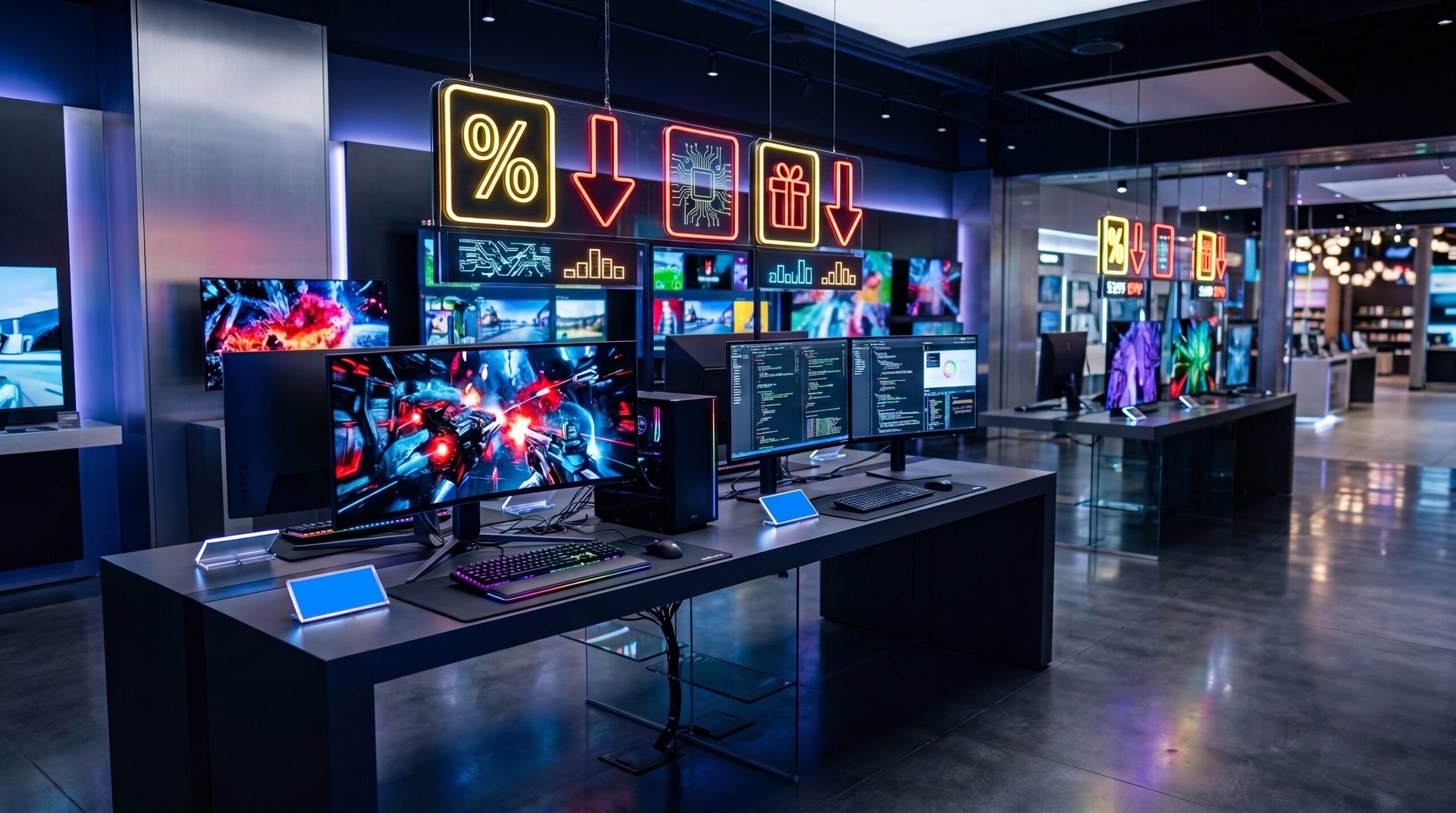
OLED monitor price drops have reshaped the display market in 2026, pushing entry-level OLED gaming monitors below $400 for the first time. After years of prices hovering between $1,000 and $1,500, major manufacturers like LG, Samsung, Alienware, and MSI have slashed costs dramatically, making premium OLED technology accessible to mainstream buyers. Whether you are a competitive gamer, a content creator, or simply someone who wants stunning picture quality, understanding how OLED pricing has shifted can save you hundreds of dollars on your next display upgrade.
I have been tracking OLED monitor pricing closely since the first gaming models launched, and the price changes we are seeing in 2026 are unlike anything the market has experienced before. Let me walk you through where prices stand, why they are falling, and the best times to grab a deal.
OLED Monitor Price Drops in 2026: Where Things Stand Now?
The current OLED monitor market spans a wide range, from $399 entry-level options to $1,399 premium displays. What makes 2026 different is that the floor has dropped significantly. You can now get a legitimate 27-inch OLED gaming monitor with a 1440p resolution and a 280Hz refresh rate for under $400, something that would have sounded impossible just two years ago.
Here are the key price points shaping the market right now:
The LG UltraGear OLED 27GX700A-B recently saw a $450 price cut, bringing it down to $399. Samsung’s Odyssey OLED G5 sits at $499. The LG 27-inch UltraGear OLED comes in around $599, while MSI’s MAG QD-OLED is priced at $619. The Alienware AW2725DF lands at $649, and stepping up to the Alienware 32-inch 4K OLED pushes the budget to $799. On the premium end, Samsung’s Odyssey G6 runs $899 and LG’s 32-inch Dual Mode OLED reaches $1,399.
Compare these prices to launch pricing just a couple of years ago, when similar OLED gaming monitors debuted at $1,200 to $1,500. The price reductions range from 40% to over 60%, representing genuine savings rather than small promotional discounts.
OLED Monitor Price History: How We Got Here?
Understanding how OLED monitor prices evolved helps you see whether current deals are actually good or just marketing noise. The trajectory has been dramatic.
In 2022, the first wave of OLED gaming monitors launched with price tags between $1,200 and $1,500. Brands like Alienware led the charge with QD-OLED panels that offered incredible contrast and color but at prices only enthusiasts could justify. Throughout 2023, prices began to ease as Samsung Display and LG Display ramped up panel production, giving monitor manufacturers more supply and better pricing. Competition from new entrants like MSI, AOC, and Acer forced earlier adopters like Alienware and LG to adjust their pricing.
By 2024, Samsung publicly announced its intention to enter the mid-to-low price range for OLED monitors, signaling that affordable OLED was a strategic priority, not just a happy accident. That same year, the $500 barrier was breached for the first time on select models during major sale events.
In 2025, entry-level OLED monitors dropped below $500 consistently, and by 2026, the sub-$400 threshold was crossed. LG’s aggressive $450 discount on its 27-inch UltraGear model became a watershed moment, proving that OLED monitors could compete directly with high-end IPS and VA panels on price.
Why Are OLED Monitors Getting Cheaper?
Several factors are working together to drive OLED monitor prices down, and understanding them helps you predict whether this trend will continue.
First, manufacturing yields have improved substantially. Early OLED panel production suffered from high defect rates, meaning manufacturers had to charge premium prices to cover wasted materials. As Samsung Display and LG Display refined their fabrication processes, more panels passed quality control per batch, lowering the cost per usable panel significantly.
Second, competition has intensified. Samsung Display’s QD-OLED panels compete directly with LG Display’s WOLED panels, and monitor brands like MSI, Acer, AOC, and Asus are all fighting for market share. When multiple companies compete for the same buyer, prices drop. This is exactly what forum users on Reddit’s r/Monitors and r/OLED_Gaming have been observing and celebrating.
Third, production scale has increased. Samsung holds roughly 71% of the OLED panel market share, and its commitment to volume production means economies of scale are kicking in. Larger production runs spread fixed costs across more units, reducing the per-unit price. Samsung’s explicit strategy to target the mid-to-low price range accelerated this effect.
Fourth, technology has matured. Fourth-generation OLED panels and QD-OLED variants are more efficient to produce than earlier versions. Features like Primary RGB Tandem OLED technology deliver better brightness and longevity without dramatically increasing manufacturing costs.
Best Current OLED Monitor Deals by Price Tier
Finding the right OLED monitor at the right price means understanding what each price tier offers. Here is a breakdown based on current market pricing.
Budget OLED Monitors Under $500
The under-$500 category is where the most exciting OLED monitor price drops are happening in 2026. The LG UltraGear OLED 27GX700A-B leads this tier at $399, offering a 27-inch 1440p display with a 280Hz refresh rate and a 0.03ms response time. This monitor uses LG’s 4th-generation Primary RGB Tandem OLED panel and covers 98% of the DCI-P3 color gamut.
The Samsung Odyssey OLED G5 at $499 is another strong contender in this tier, featuring a QD-OLED panel with vivid colors and excellent HDR performance. Both monitors deliver the core OLED benefits of infinite contrast ratio and near-instantaneous pixel response times at prices that compete with high-end IPS displays.
Mid-Range OLED Monitors ($500 to $800)
The mid-range offers more features and larger panels. The LG 27-inch UltraGear OLED at $599 adds premium build quality and advanced connectivity options. MSI’s MAG QD-OLED at $619 brings QD-OLED color vibrancy with a robust feature set including a built-in USB hub. The Alienware AW2725DF at $649 is a favorite among competitive gamers, pairing a 360Hz refresh rate with Dell’s excellent warranty coverage and burn-in protection. Stepping up, the Alienware 32-inch 4K OLED at $799 delivers stunning 4K resolution on a larger panel for immersive gaming and content creation.
Premium OLED Monitors ($800 and Above)
The premium tier is for users who want the absolute best. Samsung’s Odyssey G6 at $899 offers a compelling ultrawide OLED experience. At the top, LG’s 32-inch Dual Mode OLED at $1,399 provides the unique ability to switch between high-resolution and high-refresh-rate modes, making it ideal for users who split time between content creation and competitive gaming.
OLED vs LCD: Is the Price Gap Worth It?
One of the most common questions I see on forums is whether OLED is worth the extra cost compared to a good LCD. With prices dropping, that gap is narrowing fast.
OLED’s biggest advantage is its infinite contrast ratio. Each pixel generates its own light and can turn off completely, producing perfect blacks that no IPS or VA panel can match. This translates to noticeably better HDR performance, deeper immersion in dark scenes, and more vibrant overall picture quality. The 0.03ms response time eliminates ghosting entirely, giving competitive gamers a measurable advantage in fast-paced titles.
The main concern people raise is burn-in, where static elements like taskbars or HUD overlays can leave permanent marks on the display. Modern OLED monitors include extensive prevention features: pixel cleaning cycles, screen shift technology, and automatic logo dimming. Many brands now offer warranty coverage specifically for burn-in, which significantly reduces the risk.
At current prices, an OLED monitor under $500 competes directly with high-end IPS monitors that cost similar amounts. The value proposition has shifted firmly in OLED’s favor for most buyers.
When to Buy an OLED Monitor? Timing Guide
Getting the best deal on an OLED monitor is partly about knowing when to buy. Seasonal patterns and product cycles create predictable windows where prices drop the most.
Black Friday and Cyber Monday remain the biggest sale events for monitors. In 2026, expect major discounts across all OLED brands, with entry-level models potentially dipping below $350. Amazon’s Big Spring Sale has also become a reliable source of monitor deals, with 15-25% discounts on popular OLED models.
New product launches create another buying opportunity. When manufacturers announce next-generation models, current-generation prices typically drop by 10-20% within weeks. Watch for announcements from LG and Samsung in the first and third quarters, which is when they typically refresh their monitor lineups.
If you are debating whether to buy now or wait, consider this: prices are already at historic lows, and while further drops are likely, the savings from waiting another six months might only be $50-100. For most people, enjoying an OLED monitor now is worth more than saving a modest amount later.
Frequently Asked Questions:
Are OLED monitors going down in price?
Yes, OLED monitor prices have dropped significantly. Entry-level OLED gaming monitors now start under $400, compared to $1,200 to $1,500 when they first launched. Improvements in manufacturing, increased competition between Samsung and LG, and higher production volumes have all contributed to consistent year-over-year price reductions.
Will OLED screens get cheaper?
OLED screens will continue to get cheaper as manufacturing technology improves and production scales increase. Samsung has publicly committed to offering OLED in the mid-to-low price range, and competition from multiple brands is driving prices down further. Expect entry-level OLED monitors to approach the $300 range within the next 12 to 18 months.
Will OLED monitors get cheaper in 2026?
Yes, OLED monitors have already gotten cheaper in 2026, with prices dropping below $400 for the first time. The LG UltraGear OLED 27GX700A-B saw a $450 price cut, bringing it to $399. Continued manufacturing improvements and competitive pressure from Samsung, MSI, Acer, and AOC are expected to drive further reductions throughout the year.
Is OLED becoming obsolete?
No, OLED is not becoming obsolete. In fact, it is becoming the dominant premium display technology. OLED offers infinite contrast ratios, perfect blacks, near-instant response times, and excellent color accuracy that LCD and mini-LED panels cannot fully replicate. Major manufacturers are investing heavily in OLED production, and prices are dropping to make the technology mainstream rather than replacing it.
Conclusion
OLED monitor price drops have fundamentally changed what you can expect from a gaming or productivity display in 2026. With entry-level OLED monitors now available under $400, the technology that once cost over $1,200 is within reach of most budgets. Manufacturing improvements, fierce competition between Samsung and LG, and expanding product lineups from MSI, Acer, and Alienware are all driving prices lower.
If you have been waiting for the right moment to upgrade, the current market offers genuine value. Prices may continue to drop, but the savings from waiting are likely to be modest compared to the benefit of enjoying OLED quality right now. Track seasonal sales like Black Friday and spring events for the steepest discounts, and pay attention to new product launches that push current models to lower price points.

![Best Printers For College Students [cy]: 8 Models Tested & Reviewed](https://www.guidespot.com/wp-content/uploads/2026/07/featured-update-74261-1784120967820-370x245.webp "8 Best Printers for College Students (2026): Budget-Friendly Picks")

![Best Gaming Mice [cy]: Expert Reviews of 12 Top Models](https://www.guidespot.com/wp-content/uploads/2026/07/featured-update-43907-1783632861121-370x245.jpg "12 Best Gaming Mice (2026): Expert-Tested for Speed, Precision & Comfort")
![Best Flight Sticks of [cy]: 8 Controllers Tested for Realism](https://www.guidespot.com/wp-content/uploads/2026/07/featured-update-85916-1783632666924-370x245.jpg "Best Flight Sticks 2026: 10 Controllers Tested for Realism")