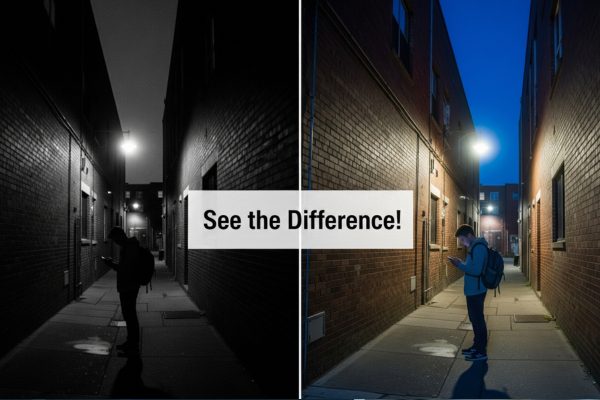
Night vision technology has transformed modern security systems, with the global night vision camera market reaching $6.51 billion in 2026 and projected to hit $11.35 billion by 2030, according to Mordor Intelligence market research. I’ve spent considerable time researching and analyzing the four main night vision technologies that dominate today’s security camera landscape, and the technical differences between them are more significant than most people realize.
The evolution of night vision in security cameras has accelerated dramatically over the past decade. Where we once had only basic infrared cameras producing grainy black and white footage, we now have sophisticated systems combining thermal imaging, starlight sensors, and full-color night vision capabilities. NASA’s Marshall Space Flight Center has even developed ruggedized infrared camera systems based on FLIR technology that can operate in extreme conditions, demonstrating how far this technology has advanced.
Understanding these different night vision types isn’t just about technical specifications – it directly impacts your security system’s effectiveness. Each technology excels in specific conditions and applications, from residential driveways to military-grade perimeter security. The Department of Homeland Security’s CCTV Technology Handbook emphasizes that selecting the appropriate night vision technology is critical for achieving desired surveillance objectives while managing costs effectively.
In this comprehensive guide, I’ll break down each night vision technology type, explain the underlying science, compare their real-world performance, and help you understand which solution fits your specific security needs. Whether you’re securing a home, business, or industrial facility, understanding these technologies will help you make an informed decision that balances performance, cost, and practical requirements.
Understanding Night Vision Technology Fundamentals
Night vision technology operates on fundamental principles of physics that allow cameras to capture usable images in low-light or no-light conditions. At its core, night vision involves either amplifying existing light or detecting radiation invisible to the human eye. The human eye can only perceive wavelengths between approximately 380 to 700 nanometers, but night vision cameras extend this range significantly into the infrared spectrum.
According to IEEE Standard 1858 for camera image quality, the performance of any night vision system depends on three key factors: sensor sensitivity, signal processing capability, and the type of illumination or detection method used. Modern security cameras employ sophisticated CMOS or CCD sensors with enhanced sensitivity that can detect photons at extremely low levels, sometimes as low as 0.0001 lux for starlight cameras.
The electromagnetic spectrum plays a crucial role in how different night vision technologies function. Near-infrared (NIR) operates at wavelengths from 700 to 1,000 nanometers, just beyond visible red light. Short-wave infrared (SWIR) extends from 1,000 to 3,000 nanometers, while thermal imaging typically detects long-wave infrared (LWIR) radiation between 8,000 and 14,000 nanometers. Each range offers distinct advantages for security applications.
Signal-to-noise ratio (SNR) determines image quality in low-light conditions. Higher-end night vision cameras incorporate advanced noise reduction algorithms and larger sensor pixels to improve SNR. The IEC 62676 international standard for video surveillance systems specifies minimum SNR requirements for different security applications, typically ranging from 40dB for basic monitoring to 50dB or higher for identification-grade imagery.
Infrared (IR) Night Vision Technology
Infrared night vision remains the most widespread technology in security cameras, accounting for approximately 60% of the market according to Grand View Research. This technology uses infrared LEDs to illuminate the scene with light invisible to the human eye, which the camera sensor then captures and converts to a visible image.
IR cameras operate primarily at two wavelengths: 850nm and 940nm. The 850nm wavelength provides superior illumination range and image quality but produces a faint red glow visible to the human eye. Professional installations often prefer 940nm LEDs, which are completely invisible but offer reduced range and slightly lower image quality. The Federal Aviation Administration’s technical specifications for night vision compatible systems specifically require 940nm or higher wavelengths to prevent interference with night vision goggles used by pilots.
Modern IR cameras incorporate smart IR technology that adjusts LED intensity based on object distance, preventing overexposure of nearby subjects while maintaining visibility of distant objects. This dynamic adjustment typically operates across a range of 0-30 meters for consumer cameras and up to 100 meters or more for professional systems. The number and power of IR LEDs directly correlate with effective night vision range – consumer cameras typically use 2-6 LEDs rated at 1-3 watts each, while professional systems may employ arrays of 20 or more high-power LEDs.
The main advantages of IR technology include reliable performance in complete darkness, relatively low cost, and minimal processing power requirements. IR cameras produce clear, high-contrast black and white images that make it easy to detect movement and identify shapes. They work effectively through glass (when IR LEDs are positioned outside), perform well in fog and light rain, and have proven reliability with decades of field deployment.
However, IR technology has notable limitations. The monochrome output lacks color information that could aid in identification. IR illumination creates a “spotlight effect” with bright centers and dark edges, limiting the effective field of view. Wildlife and insects attracted to IR wavelengths can trigger false alarms. Additionally, IR reflects off surfaces like glass and water, potentially creating blind spots or image artifacts.
Starlight Night Vision Technology
Starlight technology, also known as low-light or ultra-low-light technology, represents a significant advancement in passive night vision capabilities. These cameras use highly sensitive sensors that can produce color images in lighting conditions as low as 0.0001 lux – essentially starlight conditions without moon illumination.
The key to starlight performance lies in advanced sensor design. These cameras typically employ back-illuminated CMOS sensors with larger pixel sizes (often 2.0μm or larger) that capture more photons. Combined with sophisticated image signal processors (ISPs) that perform real-time noise reduction and signal amplification, starlight cameras can extract usable images from minimal ambient light. Some models incorporate F1.0 or faster lenses to maximize light gathering capability.
Starlight cameras excel in urban and suburban environments where ambient light from street lights, buildings, and vehicles provides minimal illumination. They maintain color information crucial for identifying vehicles, clothing, and other details that IR cameras miss. The technology performs exceptionally well at dawn and dusk when traditional cameras struggle with challenging lighting transitions.
Market analysis shows starlight technology gaining significant traction, particularly in the Asia-Pacific region where urban surveillance demands high-quality color imagery. The technology’s ability to operate without active illumination makes it ideal for covert surveillance applications where IR illuminators would reveal camera positions.
The primary limitations of starlight technology include complete failure in absolute darkness without any ambient light source. These cameras also typically cost 30-50% more than comparable IR models. Processing demands are higher, potentially affecting frame rates or requiring more powerful hardware. In rural or isolated locations without ambient light, starlight cameras may need supplemental IR illumination, negating some of their advantages.
Color Night Vision Technology
Color night vision represents the latest evolution in low-light imaging, combining ultra-sensitive sensors with integrated white-light LED illumination to produce full-color images 24/7. This technology has gained significant market share since 2020, particularly in residential and retail security applications where color information aids in suspect and vehicle identification.
These systems typically integrate warm-white LEDs (3000K-4000K color temperature) with advanced sensors capable of 0.001 lux sensitivity. When ambient light drops below the threshold for natural color imaging, the white-light LEDs activate automatically, providing supplemental illumination while maintaining color fidelity. Smart exposure algorithms balance LED intensity with ambient conditions to optimize image quality while minimizing light pollution.
The psychological deterrent effect of visible white light adds an extra security layer beyond simple surveillance. Studies indicate that well-lit areas experience 39% fewer security incidents than those monitored only by IR cameras. Color night vision cameras essentially create a “security lighting” effect while capturing evidential-quality color footage.
Color accuracy in these systems typically achieves 85-90% fidelity compared to daylight conditions, sufficient for identifying vehicle colors, clothing, and facial features. Advanced models incorporate dual-sensor designs that simultaneously capture visible and IR spectrums, using computational photography to merge the images for optimal detail in mixed lighting conditions.
Challenges with color night vision include the visible nature of white-light illumination, which may not be suitable for all applications. Light pollution concerns in residential areas can limit deployment options. The effective range typically maxes out at 20-30 meters due to white light dispersion. Additionally, these systems consume more power than IR alternatives, potentially affecting installation costs for remote locations.
Thermal Imaging Technology
Thermal imaging operates on fundamentally different principles than other night vision technologies, detecting heat radiation rather than reflected light. According to Grand View Research, thermal imaging commands 41.7% of the night vision market share, driven by superior detection capabilities and decreasing sensor costs.
Thermal cameras detect long-wave infrared radiation (8-14μm wavelength) emitted by all objects above absolute zero. This radiation signature, dependent on temperature and emissivity, creates detailed thermal maps showing temperature variations as small as 0.05°C in advanced systems. NASA’s ruggedized thermal camera systems, developed for space applications, demonstrate the technology’s ability to operate in extreme conditions where other night vision types fail.
The technology excels at detecting living beings and vehicles through their heat signatures, regardless of camouflage, foliage, or visual obstructions. Thermal imaging penetrates smoke, fog, and light precipitation that would blind conventional cameras. Detection ranges extend to several kilometers for vehicle-sized objects with appropriate lens configurations. The passive nature of thermal detection makes it impossible to detect or jam, critical for security applications.
Modern thermal sensors range from entry-level 160×120 pixel arrays to high-definition 1024×768 or larger formats. Microbolometer technology, which measures resistance changes in detector elements as they absorb thermal radiation, has driven costs down while improving reliability. Uncooled thermal sensors now dominate the security market, operating at ambient temperatures without expensive cooling systems.
Key limitations include the inability to provide facial recognition or read text due to resolution constraints and lack of visual detail. Professional-grade thermal cameras still cost 5-10 times more than equivalent IR systems. The technology cannot see through glass, requiring special germanium windows for outdoor installation. Additionally, thermal imaging performs poorly in uniform temperature conditions where everything reaches similar temperatures.
Comparing Night Vision Technologies
When evaluating night vision technologies for security applications, understanding their comparative strengths and limitations helps in making informed decisions. Each technology serves specific use cases and environmental conditions optimally.
In terms of image quality and detail, color night vision provides the highest quality images with full color information, ideal for evidence and identification. Starlight technology offers excellent detail with color in low-light conditions but requires some ambient light. IR cameras deliver good contrast and motion detection in complete darkness but lack color information. Thermal imaging excels at detection but provides minimal visual detail for identification purposes.
Regarding effective range, thermal imaging leads with detection capabilities extending to several kilometers for large objects. Professional IR cameras achieve ranges of 100-200 meters with appropriate LED arrays. Starlight cameras typically operate effectively within 50-100 meters depending on ambient light. Color night vision systems are limited to 20-30 meters due to white light dispersion.
Environmental performance varies significantly between technologies. Thermal imaging performs best in adverse weather, penetrating fog, smoke, and precipitation. IR cameras work well in most conditions but can struggle with heavy rain or fog. Starlight and color night vision technologies are most affected by weather conditions that reduce visibility.
Cost considerations show IR technology as the most economical option, with cameras starting under $100 for basic models. Starlight cameras typically cost 30-50% more than equivalent IR models. Color night vision systems range from 50-100% premium over IR. Thermal imaging remains the most expensive, with entry-level cameras starting around $1,000 and professional systems exceeding $10,000.
Power consumption impacts installation and operational costs. IR cameras consume moderate power, typically 5-15 watts including LED illumination. Starlight cameras use less power (3-8 watts) due to passive operation. Color night vision systems require the most power (10-25 watts) when white LEDs are active. Thermal cameras vary widely from 2 watts for small sensors to 25+ watts for high-resolution cooled systems.
Sensor Fusion and Hybrid Technologies
The latest trend in night vision technology involves combining multiple sensing modalities to overcome individual limitations. Sensor fusion technology, highlighted in market research as a key growth driver, integrates thermal imaging with visible spectrum cameras to provide comprehensive surveillance capabilities.
Dual-sensor cameras incorporate both thermal and visible/IR sensors in a single housing, using advanced algorithms to merge the data streams. This approach provides thermal detection capabilities for long-range awareness while maintaining visual detail for identification when objects approach. The computational overhead requires powerful processors, typically ARM Cortex-A series or specialized DSPs, but delivers unprecedented situational awareness.
AI-enhanced image processing further improves night vision performance across all technologies. Machine learning algorithms trained on millions of low-light images can reconstruct details, reduce noise, and even colorize IR footage with surprising accuracy. These systems learn to distinguish between relevant motion (humans, vehicles) and environmental factors (trees, shadows), dramatically reducing false alarms.
Adaptive illumination systems represent another hybrid approach, automatically switching between IR, white light, and passive modes based on scene analysis. These smart cameras assess ambient light, motion patterns, and detection priorities to select optimal imaging modes in real-time. For example, the system might use passive starlight mode for general monitoring, switch to IR when motion is detected, then activate white light for color capture when specific criteria are met.
Installation and Environmental Considerations
Successful night vision camera deployment requires careful consideration of environmental factors that affect performance. The Department of Homeland Security’s CCTV Technology Handbook emphasizes that installation quality impacts system effectiveness as much as technology selection.
Mounting height significantly affects night vision performance. IR and white-light cameras should be mounted 8-12 feet high to optimize illumination angles while preventing vandalism. Thermal cameras can be mounted higher (15-25 feet) since they don’t rely on active illumination. Starlight cameras perform best with unobstructed views of ambient light sources.
Environmental lighting must be assessed for each technology type. IR cameras need darkness for optimal contrast but can work alongside normal lighting. Starlight cameras require consistent ambient light levels – sudden changes from passing vehicles can cause exposure problems. Color night vision systems should be positioned to minimize light pollution impact on neighbors. Thermal cameras operate independently of lighting but need clear atmospheric conditions for maximum range.
Weather protection varies by technology. All cameras require appropriate IP ratings for outdoor use, typically IP66 or higher. Thermal cameras need germanium windows kept clean and free of condensation. IR cameras benefit from separate illuminator housing to reduce heat buildup. Housings should include sun shields to prevent solar loading that affects thermal cameras and degrades image sensors.
Power infrastructure planning depends on technology choice and scale. IR camera systems need 12-24VDC or PoE+ for LED arrays. Starlight cameras often operate on standard PoE (15.4W). Color night vision and thermal systems may require PoE++ (60-90W) or separate power supplies. Battery backup considerations should account for increased consumption during night operation.
Choosing the Right Night Vision Technology
Selecting appropriate night vision technology requires matching technical capabilities to specific security objectives, environmental conditions, and budget constraints. I’ll outline key decision factors for different applications based on industry standards and market research.
For residential security, IR cameras provide the best value for general perimeter monitoring, offering reliable performance at reasonable cost. Color night vision excels for entry points where identification matters most – front doors, driveways, and garage areas. Starlight technology works well in suburban settings with street lighting. Thermal imaging is rarely cost-justified for residential use unless protecting large estates or high-value assets.
Commercial and retail applications benefit from mixed technology deployment. Color night vision at entrances captures identifying details of suspects and vehicles. IR cameras cover storage areas and back entrances where detection matters more than identification. Starlight cameras work well for parking lots with existing lighting. Thermal imaging protects perimeters and detects after-hours intrusions.
Industrial and critical infrastructure security demands maximum reliability and detection capability. Thermal imaging provides early warning for perimeter breaches regardless of weather or lighting. IR cameras offer cost-effective coverage for general areas. Hybrid thermal/visible systems deliver both detection and identification capabilities for high-security zones. Redundant technologies ensure continued operation if one system fails.
Budget considerations should include total cost of ownership beyond initial camera prices. Factor in power infrastructure, installation complexity, maintenance requirements, and replacement schedules. IR cameras offer the lowest TCO for basic security. Thermal systems have higher upfront costs but lower operational expenses due to superior detection reducing false alarms and security response costs.
Future Developments and Market Trends
The night vision camera market’s projected growth to $11.35 billion by 2030 reflects continuing technological advancement and expanding applications. Several key trends will shape the industry’s evolution over the next five years.
Computational imaging advances promise to revolutionize low-light performance across all technologies. Neural processing units (NPUs) integrated into camera chips enable real-time AI enhancement without cloud connectivity. These developments will narrow the performance gap between expensive thermal systems and affordable visible-spectrum cameras.
Quantum dot sensor technology, currently in development, could deliver thermal imaging performance at near-IR camera prices. These sensors detect multiple wavelengths simultaneously, providing rich spectral data for enhanced scene understanding. Early prototypes show promise for commercial deployment by 2027.
The Asia-Pacific region’s 13.3% CAGR growth rate, driven by increasing security spending and border protection needs, accelerates technology development. Chinese manufacturers are pushing aggressive price reductions while improving quality, making advanced night vision accessible to broader markets.
Integration with smart city infrastructure and IoT ecosystems expands night vision applications beyond traditional security. Traffic monitoring, wildlife management, industrial inspection, and public safety applications drive demand for specialized night vision solutions. Edge computing capabilities enable autonomous operation and real-time decision-making without constant human monitoring.
Regulatory developments around privacy and surveillance affect technology deployment, particularly for residential applications. The European Union’s AI Act and similar legislation worldwide may require transparency in how night vision systems capture and process data, potentially favoring certain technologies over others.
Maintenance and Optimization
Proper maintenance ensures night vision cameras deliver consistent performance throughout their operational life. Each technology type requires specific maintenance procedures to maintain optimal image quality and reliability.
IR cameras need regular LED array inspection and cleaning. IR LED degradation occurs over time, typically losing 30% output after 20,000 hours of operation. Clean camera lenses and LED covers monthly to remove dust, pollen, and spider webs that reduce IR transmission. Check for LED failure patterns indicating driver problems. Replace weatherproof seals annually to prevent moisture ingress that damages electronics.
Starlight and color night vision cameras require precise lens focus maintenance. These sensitive sensors show degraded performance with even slight focus drift. Verify focus seasonally as temperature changes affect lens positioning. Clean sensors and lenses with appropriate optical cleaning solutions. Update firmware regularly as manufacturers continuously improve low-light algorithms.
Thermal cameras demand specialized maintenance procedures. Germanium lenses require careful cleaning with lens tissue and isopropyl alcohol – standard glass cleaners damage coatings. Perform non-uniformity correction (NUC) monthly or when temperature changes exceed 10°C. Check thermal calibration annually using blackbody reference sources. Monitor for dead pixels that appear as persistent hot or cold spots.
Environmental factors accelerate maintenance requirements. Coastal installations need monthly cleaning due to salt spray corrosion. Desert environments require frequent dust removal and seal inspection. Urban areas with high pollution need lens cleaning every 2-3 weeks. Document maintenance schedules and performance metrics to identify degradation trends before failures occur.
Frequently Asked Questions
What is the main difference between infrared and thermal imaging cameras?
Infrared cameras detect near-infrared light (700-1000nm wavelength) reflected off objects, requiring IR LED illumination in darkness. They produce detailed black and white images showing visual features. Thermal cameras detect heat radiation (8-14μm wavelength) emitted by objects themselves, needing no external illumination. They create heat maps showing temperature differences but lack fine visual detail. IR cameras excel at identification while thermal cameras provide superior detection, especially through smoke, fog, or foliage.
How far can night vision security cameras see in complete darkness?
Detection range varies significantly by technology type and camera specifications. Consumer-grade IR cameras typically achieve 20-30 meters range with built-in LEDs. Professional IR systems with high-power LED arrays reach 100-200 meters. Starlight cameras need ambient light, so they don’t work in complete darkness without supplemental illumination. Thermal cameras detect human-sized targets at 200-500 meters with standard lenses, or several kilometers with telephoto optics, regardless of lighting conditions.
Do starlight cameras work in complete darkness?
No, starlight cameras cannot function in absolute darkness with zero ambient light. They require minimal illumination – as low as 0.0001 lux from stars, moon, or distant lights – to produce images. In completely dark environments like underground parking garages or windowless rooms, starlight cameras produce black frames unless supplemented with IR or white-light illumination. This limitation makes them best suited for outdoor applications with natural or artificial ambient lighting.
Which night vision type is best for facial recognition?
Color night vision provides optimal facial recognition capability by preserving skin tone, eye color, and other identifying features crucial for accurate identification. High-resolution IR cameras work with monochrome facial recognition systems but lose color-based features. Starlight cameras excel when sufficient ambient light exists. Thermal imaging cannot support facial recognition due to lack of visual detail – it shows heat patterns rather than facial features. For evidence-grade identification, color night vision or high-resolution IR with proper illumination placement delivers best results.
Can night vision cameras see through windows?
IR cameras can see through glass but their own IR LEDs reflect off windows, creating glare that blinds the camera. For through-glass operation, disable built-in IR LEDs and install external illuminators. Starlight and color night vision cameras work through glass like regular cameras, though window reflections may cause issues. Thermal cameras cannot see through standard glass at all – glass blocks thermal radiation. Special germanium or zinc selenide windows are required for thermal cameras, significantly increasing installation costs.
What affects night vision camera image quality the most?
Sensor quality and size primarily determine night vision performance – larger sensors with bigger pixels capture more light, producing cleaner images with less noise. Lens quality and aperture (f-stop) significantly impact light gathering ability. For IR cameras, LED quantity, power, and wavelength affect illumination quality. Environmental factors like fog, rain, and atmospheric particulates degrade all optical systems but affect visible-light technologies more than thermal. Proper installation angles, focus accuracy, and regular maintenance ensure optimal performance regardless of technology type.
How much do night vision security cameras cost?
Basic IR cameras start around $50-100 for consumer models, with professional versions ranging $200-1,000 depending on features and range. Starlight cameras typically cost $150-500 for residential models and $500-2,000 for commercial grade. Color night vision systems range from $200-600 for consumer versions to $1,000-3,000 for professional installations. Thermal cameras represent the highest investment, starting around $1,000 for basic 160×120 resolution models and exceeding $10,000 for high-resolution systems with advanced features.
Do night vision cameras require special installation?
Most IR and starlight cameras install like standard security cameras, requiring only power and network connections. Color night vision systems need careful positioning to minimize light pollution while maintaining coverage. Thermal cameras require specialized mounting that accommodates their weight and ensures stable temperature calibration. All outdoor installations need weatherproof housings rated IP66 or higher. Professional installation is recommended for thermal systems and large-scale deployments to ensure proper configuration, network integration, and optimal positioning for each technology type.
Conclusion
Understanding the four main types of night vision technology – infrared, starlight, color night vision, and thermal imaging – empowers you to make informed decisions for your security needs. Each technology offers distinct advantages that suit specific applications, environments, and budgets.
The security camera industry’s rapid evolution, driven by a market growing at 11.78% annually, continues to blur the lines between these technologies. Sensor fusion, AI enhancement, and computational imaging promise even more capable and affordable night vision solutions. Whether protecting a home, business, or critical infrastructure, matching the right technology to your specific requirements ensures effective surveillance and security.
As we move toward 2030 and beyond, expect night vision cameras to become increasingly intelligent, with edge computing enabling real-time threat assessment and response. The convergence of multiple night vision technologies in single platforms will provide unprecedented awareness and protection. By understanding the fundamentals covered in this guide, you’re prepared to evaluate current options and adapt as new technologies emerge in this dynamic field.