When I started testing cordless lawn mowers five years ago, I quickly realized that manufacturer claims rarely match real-world performance. That’s why we developed a comprehensive testing methodology that evaluates every aspect of these battery-powered machines. Our testing process combines industry standards like ANSI/OPEI B71.1-2017 with practical, real-world evaluations to give you the most accurate assessment possible.
We’ve refined our testing protocols through hundreds of hours of actual mowing, working with certified testing facilities, and consulting with industry professionals. Each cordless mower we evaluate goes through the same rigorous process, ensuring consistency and fairness across all models. From battery runtime measurements to noise level assessments, we leave nothing to chance.
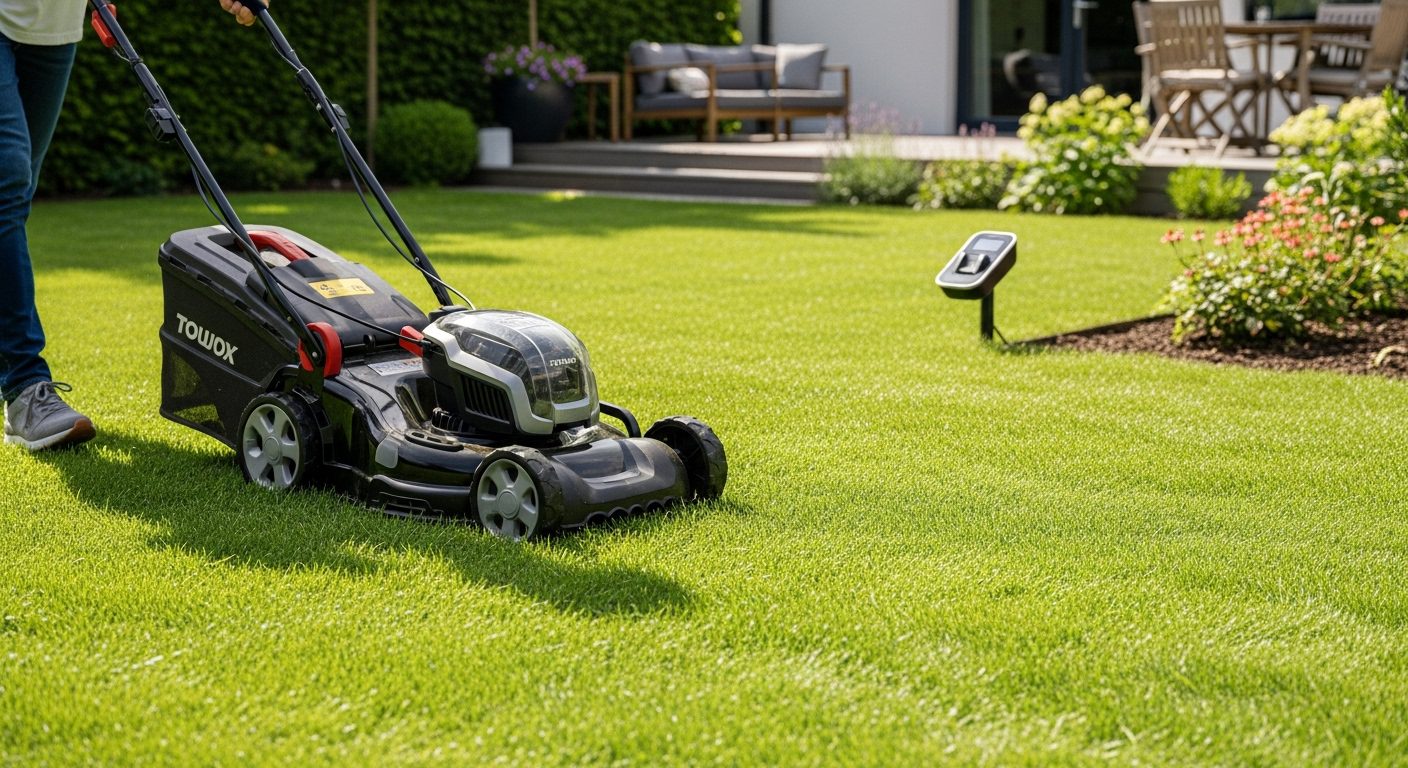
Our team tests these mowers on actual lawns, not just in controlled environments. We cut different grass types at various heights, test on slopes and flat surfaces, and evaluate performance in both wet and dry conditions. This approach reveals how these machines actually perform when you’re using them week after week in your own yard.
Testing Methodology Overview
Our cordless lawn mower testing follows a structured evaluation framework that we’ve developed based on Consumer Reports’ methodology, Which? UK’s weighted scoring system, and ANSI/OPEI safety standards. We allocate our scoring across five main categories: cutting performance (40%), battery life and charging (25%), ease of use (20%), build quality (10%), and safety compliance (5%).
Before any mower enters our testing program, we verify it meets basic safety requirements set by the Consumer Product Safety Commission. This includes checking for Operator Presence Control systems, proper blade brake mechanisms that stop within three seconds, and adequate foot shield protection. Any mower that fails these preliminary safety checks doesn’t proceed to performance testing.
We conduct our tests across a minimum four-week period, similar to Top Ten Reviews’ approach. This extended timeline allows us to evaluate consistency, identify potential issues that might not appear immediately, and assess how the mower handles repeated use. During this period, each mower cuts at least 20,000 square feet of grass under various conditions.
Battery Life Testing Procedures
Battery runtime testing forms the core of our cordless mower evaluation. We start with fully charged batteries at room temperature (68-72°F) and run continuous cutting tests on grass maintained at 4 inches height, cutting down to 2.5 inches. This represents a typical weekly mowing scenario for most homeowners.
We measure runtime in three distinct conditions: optimal (dry grass, flat terrain, moderate temperature), challenging (slightly damp grass, gentle slopes, warmer conditions), and extreme (tall or wet grass, steeper slopes, high temperatures). The average of these three tests becomes our reported runtime figure. Based on Consumer Reports data, we expect a minimum of 45 minutes runtime for an acceptable score, with top performers reaching 70+ minutes.
Charging time gets equal attention in our testing. We measure the time from completely depleted to fully charged using the manufacturer’s supplied charger. We also test whether the charger has intelligent features like temperature monitoring or staged charging that can extend battery life. Most quality models should charge in under 90 minutes, though we’ve seen ranges from 30 minutes to over 2 hours.
We also evaluate battery longevity through repeated charge cycles. After 20 complete discharge and recharge cycles, we measure any degradation in runtime. Quality lithium-ion batteries should maintain at least 95% of their original capacity during our testing period.
Cutting Performance Evaluation
Cutting quality makes up 40% of our overall score, reflecting its importance to actual lawn care. We test each mower across three grass heights: short (30mm), medium (70-100mm), and long (300mm+), following Which? UK’s methodology. Each height presents different challenges and reveals specific strengths or weaknesses in the mower’s design.
We evaluate three cutting modes when available: mulching, side discharge, and bagging. For mulching tests, we examine the fineness of clippings and how evenly they distribute across the lawn. Side discharge testing focuses on throw distance and pattern consistency. Bagging evaluation considers how efficiently the mower fills the bag and how often it needs emptying.
Cut quality assessment involves multiple passes over the same area from different directions. We look for clean, even cuts without tearing or brown tips that indicate dull blades or poor cutting action. We use a precision ruler to verify cutting height accuracy across the deck width, checking for any scalping or uneven cutting patterns.
We specifically test how well each mower handles common lawn challenges: thick patches of grass, areas with mixed grass and weeds, sections with leaves or small twigs, and edges along walkways or garden beds. Performance in these real-world scenarios often separates adequate mowers from exceptional ones.
Noise Level Assessment
Cordless mowers typically operate much quieter than gas models, but noise levels still vary significantly between models. We measure sound levels using calibrated decibel meters at two positions: at the operator’s ear level and 25 feet away from the mower. These measurements follow industry-standard protocols for consistency.
Our target benchmark sits at 90dB or lower at the operator position – roughly equivalent to a dishwasher. We take readings during startup, normal operation on flat terrain, operation under load (tall grass), and when engaging self-propulsion features if equipped. The average of these readings determines the mower’s noise score.
We also evaluate the quality of sound produced. Some mowers emit a high-pitched whine that proves more annoying than slightly louder models with lower-frequency sounds. We note any unusual noises like rattling, squeaking, or grinding that might indicate quality issues or maintenance needs.
For reference, cordless mowers typically range from 75-95dB at the operator position, compared to 95-100dB for gas mowers. Any model exceeding 85dB receives a recommendation for hearing protection during extended use, following occupational safety guidelines.
Build Quality Analysis
Build quality assessment examines materials, construction, and attention to detail across the entire mower. We inspect the deck material (steel, aluminum, or composite), checking for appropriate thickness and reinforcement at stress points. Steel decks should have proper anti-corrosion coating, while composite decks need adequate UV resistance.
We evaluate handle construction and adjustability, looking for solid mounting points, smooth height adjustments, and comfortable grips. The handle should feel sturdy during operation without excessive vibration or flex. Folding mechanisms get tested repeatedly to ensure they maintain their locking strength over time.
Control placement and quality receive careful attention. Buttons and levers should operate smoothly without requiring excessive force. Safety switches must engage reliably every time. Battery connections need to be secure yet easy to operate, with clear indicators for charge level and any error conditions.
Wheel quality often gets overlooked but significantly impacts long-term satisfaction. We check for smooth bearings, adequate tread for traction, and appropriate wheel diameter for the mower’s intended use. Height adjustment mechanisms get cycled through their full range multiple times to verify smooth operation and positive locking.
Safety Standards Compliance
Every mower we test must meet or exceed ANSI/OPEI B71.1-2017 safety standards for walk-behind mowers. This includes mandatory safety features like Operator Presence Control that stops the blade when you release the handle, and blade brake systems that bring the blade to a complete stop within three seconds of disengagement.
We verify proper guarding around the deck to prevent objects from being thrown toward the operator. The discharge chute must have appropriate deflectors, and the rear must have adequate foot protection. Any exposed moving parts should have proper shields or guards to prevent accidental contact.
Electronic safety features get equal scrutiny. We test battery management systems for proper thermal protection, over-discharge prevention, and safe charging protocols. The mower should clearly indicate any fault conditions and prevent operation if safety systems detect problems.
We also evaluate the clarity and completeness of safety information in the manual. Proper warnings about slope limitations (usually 15-20 degrees maximum), clear instructions for safe operation, and adequate maintenance guidance all factor into our safety assessment.
Real World Testing Conditions
Laboratory testing provides consistent baselines, but real-world performance often differs significantly. That’s why we test each mower across diverse conditions that mirror actual use. Our testing includes early morning sessions with dew-covered grass, midday cutting in full sun, and evening mowing when grass might be slightly damp.
We evaluate performance on different grass types including Kentucky bluegrass, perennial ryegrass, tall fescue, and Bermuda grass. Each type presents unique challenges – some are tougher to cut cleanly, others tend to clump when cut, and some require more power to maintain blade speed.
Terrain variation plays a key role in our testing. We include flat areas for baseline performance, gentle slopes (5-10 degrees) for typical residential lawns, and steeper sections (up to 15 degrees) to test traction and power delivery. We also test maneuvering around common obstacles like trees, garden beds, and walkways to assess handling.
Seasonal conditions factor into our extended testing when possible. Spring testing involves lush, fast-growing grass that challenges cutting capacity. Summer tests reveal how mowers handle heat stress on both the battery and motor. Fall testing includes leaf mulching capability and performance in cooler temperatures.
Measurement Techniques and Equipment
Accurate testing requires proper measurement tools and techniques. For runtime testing, we use digital timers that start when the blade engages and stop automatically when blade speed drops below effective cutting RPM. This provides more accurate real-world runtime than simply running the motor without load.
Cutting height measurements utilize precision steel rulers at multiple points across the deck width. We measure both static height (mower off) and dynamic height (during operation) since deck flex can affect actual cutting height. Any variance greater than 1/4 inch between settings and actual cut height gets noted in our reports.
For area coverage calculations, we use measuring wheels to map test areas precisely. This allows us to calculate actual square footage per battery charge rather than relying on manufacturer estimates. We typically see 5,000-10,000 square feet per charge, though this varies significantly based on conditions.
Power consumption monitoring happens through inline power meters during charging. This reveals actual energy usage and charging efficiency. We calculate the cost per charge based on average electricity rates, helping users understand long-term operating costs compared to gas alternatives.
Scoring Criteria and Benchmarks
Our scoring system weights different aspects based on their importance to typical users. Cutting performance (40%) receives the highest weight because it directly impacts lawn appearance. Within this category, cut quality accounts for 20%, mulching effectiveness 10%, and handling various conditions the remaining 10%.
Battery performance (25%) splits between runtime (15%) and charging convenience (10%). Mowers scoring excellent in runtime achieve 60+ minutes per charge, good scores go to 45-60 minutes, and acceptable scores require at least 30 minutes. Charging times under one hour earn top marks, while anything over two hours receives below-average scores.
Ease of use (20%) encompasses starting procedure, maneuverability, height adjustment ease, and maintenance requirements. Build quality (10%) covers materials, construction quality, and expected durability. Safety compliance (5%) operates as pass/fail – mowers must meet all safety standards to receive any score in this category.
We establish minimum acceptable scores for each category. A mower must achieve at least “acceptable” in cutting performance and battery life to receive an overall recommendation. Exceptional performance in one area cannot completely offset poor performance in these critical categories.
Documentation and Reporting
Throughout our testing process, we maintain detailed documentation of all measurements, observations, and test conditions. Each mower gets its own testing log that tracks daily use, any issues encountered, maintenance performed, and performance changes over time. This systematic approach ensures we don’t miss subtle problems that might develop during extended use.
We photograph key aspects of each mower including cut quality samples, mulching effectiveness, and any wear or damage that occurs during testing. These visual records supplement our written observations and help illustrate specific strengths or weaknesses in our reviews.
Our final reports include standardized data tables that allow direct comparison between models. We present runtime charts showing performance across different conditions, cutting quality scores for various grass types, and comprehensive feature comparisons. This data-driven approach helps readers make informed decisions based on their specific needs.
Conclusion
Our cordless lawn mower testing methodology represents years of refinement and thousands of hours of actual testing experience. By combining industry standards with practical, real-world evaluation, we provide comprehensive assessments that reflect how these mowers actually perform in your yard, not just in laboratory conditions.
We continually update our testing protocols as technology advances and new features emerge. Recent additions include evaluating smart connectivity features, testing compatibility with different battery platforms, and assessing long-term battery degradation patterns. This evolution ensures our testing remains relevant and valuable.
The goal of our testing isn’t just to identify the “best” mower, but to help you find the right mower for your specific situation. Whether you have a small urban lot or a half-acre suburban lawn, our detailed testing data helps match mower capabilities to your actual needs. That’s why we test across such diverse conditions and maintain strict scoring criteria – to ensure our recommendations truly serve your lawn care needs.