A sharp lawn mower blade makes all the difference between a healthy, pristine lawn and one that looks ragged and stressed. When I first started maintaining my own lawn equipment, I was surprised to learn that dull blades don’t just give you an uneven cut – they actually tear grass instead of cutting it cleanly, leaving your lawn vulnerable to disease and turning brown at the tips.
After years of sharpening blades both professionally and at home, I’ve learned that this essential maintenance task isn’t nearly as intimidating as it seems. With the right tools, proper safety precautions, and about 30 minutes of your time, you can restore your mower blades to their original cutting efficiency. More importantly, you’ll save money on professional sharpening services that typically cost $15-25 per blade.
In this comprehensive guide, I’ll walk you through every aspect of lawn mower blade sharpening, from recognizing when your blades need attention to choosing the right sharpening method for your skill level and available tools. We’ll cover safety extensively because working with sharp metal edges requires respect and proper precautions. By the end, you’ll have the confidence and knowledge to maintain your mower blades like a professional.
When to Sharpen Your Lawn Mower Blades?
Knowing when to sharpen your mower blades is just as important as knowing how to do it. I recommend checking your blades at the beginning of each mowing season and after every 20-25 hours of use. However, several tell-tale signs indicate your blades need immediate attention, regardless of your maintenance schedule.
Visual Signs Your Grass Is Being Torn, Not Cut
The most obvious sign of dull blades appears on your grass itself. After mowing, examine the grass tips closely. Sharp blades create clean, straight cuts across the grass blades, while dull blades leave jagged, torn edges that turn brown within a day or two. This browning occurs because torn grass loses more moisture and becomes susceptible to fungal infections.
You might also notice uneven cutting patterns, with some areas of grass appearing longer than others despite multiple passes. This happens when dull blades push grass down rather than cutting through it cleanly. Additionally, if you’re seeing clumps of grass left behind or need to make multiple passes over the same area, your blades definitely need sharpening.
Physical Blade Inspection Indicators
Direct blade inspection provides the most accurate assessment of their condition. Always disconnect the spark plug wire before inspecting blades to prevent accidental starting. Look for visible nicks, dents, or bent areas along the cutting edge. Even small imperfections can significantly impact cutting performance.
Run your finger carefully along the blade edge (never across it). A properly sharp blade should feel similar to a butter knife – not razor-sharp, but with a defined edge. If the edge feels rounded or completely dull, it’s time for sharpening. Also check for excessive wear on the blade’s lifting wings – these create the suction that stands grass up for cutting.
Recommended Sharpening Schedule
For average homeowners mowing weekly during the growing season, I recommend sharpening blades twice per year – once at the beginning of spring and again mid-season. If you have a larger property (over an acre) or mow more frequently, consider sharpening every 20-25 hours of use or monthly during peak growing season.
Certain conditions accelerate blade dulling and require more frequent sharpening. Sandy soil, frequent contact with sticks or debris, and mowing when grass is wet all contribute to faster blade degradation. Keep a log of your mowing hours and sharpening dates to establish a schedule that works for your specific conditions.
Essential Tools and Materials Needed
Before starting any blade sharpening project, gathering the right tools ensures both safety and effectiveness. You don’t need expensive equipment to achieve professional results, but having the proper tools makes the job significantly easier and safer.
Safety Equipment (Non-Negotiable)
Safety equipment isn’t optional when working with sharp blades and power tools. Heavy-duty work gloves protect your hands from sharp edges and provide better grip when handling blades. Choose gloves with cut-resistant material if possible.
Safety glasses or goggles are essential, especially when using power tools. Metal filings and sparks can cause serious eye injuries. I learned this lesson the hard way when a small metal fragment lodged in my eye while using an angle grinder without protection.
Hearing protection becomes necessary when using power tools like angle grinders or bench grinders. Prolonged exposure to high-decibel grinding can cause permanent hearing damage. Simple foam earplugs work well, though over-ear protection provides better coverage.
A dust mask or respirator prevents inhalation of metal particles and grass debris. This is particularly important if you’re sharpening indoors or in an enclosed space. Finally, wear closed-toe shoes or work boots to protect your feet from dropped blades or tools.
Sharpening Tool Options
You have several tool options for sharpening, each with distinct advantages. A 10-inch mill bastard file offers the most control and is ideal for beginners. It’s inexpensive (around $10-15), requires no power source, and allows you to feel exactly how much metal you’re removing. The downside is that hand filing takes more time and physical effort.
An angle grinder with a flap disc or grinding wheel provides faster results and works well for heavily damaged blades. A decent angle grinder costs $30-60, and you’ll need appropriate grinding discs. The learning curve is steeper, and it’s easier to remove too much metal or overheat the blade, which can ruin its temper.
A drill-powered blade sharpening attachment offers a middle ground between speed and control. These attachments ($15-25) fit standard drills and include a guide that maintains the proper sharpening angle. They’re faster than hand filing but provide more control than an angle grinder.
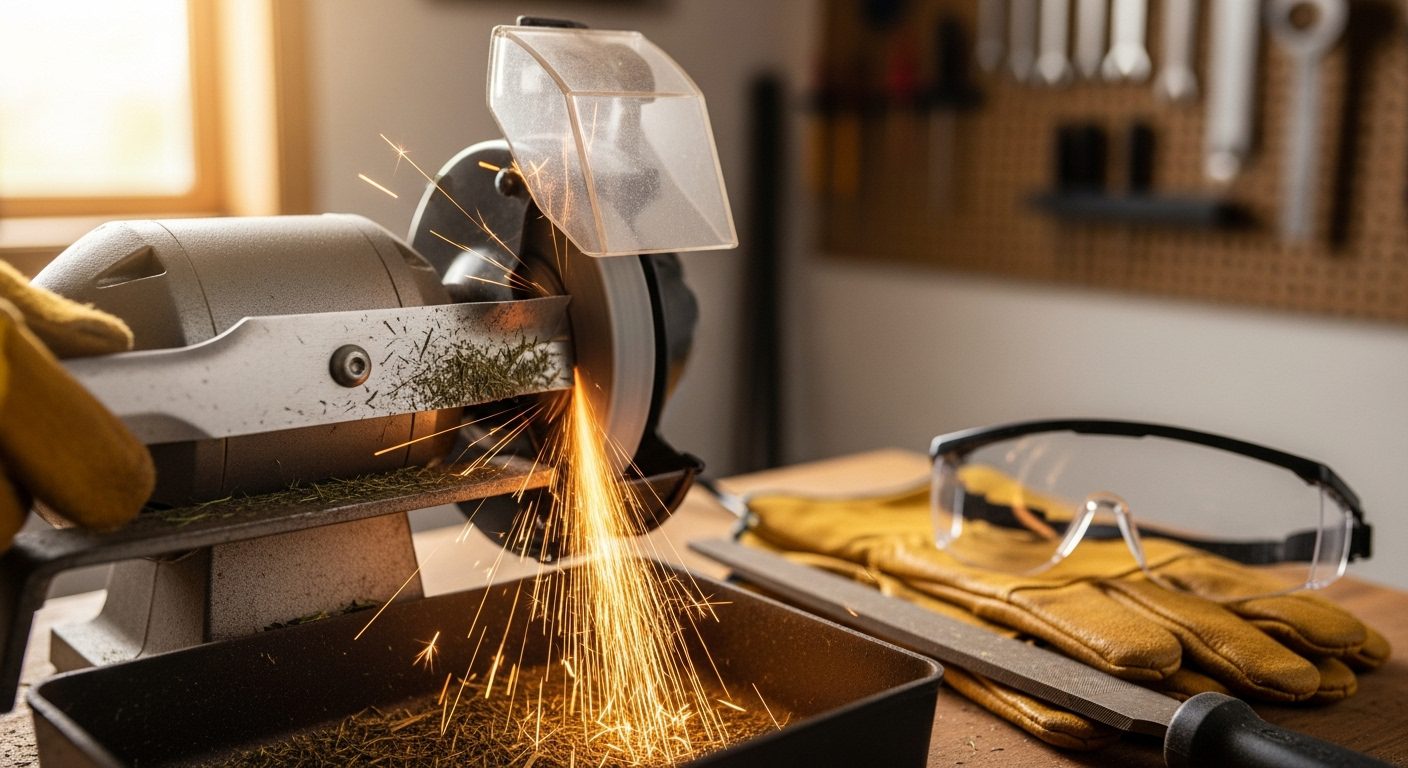
For those who sharpen frequently, a bench grinder offers consistent, professional results. While more expensive ($50-150), a bench grinder allows precise angle control and rapid sharpening. However, it requires a dedicated workspace and has the highest risk of overheating blades.
Additional Supplies
Beyond sharpening tools, several supplies make the job easier and ensure better results. A blade balancer ($10-15) or a simple nail in the wall helps verify your blade is balanced after sharpening. Unbalanced blades cause excessive vibration that damages mower components.
Keep penetrating oil (WD-40 or similar) on hand to loosen stuck blade bolts. Years of grass buildup and moisture can make blade removal challenging without lubrication. A socket wrench set with the appropriate size socket (usually 15/16″ or 5/8″) removes blade bolts more easily than adjustable wrenches.
A wire brush cleans grass buildup and rust from blades before sharpening. Clean blades allow better inspection and more accurate sharpening. Finally, have marking paint or a permanent marker to mark the bottom of the blade – it’s surprisingly easy to reinstall a blade upside down.
Safety Preparation and Workspace Setup
Proper safety preparation prevents accidents and ensures a smooth sharpening process. I’ve seen too many injuries result from rushing through safety steps or working in cluttered spaces. Taking an extra 10 minutes for proper setup can prevent serious injuries and equipment damage.
Disconnecting the Spark Plug – Critical First Step
Never skip this step. Before any mower maintenance, locate and disconnect the spark plug wire. On push mowers, you’ll find the spark plug on the side or front of the engine, covered by a rubber boot. Simply pull the boot straight off the plug – don’t pull on the wire itself.
For riding mowers, the spark plug might be less accessible, often under the hood or seat. Consult your owner’s manual for the exact location. After disconnecting, bend the wire away from the plug to prevent accidental reconnection. Some people tape the wire to the mower handle as an extra precaution.
This simple step prevents the engine from accidentally starting if the blade rotates during removal or if someone unknowingly pulls the starter cord. I once witnessed a mower start unexpectedly during blade work because vibrations reconnected a loosely disconnected spark plug wire – a terrifying reminder of why this step is critical.
Proper Mower Positioning
Position your mower correctly to access the blade safely. For push mowers, you have two options: tipping the mower on its side or using a mower lift. If tipping, always tip carburetor-side up to prevent oil from flooding the air filter and carburetor. This usually means tipping to the right when standing behind the mower.
Before tipping, run the mower until the fuel tank is nearly empty, or use a siphon to remove excess fuel. This prevents fuel spillage and reduces fire hazard. Place a tarp or cardboard under the work area to catch any drips.
For riding mowers, use jack stands or ramps rated for the mower’s weight. Never rely solely on a hydraulic jack – always use stands as backup. Some people drive the front wheels onto car ramps for better access. Ensure the parking brake is engaged and the transmission is in park or neutral with wheels blocked.
Workspace Organization for Efficiency
An organized workspace improves both safety and efficiency. Choose a well-lit area with adequate ventilation, especially if using power tools. Natural light works best for inspecting blade condition, but supplement with work lights if necessary.
Clear a stable work surface for blade sharpening. A sturdy workbench is ideal, but a solid table or even a piece of plywood on sawhorses works. The surface should be at a comfortable working height to maintain control while sharpening.
Arrange your tools within easy reach but not where they can be knocked over. I use a magnetic parts tray for bolts and washers – nothing worse than losing hardware in grass or gravel. Keep cleaning supplies, sharpening tools, and safety equipment in designated areas to avoid confusion during the process.
Step-by-Step Blade Removal Process
Removing the blade correctly sets the foundation for successful sharpening. Rushing this step often leads to stripped bolts, damaged blade adapters, or injury. With proper technique and patience, blade removal becomes routine.
Locating and Loosening Blade Bolts
Once your mower is safely positioned, locate the blade bolt in the center of the blade. Most mowers use a single bolt, though some commercial models have multiple mounting points. The bolt typically has a 15/16″ or 5/8″ head, though sizes vary by manufacturer.
Before attempting removal, spray penetrating oil on the bolt and let it soak for 10-15 minutes. This step is crucial for older mowers or those exposed to moisture. While waiting, use a wire brush to clean around the bolt head and blade mounting area.
To prevent the blade from rotating while loosening the bolt, wedge a piece of 2×4 wood between the blade and mower deck. Apply steady pressure with your socket wrench, turning counterclockwise. If the bolt won’t budge, don’t force it – apply more penetrating oil and try again. Excessive force can strip the bolt head or damage the blade adapter.
Safe Blade Handling Techniques
Always wear heavy gloves when handling mower blades, even dull ones. The blade edges might seem dull, but they can still cause serious cuts, especially if the blade slips. Grip the blade firmly at both ends, keeping your hands away from the cutting edges.
As you remove the bolt, support the blade with your free hand to prevent it from dropping. Note the blade’s orientation before removal – the wings or fins should face toward the mower deck. Many blades have “BOTTOM” or “THIS SIDE DOWN” stamped on them, but marking with paint provides extra insurance against incorrect reinstallation.
Once removed, inspect the blade adapter, washers, and mounting hardware. Clean any grass buildup and check for damage. Worn or damaged mounting hardware should be replaced before reinstalling the blade. Set all hardware in your parts tray in the order removed for easy reassembly.
Marking Blade Orientation
Before cleaning or sharpening, clearly mark your blade’s orientation. Use spray paint or a permanent marker to mark the bottom side that faces the ground. I prefer bright orange paint – it’s visible even after cleaning and won’t wear off during sharpening.
Also mark which end is which if your blade isn’t symmetrical. Some mulching blades have different angles or lengths on each end. A simple “1” and “2” on the mounting hole area ensures correct reinstallation. These marks save frustration during reassembly and prevent the dangerous mistake of installing a blade upside down.
Take a photo of the blade installation before removal. This visual reference helps during reinstallation, especially if you’re working on multiple mowers or taking a break between removal and reinstallation. Document any special washers, spacers, or mounting configurations specific to your mower.
Blade Sharpening Methods and Techniques
With your blade safely removed and workspace prepared, it’s time for the actual sharpening. Each method has its place, and I’ll guide you through all options so you can choose what works best for your situation and skill level.
Method 1: Hand File Sharpening (Best for Beginners)
Hand filing remains my recommended method for beginners because it offers maximum control with minimal risk of blade damage. Secure your blade in a vise with the cutting edge facing up and accessible. If you don’t have a vise, clamp the blade to your work surface with C-clamps, leaving the edge to be sharpened hanging over the edge.
Hold your 10-inch mill bastard file at the same angle as the existing blade bevel – typically 30-45 degrees. You can buy angle guides, but I find matching the existing angle by eye works well with practice. Push the file across the blade edge in smooth, consistent strokes, applying moderate pressure on the forward stroke only.
Count your strokes to ensure even sharpening on both ends of the blade. I typically use 50-60 strokes per side for routine sharpening, more for badly damaged blades. File in one direction only – from the inside of the blade toward the outside edge. This technique prevents creating a burr on the cutting edge.
After sharpening one side, flip the blade and repeat on the opposite cutting edge. The goal isn’t to create a razor-sharp edge but rather a clean, consistent bevel similar to a butter knife’s edge. Over-sharpening actually makes blades dull faster and creates safety hazards.
Method 2: Angle Grinder Technique
Angle grinders remove metal quickly, making them ideal for severely damaged blades or when time is limited. However, they require more skill to avoid removing too much metal or overheating the blade. Always use a flap disc rather than a grinding wheel for better control and cooler cutting.
Secure the blade in a vise or clamp it firmly to your work surface. Hold the grinder at the proper angle – match the existing bevel angle just as with hand filing. Keep the grinder moving continuously along the edge to prevent overheating any single spot. Overheating turns the metal blue and ruins its temper, making it soft and unable to hold an edge.
Use light pressure and multiple passes rather than trying to sharpen in one heavy pass. After each pass, check the blade temperature with your hand – if it’s too hot to touch comfortably, let it cool before continuing. Some professionals dip the blade in water between passes, though this isn’t necessary if you work patiently.
Grind each cutting edge equally, counting passes to maintain balance. After grinding, use a file for final finishing – this removes any burrs and creates a more uniform edge. The combination of rough shaping with the grinder followed by finish filing produces professional results.
Method 3: Drill Attachment Sharpening
Drill-powered sharpening attachments offer a good compromise between speed and control. These devices consist of a grinding stone mounted in a guide that maintains the proper angle. They’re particularly useful for homeowners who sharpen occasionally but want faster results than hand filing.
Mount the sharpening attachment in your drill according to manufacturer instructions. Most require a variable-speed drill for best results. Secure your blade in a vise or clamp it firmly – the drill’s torque can grab and throw an unsecured blade.
Place the guide against the blade edge and run the drill at medium speed. Move the attachment smoothly along the cutting edge, maintaining consistent contact. The guide ensures you maintain the proper angle, though you still need to apply even pressure and keep the tool moving to prevent overheating.
These attachments typically include a small grinding stone that wears down with use. Replace the stone when it becomes too small or worn to maintain proper contact with the blade. Like the angle grinder method, finish with a few strokes of a hand file to remove any burrs and ensure a clean edge.
Method 4: Bench Grinder Option
Bench grinders provide the fastest, most consistent results but require the most skill and equipment investment. If you already own a bench grinder for other projects, it’s an excellent option for regular blade maintenance.
Adjust your grinder’s tool rest to match your blade’s bevel angle. This setup is crucial – an incorrect angle ruins the blade’s cutting geometry. Use a medium-grit wheel (60-80 grit) for general sharpening. Dress the wheel if it’s glazed or loaded with metal particles.
Hold the blade firmly with both hands and move it smoothly across the wheel. Keep the blade moving to prevent overheating – never hold it in one spot. The blade should contact the wheel lightly, letting the wheel do the work rather than forcing it.
Dip the blade in water frequently to keep it cool. Have a container of water next to your grinder and dip after every few passes. Watch for color changes in the metal – any blue or purple discoloration indicates overheating. If this occurs, grind past the discolored area to remove the weakened metal.
Achieving Proper Blade Balance
A balanced blade is just as important as a sharp one. Unbalanced blades cause excessive vibration that damages bearings, ruins spindles, and creates an uncomfortable mowing experience. I’ve seen mowers destroyed by running unbalanced blades for extended periods.
Why Balance Matters for Mower Longevity?
When a blade spins at 3,000+ RPM, even small weight differences create significant centrifugal force. This force translates into vibration that affects every mower component. Bearings wear prematurely, bolts loosen, and deck welds can crack. The vibration also fatigues the operator and makes precise cutting impossible.
Balance problems usually result from uneven sharpening – removing more metal from one end than the other. Damage from hitting rocks or other objects can also create imbalance. Even new blades occasionally need balancing due to manufacturing variations.
Using a Blade Balancer Tool
Commercial blade balancers provide the most accurate results. These cone-shaped tools support the blade at its center hole, allowing it to pivot freely. A balanced blade sits level, while an unbalanced blade tips toward the heavier side.
Place your sharpened blade on the balancer and observe its position. If one side dips, that end is heavier and needs additional metal removed. Remove the blade and grind or file a small amount from the heavy end’s back edge – not the cutting edge. Replace on the balancer and check again.
Continue making small adjustments until the blade sits perfectly level. This process requires patience – removing too much metal means starting over on the opposite side. Work in small increments and check frequently for best results.
DIY Balance Testing Methods
If you don’t have a commercial balancer, several DIY methods work well. The simplest involves driving a nail horizontally into a wall stud and hanging the blade on it through its center hole. A balanced blade hangs level, while an unbalanced one tips.
Another method uses a screwdriver clamped horizontally in a vise. Place the blade’s center hole on the screwdriver shaft and check for level. Some people use a length of string through the center hole, though this method is less accurate due to blade movement.
Regardless of method, the principle remains the same – identify the heavy side and remove small amounts of metal until the blade balances. Always remove metal from the back edge or the lift wing area, never from the cutting edge you just sharpened.
Blade Reinstallation and Final Checks
Proper reinstallation ensures your newly sharpened blade performs safely and effectively. Rushing this final step can negate all your careful sharpening work or create dangerous conditions.
Correct Mounting Orientation
Refer to your earlier markings and photos to ensure correct blade orientation. The cutting edges should face the direction of rotation, with the lift wings pointing up toward the deck. Installing a blade upside down results in poor cutting and potential safety hazards.
Clean the blade adapter and mounting surface before installation. Grass buildup or debris prevents proper seating and can cause vibration. Apply a small amount of anti-seize compound to the bolt threads to ease future removal.
Position the blade on the adapter, ensuring it seats properly on any alignment pins or keys. Install washers and bolts in the correct order – some mowers use special cupped washers that must face a specific direction. Hand-tighten the bolt initially to ensure proper thread engagement.
Proper Torque Specifications
Blade bolts require specific torque for safe operation. Under-tightened bolts can loosen during operation, while over-tightening can strip threads or crack blade adapters. Most walk-behind mowers require 35-40 ft-lbs of torque, while riding mowers typically need 45-60 ft-lbs. Check your owner’s manual for exact specifications.
If you don’t have a torque wrench, tighten the bolt firmly with a standard wrench, then add an additional quarter turn. This method isn’t as accurate as using a torque wrench but works for most homeowner applications. Mark the bolt head and deck with paint to monitor for loosening during use.
Test Run Procedures
Before returning to normal mowing, perform a careful test run. Reconnect the spark plug wire and start the mower in an open area away from people and property. Listen for unusual noises or vibrations that indicate installation problems.
Let the mower run for 30 seconds, then shut it off and recheck bolt tightness. Sometimes bolts settle during initial operation and need retightening. Check again after your first mowing session – this redundancy prevents dangerous blade separation.
Test the cutting performance on a small grass area. The mower should cut cleanly without requiring excessive forward pressure. If cutting seems poor despite sharp blades, check for engine RPM issues or deck problems that affect blade speed.
Maintenance Tips for Longer Blade Life
Proper maintenance between sharpenings extends blade life and maintains cutting quality. These practices reduce sharpening frequency and prevent premature blade replacement.
Regular Cleaning Practices
Clean your mower deck and blades after each use, especially when cutting wet grass. Grass buildup creates moisture pockets that accelerate rust and corrosion. Use a putty knife or deck scraper to remove clippings, then rinse with a garden hose.
Some people spray the deck underside with cooking oil or silicone spray to prevent grass adhesion. While this helps, avoid petroleum-based products that can damage grass when they drip. Commercial deck coatings provide longer-lasting protection but require thorough cleaning before application.
During your regular cleaning, inspect blades for damage. Small nicks from hitting debris can often be filed out immediately, preventing larger problems. Address rust spots with sandpaper and rust-preventive paint to stop spreading.
Proper Storage Techniques
End-of-season storage significantly impacts blade condition. Clean blades thoroughly and coat them with light oil or WD-40 to prevent rust. Some professionals remove blades for winter storage, though this isn’t necessary if the mower is stored in a dry location.
Store mowers in a dry, covered area when possible. Moisture accelerates rust and corrosion, particularly on blade edges. If outdoor storage is unavoidable, use a quality mower cover and elevate the mower slightly to improve air circulation.
Consider having a spare set of blades. This allows you to swap blades quickly when one set needs sharpening, minimizing downtime. Mark each set clearly and rotate them to ensure even wear. Professional landscapers typically maintain three sets – one on the mower, one being sharpened, and one ready to install.
Avoiding Common Blade Damage
Prevention is easier than repair when it comes to blade damage. Walk your lawn before mowing to remove sticks, rocks, toys, and other debris. These objects can cause severe blade damage that requires grinding away significant metal to repair.
Avoid mowing when grass is excessively wet or tall. Wet grass requires more cutting force and accelerates blade dulling. Tall grass should be cut in stages, removing no more than one-third of the grass height per pass. This approach reduces blade stress and improves cut quality.
Adjust cutting height appropriately for conditions. Scalping the lawn by cutting too low causes blades to contact soil and rocks more frequently. Most grass types thrive when cut at 2.5-3.5 inches, which also reduces blade ground contact.
Troubleshooting Common Sharpening Issues
Even experienced sharpeners encounter problems occasionally. Understanding common issues and their solutions helps you achieve better results and avoid frustration.
Fixing Nicks and Severe Damage
Small nicks from normal use can usually be filed out during regular sharpening. However, large nicks or bends require special attention. For nicks deeper than 1/4 inch, use an angle grinder to reshape the entire cutting edge, maintaining the original angle.
Bent blades should generally be replaced rather than repaired. Attempting to straighten a bent blade weakens the metal and creates balance problems that are nearly impossible to correct. The cost of a new blade is minor compared to potential mower damage from a failing blade.
For expensive commercial blades, some shops offer professional repair services. They use specialized equipment to remove nicks and restore balance. This service typically costs less than replacement for high-end mulching or high-lift blades.
Dealing with Rust and Corrosion
Surface rust doesn’t significantly affect blade performance but indicates moisture exposure that needs addressing. Remove rust with sandpaper or a wire brush before sharpening. Start with coarse grit (80-100) for heavy rust, then progress to finer grits for a smooth finish.
After rust removal, apply a rust converter product to neutralize any remaining rust and prevent spreading. Once dry, paint the blade with rust-resistant paint, leaving the cutting edges unpainted. This treatment significantly extends blade life in humid climates.
Severe pitting from advanced rust weakens blades structurally. If rust has created deep pits or thin spots, replace the blade. The risk of blade failure during operation outweighs any savings from continued use.
When to Replace Instead of Sharpen?
Blades don’t last forever, and recognizing when replacement is necessary ensures safe operation. Replace blades when the cutting edge is worn back more than half the distance to the lift wing. Further sharpening removes too much material and compromises blade strength.
Check blade thickness, especially near the cutting edges. Repeated sharpening gradually thins the blade. When edges become noticeably thinner than the center section, replacement is due. Thin edges bend easily and can break during operation.
Any cracks, regardless of size, mandate immediate replacement. Cracks propagate rapidly under operational stress and can cause catastrophic failure. Similarly, replace blades with worn center holes that allow excessive play on the adapter – this movement causes vibration and prevents proper cutting.
Professional vs. DIY: Cost-Benefit Analysis
Understanding when to sharpen yourself versus using professional services helps you make informed maintenance decisions. Both options have their place depending on your situation, skills, and available time.
When Professional Sharpening Makes Sense?
Professional sharpening services typically charge $7-15 per blade, with some shops offering bulk discounts. For homeowners with a single mower who sharpen twice yearly, the $20-30 annual cost might be worth the convenience. Professionals have specialized equipment that produces consistent results quickly.
Consider professional service if you lack proper tools or workspace. Buying quality sharpening equipment costs $50-100 minimum, which takes several years to recoup through DIY savings. Professionals also handle severely damaged blades that require extensive grinding or specialized repair.
Time factors into the equation too. If your hourly time value exceeds the service cost, professional sharpening makes economic sense. Some shops offer while-you-wait service or blade exchange programs that minimize downtime.
DIY Cost Savings Calculation
For homeowners with multiple mowers or who sharpen frequently, DIY provides significant savings. Initial tool investment of $50-100 pays for itself within 5-10 sharpenings. Once you own the tools, per-blade cost drops to essentially zero beyond your time investment.
Calculate your break-even point by dividing tool cost by professional service cost. For example, $60 in tools divided by $12 per sharpening equals 5 sharpenings to break even. If you sharpen three blades twice yearly, you’ll recoup costs within one year.
DIY sharpening also provides intangible benefits. You can sharpen whenever needed without transportation or shop schedules. You’ll develop mechanical skills applicable to other maintenance tasks. Most importantly, you control the quality and know exactly what was done to your equipment.
Seasonal Blade Maintenance Schedule
A structured maintenance schedule ensures optimal blade performance throughout the mowing season. This proactive approach prevents problems and extends equipment life.
Spring Preparation
Begin your mowing season with thorough blade inspection and sharpening. Even if blades looked good when stored last fall, winter moisture can cause rust or corrosion. Remove blades and inspect for damage, rust, or wear that developed during storage.
Sharpen blades to prepare for the season’s first cut. Spring grass grows rapidly and tends to be thicker, requiring sharp blades for clean cutting. This is also the ideal time to purchase spare blades if yours show significant wear.
Document your blade condition with photos and measurements. Record blade model numbers for easy replacement ordering. Note any special mounting hardware or adapters specific to your mower. This documentation proves valuable when you need replacement parts mid-season.
Mid-Season Checks
Schedule mid-season blade inspection after 20-25 hours of use, typically in mid-summer. This check catches problems before they affect cut quality or damage your mower. Look for nicks, wear patterns, and balance issues that developed through use.
Mid-season sharpening maintains peak performance during the most demanding mowing period. Summer heat and rapid growth stress both grass and equipment. Sharp blades reduce engine load and improve fuel efficiency during this intensive period.
Use this opportunity to clean under the deck thoroughly. Compressed grass buildup affects cutting performance and accelerates corrosion. Check blade mounting hardware for looseness or wear. Replace any questionable bolts or washers to prevent future problems.
End-of-Season Preparation
Proper end-of-season preparation prevents winter damage and ensures easy spring startup. Remove and thoroughly clean blades, even if they won’t need sharpening until spring. This prevents rust and allows detailed inspection for developing problems.
Decide whether to sharpen now or wait until spring. Sharpening before storage means you’re ready to mow immediately in spring. However, blades can develop surface rust during storage that requires attention anyway. I prefer sharpening in spring when I can assess winter storage effects.
Apply rust preventive coating to clean blades before storage. Light machine oil, WD-40, or specialized rust preventives all work well. Store blades in a dry location, preferably hanging to prevent moisture accumulation. Label each blade if you maintain multiple sets.
Frequently Asked Questions
How can I tell if my lawn mower blade is sharp enough?
A properly sharpened lawn mower blade should feel similar to a butter knife edge – not razor-sharp but with a distinct, clean edge. After sharpening, test the blade by carefully running your finger along (not across) the edge. You should feel a consistent, smooth surface without nicks or rough spots. The real test comes during mowing – sharp blades leave clean cuts on grass tips that stay green, while dull blades create ragged tears that turn brown within a day or two.
Can I sharpen a lawn mower blade without removing it?
While technically possible to sharpen a blade without removal, I strongly advise against it for safety and quality reasons. Attempting to sharpen a mounted blade requires awkward positioning that compromises both safety and sharpening angle accuracy. You also can’t properly inspect, clean, or balance the blade while it’s mounted. The few minutes saved by not removing the blade aren’t worth the increased injury risk and inferior results.
What angle should a lawn mower blade be sharpened to?
Most lawn mower blades should be sharpened to a 30-45 degree angle, with 30 degrees being most common for standard blades. The key is maintaining the blade’s original factory angle rather than creating a new one. Mulching blades sometimes have varying angles along their length, so follow the existing bevel. Too steep an angle (under 30 degrees) creates a weak edge that dulls quickly, while too shallow an angle (over 45 degrees) won’t cut effectively.
How often should I sharpen my lawn mower blade?
For average homeowners mowing weekly during growing season, sharpening twice per year – spring and mid-summer – typically suffices. However, this varies based on lawn size, mowing frequency, and conditions. Sandy soil, frequent debris contact, and mowing wet grass accelerate dulling. Commercial operators often sharpen daily or weekly. Monitor your grass appearance and increase sharpening frequency if you notice tearing or uneven cuts.
Is it better to sharpen or replace lawn mower blades?
Sharpening is cost-effective for blades in good structural condition with minor dulling or small nicks. However, replace blades that show severe damage, cracks, excessive wear, or thin edges from repeated sharpening. A new blade costs $15-30 and ensures safe, effective cutting. If sharpening requires removing more than 1/4 inch of material to eliminate damage, replacement is often the better choice.
Can I use a Dremel to sharpen lawn mower blades?
While a Dremel can technically sharpen mower blades, it’s not ideal for this application. Dremel tools work too slowly for the amount of metal removal required and tend to overheat the blade edge, potentially ruining its temper. They’re also difficult to control consistently across the blade’s length. Reserve your Dremel for detail work on other projects and use proper sharpening tools for mower blades.
What happens if I install the blade upside down?
Installing a blade upside down creates multiple problems. The blade won’t cut properly since the cutting edges face the wrong direction. The lift wings point downward, eliminating the suction that stands grass for cutting and discharges clippings. You’ll notice immediately that the mower barely cuts and leaves clippings lying on the lawn. Additionally, reversed blades can create unusual vibrations and stress mower components.
Should lawn mower blades be razor sharp?
No, lawn mower blades shouldn’t be razor sharp. An extremely sharp edge is actually counterproductive – it dulls faster, is more prone to chipping, and creates safety hazards. Mower blades work through impact at high speed rather than slicing like a knife. Aim for a clean, consistent edge similar to a butter knife. This provides effective cutting while maintaining durability and safety.
How do I know when my blade is balanced?
A balanced blade sits level when supported at its center point. Using a blade balancer or nail-in-wall method, the blade should remain horizontal without tipping to either side. During operation, balanced blades run smoothly without excessive vibration. If your mower vibrates noticeably after sharpening, recheck blade balance. Even small imbalances become significant at operational speeds, causing component wear and poor cut quality.
Can I sharpen stainless steel or specialty blades the same way?
Specialty blades like high-lift, mulching, or gator blades follow the same basic sharpening principles but may require extra attention to their unique features. Mulching blades often have multiple cutting surfaces at different angles – maintain each angle independently. Stainless steel blades are harder and may require more aggressive grinding or specialized wheels. Always follow manufacturer recommendations for specialty blades, as some have specific requirements for maintaining their designed performance characteristics.
Conclusion
Sharpening lawn mower blades represents one of the most impactful maintenance tasks you can perform for your lawn’s health and your mower’s longevity. Through this comprehensive guide, we’ve covered everything from recognizing when blades need attention to choosing the appropriate sharpening method for your skill level and available tools.
The key to successful blade maintenance lies in establishing a routine that prioritizes safety while delivering consistent results. Whether you choose hand filing for maximum control or power tools for efficiency, the principles remain the same: maintain the proper angle, ensure blade balance, and never compromise on safety equipment and procedures.
Remember that sharp blades do more than just improve your lawn’s appearance. They reduce engine strain, improve fuel efficiency, and promote healthier grass growth by creating clean cuts that resist disease and moisture loss. The time and effort invested in proper blade maintenance pays dividends through reduced equipment wear and a lawn that remains green and vibrant throughout the growing season.
Start with the basics – gather proper safety equipment, choose a sharpening method that matches your comfort level, and establish a regular maintenance schedule. As you gain experience, you’ll develop the confidence to handle more challenging repairs and may even find yourself helping neighbors with their mower maintenance.
Most importantly, never rush the process or skip safety steps. The few minutes saved by cutting corners pale in comparison to the potential consequences of accidents or equipment damage. Take pride in maintaining your equipment properly, and your lawn mower will reward you with years of reliable service and professional-quality results.