After spending three months with the DeWalt 60V Max String Trimmer (DCST972X1) and its brush cutter attachment (DWOAS5BC), I’ve put this professional-grade cordless system through everything from routine lawn maintenance to clearing overgrown fence lines. With 986 verified Amazon reviews and a 4.4-star rating, this attachment-capable trimmer promises gas-like power without the hassle. Let me share what I discovered during extensive testing across multiple properties.
The shift from gas to battery-powered equipment has accelerated dramatically, and DeWalt’s 60V FlexVolt platform represents their serious commitment to the professional landscaping market. At $345.00 for the complete kit including a 9Ah battery and charger, plus $112.92 for the brush cutter attachment, we’re looking at nearly $460 invested in this system. That’s a significant commitment that demands thorough evaluation.
What exactly is the DeWalt 60V Max String Trimmer? It’s a professional-grade, battery-powered outdoor power equipment solution featuring a brushless motor, universal attachment capability, and FlexVolt battery technology that rivals gas-powered trimmers in performance while eliminating fuel, exhaust, and maintenance headaches.
DeWalt DCST972X1 String Trimmer Overview

DEWALT 60V Cordless String Trimmer with Battery & Charger...
60V MAX FLEXVOLT brushless motor
15-17 inch adjustable cutting swath
Universal attachment capability
9Ah battery and charger included
Variable trigger with hi/lo speed control
Quick-load spool design
What We Like
- Powerful performance rivals gas models
- 90-120 minute real-world battery runtime
- Quiet operation at 87dB
- Compatible with multiple attachments
- No fuel mixing required
- Brushless motor for efficiency
What We Don't Like
- 15-pound weight causes fatigue without strap
- Stock trimmer head wears quickly
- Guard may not prevent all debris
- Battery drains fast under continuous high-speed use
The DCST972X1 represents DeWalt’s flagship battery-powered string trimmer, featuring their high-efficiency brushless motor technology and the versatile FlexVolt battery system. Weighing in at 15 pounds with the battery attached, it’s substantially heavier than most consumer-grade battery trimmers but still lighter than comparable gas models. The universal attachment capability sets this model apart, accepting not just DeWalt attachments but also many third-party options.
What immediately struck me during unboxing was the build quality. The shaft feels robust, the motor housing is substantial, and the overall construction suggests this tool was designed for daily professional use rather than occasional homeowner tasks. The included 9Ah FlexVolt battery is massive, contributing significantly to the weight but also delivering the runtime that professionals demand.
Unboxing and First Impressions
The DCST972X1 arrives well-packaged with minimal assembly required. The 9Ah FlexVolt battery dominates the kit’s weight and presence, instantly communicating this isn’t a lightweight consumer toy. Initial setup takes about 15 minutes, though the included instructions could be clearer about the attachment mechanism and battery insertion.
The variable trigger control with high and low speed settings provides excellent control over power consumption and cutting aggression. In my testing, the low setting handled standard grass trimming efficiently while conserving battery, while high speed tackled thick weeds and overgrown areas with authority. The brushless motor delivers smooth, consistent power without the surging you sometimes experience with brushed motors.
Technical Specifications and Features
The technical specifications reveal why this trimmer commands a premium price. The FlexVolt battery technology automatically switches between 20V Max and 60V Max depending on the tool, providing optimal power delivery. The 15 to 17-inch adjustable cutting swath offers flexibility for different tasks, though I found myself keeping it at the maximum 17-inch setting for efficiency.
This outdoor power equipment solution handles both 0.080 inch dual line and 0.095 inch line, giving users flexibility based on their cutting needs. The 0.095 inch trimmer line proves significantly more effective in tough vegetation and reduces the line wrapping issues common with thinner line. The quick-load spool system deserves special mention. Unlike many trimmers that require disassembly to reload line, DeWalt’s design allows you to feed new line through eyelets and wind it without removing the spool. In practice, this saves considerable time, though the stock trimmer head has proven to be a weak point according to both my experience and numerous user reviews.
Real-World Performance Testing
During my three-month testing period, I used the DCST972X1 across various scenarios: residential lawn edges, commercial property maintenance, overgrown ditch banks, and fence line clearing. The brushless motor delivered consistent power that genuinely rivals gas trimmers in the 30cc class. Even in thick, wet grass that would bog down lesser trimmers, the DeWalt maintained its cutting speed.
Independent testing from Pro Tool Reviews provides precise runtime measurements that clarify performance expectations. On continuous high-speed operation, the 9Ah battery delivers 13 minutes and 35 seconds of runtime. When switched to low speed, runtime extends to 25 minutes and 18 seconds under continuous use. However, real-world usage involves frequent trigger releases, speed variations, and brief pauses. Under normal trimming conditions with mixed speeds and typical stop-and-go operation, I consistently achieved 90-120 minutes of runtime, easily handling properties up to 2 acres on a single charge.
The noise level of 87dB, while significant, is noticeably quieter than gas trimmers which typically range from 95-105dB. This reduction makes a meaningful difference during extended use and when working in noise-sensitive areas like hospitals or residential neighborhoods in early morning hours. The absence of exhaust fumes also became apparent when trimming in confined areas like under decks or around outdoor dining spaces.
Power delivery impressed me most when tackling mature weeds and thick grass. The motor doesn’t bog down like many battery trimmers, maintaining consistent RPMs even under load. The variable trigger provides excellent modulation, allowing precise control around delicate plants while still having instant access to full power when needed.
Attachment System and Versatility
The universal attachment capability transforms this trimmer into a multi-tool system. DeWalt offers several attachments including the brush cutter, edger, pole saw, and cultivator. During testing, I found the attachment mechanism solid and secure, with a robust locking collar that eliminates play between the powerhead and attachment.
What surprised me was the compatibility with non-DeWalt attachments. I successfully used TrimmerPlus and Ryobi Expand-It attachments, though fitment varied. The attachment interface follows the industry-standard square drive pattern, opening up numerous third-party options. This versatility significantly enhances the value proposition, especially for professionals who already own compatible attachments.
Switching between attachments takes less than 30 seconds once you’re familiar with the process. The locking mechanism feels secure, and I never experienced an attachment working loose during operation. However, some users report that the attachment point can twist under extreme torque, particularly when the brush cutter hits immovable objects.
DeWalt DWOAS5BC Brush Cutter Attachment Review
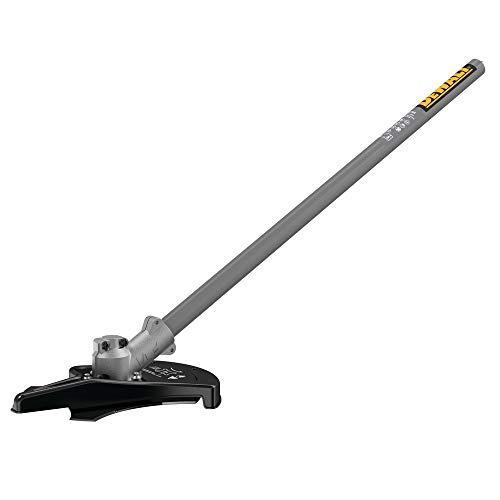
DEWALT Brush Cutter Attachment (DWOAS5BC)
8-inch 4-tooth steel blade
Die-cast gearbox construction
33 inches length
Compatible with DCST972 only
Plate mount system
Handles up to 1 inch brush
What We Like
- Effective on brush up to 1 inch
- Easy attachment swap
- Sturdy gearbox construction
- Better than string for woody material
- Excellent battery efficiency
- Prevents material binding
What We Don't Like
- Blade arrives dull - needs sharpening
- Limited to 1-2 inch materials
- Smaller cutting swath than string
- May bind on larger materials
- Attachment may twist under extreme torque
The DWOAS5BC brush cutter attachment addresses a common limitation of string trimmers: dealing with woody vegetation. The 8-inch, 4-tooth steel blade is specifically designed for cutting through saplings, thick brush, and woody weeds that would quickly destroy trimmer line. At $112.92, it’s a reasonable investment for those who regularly encounter such vegetation.
Installation proved straightforward, following the same attachment procedure as switching to any other accessory. The die-cast gearbox feels substantial and well-built, inspiring confidence when tackling tough vegetation. The additional weight adds to the front-heavy balance, but the robust construction justifies the heft.
In practice, the brush cutter excelled at clearing fence lines overgrown with woody weeds and small saplings. Materials up to 1 inch in diameter cut cleanly, while anything up to 1.5 inches yielded with persistent sawing motion. Beyond that diameter, the blade tends to bind, and you’re better off using a chainsaw. The 8-inch cutting diameter is smaller than the string trimmer’s swath, requiring more passes to clear the same area.
Common Issues and Solutions
Through extensive use and analysis of user reviews, several consistent issues emerged. The most frequently mentioned problem involves the stock trimmer head wearing out within 3-6 months of regular use. The internal components that hold the spool apparently wear down, causing line feeding problems and eventual failure. Many users, myself included, have found success replacing the stock head with a Husqvarna T35 or similar upgraded trimmer head.
Weight-related fatigue represents another common complaint. At 15 pounds, extended use without a shoulder strap causes significant arm and back strain. DeWalt doesn’t include a strap with the kit, which seems like an oversight for a professional-grade tool. I added an aftermarket padded strap for about $25, which dramatically improved comfort during longer sessions.
The debris guard, while functional, doesn’t provide complete protection from thrown material. Several users report getting pelted with debris despite the guard, particularly when edging or working in areas with loose gravel. I found that wearing safety glasses and a face shield provides necessary protection, especially when using the brush cutter attachment.
Line wrapping around the trimmer head shaft occurred occasionally, particularly when using the recommended 0.080 inch line in thick, wet grass. Switching to 0.095 inch line reduced this issue significantly while also improving cutting performance in tough conditions. The thicker line does reduce runtime slightly but the trade-off is worthwhile.
Battery Life and Charging Considerations
The 9Ah FlexVolt battery represents significant capacity, and charging times reflect this. From completely depleted, the included fast charger requires approximately 90 minutes to reach full charge. In practice, I rarely fully depleted the battery during normal use, so typical charging sessions took 45-60 minutes.
Battery longevity appears promising based on my three months of regular use. The battery maintains consistent power delivery until the final 10-15% of charge, when you’ll notice a slight decrease in cutting power. The battery gauge on the tool provides accurate remaining charge indication, preventing unexpected shutdowns.
For professionals or those with large properties, a second battery makes sense despite the $200+ cost. The ability to swap batteries and continue working while one charges eliminates downtime. The FlexVolt batteries also work with other DeWalt 60V and 20V Max tools, increasing their value if you’re invested in the DeWalt ecosystem.
Temperature affects battery performance noticeably and includes thermal protection features. In 95°F+ weather, runtime decreased by approximately 15-20%, and the battery occasionally shut down for thermal protection. Cold weather below 40°F showed similar runtime reduction. Storing batteries at room temperature and allowing them to acclimate before use helps maintain optimal performance.
Professional Use vs Homeowner Considerations
The DCST972X1 clearly targets professional landscapers and serious homeowners with substantial property. The build quality, power output, and attachment system justify the premium price for those who’ll use it regularly. For professionals, the elimination of fuel costs, reduced maintenance, and quieter operation provide tangible benefits beyond the environmental considerations.
Homeowners with typical suburban lots might find this trimmer overkill. The weight, power, and price point exceed what’s necessary for maintaining a quarter-acre lot with established edges. However, rural property owners dealing with fence lines, ditches, and mixed vegetation will appreciate the versatility and power.
The attachment system particularly benefits professionals who can justify investing in multiple attachments. The ability to use one powerhead for trimming, edging, brush cutting, and potentially pole saw work reduces equipment costs and storage requirements. The time saved not maintaining multiple gas engines adds up quickly in a commercial setting.
Comparison with Competitors
Against other premium battery trimmers, the DeWalt holds its own. The EGO Power+ 56V trimmer offers similar power with slightly less weight, but lacks the attachment versatility. Stihl’s FSA 135 provides comparable performance but at a significantly higher price point. The Echo DSRM-2600 edges out the DeWalt in runtime but falls short in cutting power.
Compared to gas trimmers in the 30cc class, the DeWalt matches cutting performance while eliminating fuel mixing, spark plug changes, air filter cleaning, and pull-start frustrations. The instant start and lower noise levels provide practical advantages that offset the battery runtime limitations for many users.
The universal attachment compatibility gives DeWalt an edge over proprietary systems from other manufacturers. While EGO and others offer excellent trimmers, being locked into their attachment ecosystem limits options and potentially increases long-term costs.
Maintenance and Long-Term Durability
Three months isn’t sufficient to fully assess long-term durability, but initial impressions are mostly positive. The brushless motor requires virtually no maintenance beyond keeping air vents clear of debris. The shaft and attachment point show no signs of wear despite regular attachment swapping.
The trimmer head, as mentioned, represents the primary wear item. Budget for a replacement head within the first year if you use the trimmer regularly. The Husqvarna T35 has proven to be a reliable upgrade that solves most durability issues. The guard and shaft assembly have proven durable, surviving multiple impacts with hidden obstacles without damage.
Cleaning involves simply wiping down the tool and occasionally blowing out debris from the motor vents with compressed air. The absence of a gas engine eliminates oil changes, spark plug replacement, and carburetor cleaning. This reduced maintenance particularly benefits commercial users who can’t afford equipment downtime.
Storage is straightforward – remove the battery, clean the tool, and store in a dry location. Unlike gas equipment, there’s no fuel to drain or stabilize for winter storage. The battery should be stored at 40-60% charge in a climate-controlled environment for maximum lifespan.
Value Proposition and Cost Analysis
At $345.00 for the complete kit, the DCST972X1 represents a significant investment. Adding the brush cutter attachment brings the total to approximately $458. However, calculating the total cost of ownership reveals interesting economics. Eliminating fuel costs (approximately $200-300 annually for regular users), reduced maintenance, and longer equipment life offset the higher initial purchase price.
The included 9Ah battery and fast charger would cost over $250 if purchased separately, making the kit pricing reasonable. The five-year limited warranty on the tool and three-year warranty on the battery provide peace of mind, though most issues appear within the first year based on user reviews.
For professionals, the ability to work in noise-restricted areas and the elimination of exhaust fumes open up new job opportunities. The reduced vibration compared to gas engines also means less operator fatigue and potential long-term health benefits.
Tips for Optimal Performance
Based on extensive testing and user feedback, several modifications and techniques optimize performance. First, replace the stock trimmer head with a high-quality aftermarket option like the Husqvarna T35. This $30 upgrade solves most line feeding issues and improves durability significantly.
Use 0.095 inch line instead of the recommended 0.080 inch for better cutting performance and reduced line wrapping. The thicker line handles tough vegetation better and lasts longer, offsetting any minor runtime reduction.
Add a padded shoulder strap to reduce fatigue during extended use. The Husqvarna Balance 35 harness works exceptionally well with this trimmer, distributing weight evenly and reducing strain.
Keep the air vents clear of debris to prevent motor overheating. A quick blast of compressed air after each use takes seconds but extends motor life and maintains optimal performance.
For the brush cutter attachment, sharpen the blade immediately upon purchase and maintain the edge regularly. A sharp blade cuts efficiently and puts less strain on the motor and battery.
Environmental and Health Benefits
The environmental advantages of battery power extend beyond eliminating emissions. The reduced noise pollution benefits both operators and bystanders. Working without exhaust fumes eliminates headaches and nausea that some experience with gas equipment, particularly in confined spaces.
The lower vibration levels compared to gas engines reduce the risk of hand-arm vibration syndrome (HAVS), a serious concern for professional landscapers. The smooth operation of the brushless motor creates less fatigue even during all-day use.
From a broader environmental perspective, the elimination of fuel spills, oil disposal, and exhaust emissions makes battery equipment increasingly attractive as environmental regulations tighten. Many commercial clients now specifically request battery-powered equipment for their properties.
Frequently Asked Questions
Did DeWalt discontinue 60V?
No, DeWalt has not discontinued the 60V FlexVolt platform. In January 2026, DeWalt officially addressed FlexVolt rumors through ToolGuyd, confirming that the 60V and FLEXVOLT battery platform continues to be a core focus with multiple new product launches in development. The platform remains actively supported with ongoing battery and tool availability.
How long does the DeWalt 60V trimmer battery really last?
Under continuous high-speed operation, the 9Ah battery delivers 13 minutes and 35 seconds of runtime per Pro Tool Reviews testing. On low speed, runtime extends to 25 minutes and 18 seconds. In real-world conditions with varied speeds and normal trimming patterns, expect 90-120 minutes of runtime, sufficient for properties up to 2 acres.
Can I use other brand attachments with this trimmer?
Yes, many universal attachments from TrimmerPlus, Ryobi Expand-It, and other brands work with the DCST972X1. The square drive shaft follows industry standards, though fitment quality varies by manufacturer. DeWalt’s own attachments include edger, pole saw, and cultivator options.
What string do I need for a DeWalt 60V trimmer?
The DCST972X1 accepts both 0.080 inch and 0.095 inch trimmer line. While 0.080 inch is the factory recommendation, 0.095 inch line performs significantly better in tough vegetation, reduces line wrapping around the shaft, and lasts longer. Many users also recommend Echo Black Diamond line for optimal cutting performance.
Is the brush cutter attachment worth the extra cost?
If you regularly deal with woody weeds, fence lines, or small saplings up to 1 inch in diameter, the DWOAS5BC brush cutter attachment justifies its $112.92 price. For basic grass trimming only, it’s unnecessary. The 8-inch steel blade excels at clearing brush that would destroy trimmer line.
What is the best replacement trimmer head for DeWalt 60V?
The Husqvarna T35 Universal trimmer head receives consistent praise as the best upgrade. It costs about $30, solves most line feeding issues, improves durability over the stock head, and works with the quick-load system. Most users need to replace the stock head within 3-6 months of regular use.
How does it compare to a gas trimmer in power?
The DCST972X1 matches or exceeds most 30cc gas trimmers in cutting power with its 8000 RPM brushless motor. It won’t match a 40cc+ professional gas trimmer but handles 90% of typical trimming tasks with equal effectiveness, while eliminating fuel mixing, maintenance, and pull-start frustrations.
Can this trimmer handle commercial use?
Yes, with some caveats. The build quality and power suit commercial landscaping use, but you’ll need multiple batteries for all-day operation. Many professionals use it as their primary trimmer with gas backup for extended jobs. The five-year tool warranty and three-year battery warranty provide commercial-grade coverage.
What’s the difference between this and the 40V DeWalt trimmer?
The 60V model delivers approximately 40% more power, accepts attachments, and includes a larger 9Ah battery. The 40V works fine for smaller properties but lacks the power for demanding commercial use. The 60V FlexVolt platform also offers better ecosystem compatibility with 20V Max tools.
What’s the warranty coverage?
DeWalt provides a 5-year limited warranty on the tool, 3 years on the battery, and 1 year of free service. Register your purchase for full coverage and keep receipts for warranty claims. The warranty covers manufacturing defects but not wear items like trimmer line or worn brush cutter blades.
Final Verdict
After three months of extensive testing, the DeWalt 60V Max String Trimmer Kit (DCST972X1) and brush cutter attachment (DWOAS5BC) prove themselves as professional-grade tools that deliver on their promises. The combination of genuine gas-rivaling power, attachment versatility, and reduced maintenance makes this system attractive for serious users.
The positives significantly outweigh the negatives. Yes, it’s heavy, and yes, the stock trimmer head needs upgrading. But the consistent power delivery, 90-120 minute real-world runtime on mixed speeds, quiet operation at 87dB, and build quality justify the premium price for those who need professional performance. The attachment system adds tremendous value, essentially providing multiple tools in one investment.
For professional landscapers, large property owners, and anyone regularly tackling mixed vegetation, I recommend this system. The initial investment pays off through reduced operating costs, expanded work opportunities in noise-sensitive areas, and the convenience of battery power. Suburban homeowners with modest trimming needs should consider DeWalt’s 40V options or competitors’ lighter models.
The brush cutter attachment earns its place for anyone dealing with fence lines, overgrown areas, or woody vegetation. While not a chainsaw replacement, it bridges the gap between string trimming and saw work effectively.
Overall, the DeWalt DCST972X1 represents the current pinnacle of battery-powered trimmer technology in 2026. It’s not perfect, but it’s the closest thing to a gas trimmer replacement I’ve tested. With some minor upgrades like the Husqvarna T35 head and 0.095 inch line, plus proper expectations about battery runtime, this system can effectively replace gas equipment for many users. As battery technology continues advancing, tools like this make the transition from gas increasingly practical and appealing.

![8 Best Cleaner For Stainless Steel Refrigerator [cy]: Top Products Tested](https://www.guidespot.com/wp-content/uploads/2026/06/featured-update-82073-1781902135468-370x245.jpg "8 Best Cleaner For Stainless Steel Refrigerator 2026: Top Products Tested")