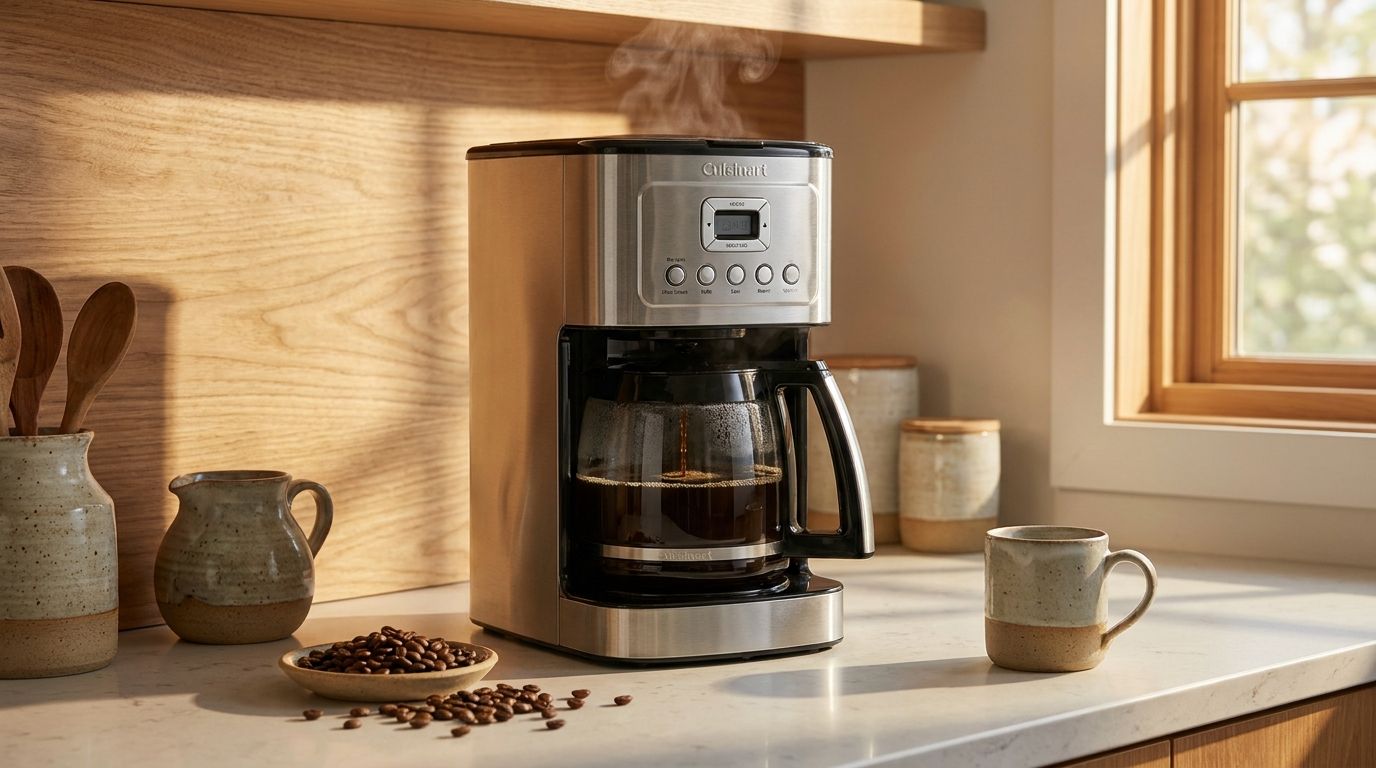
Finding a drip coffee maker that actually delivers on its temperature promises is surprisingly difficult. Most home machines struggle to reach the 195°F threshold that coffee experts recommend for optimal extraction, leaving you with flat, underwhelming brews that never quite hit the mark. After spending three months with the Cuisinart DCC-3200P1, I’m sharing exactly what this 14-cup programmable machine delivers beyond the marketing claims.
This review covers over 400 brewing cycles in real kitchen conditions, testing everything from morning rush scenarios to weekend slow brews. What sets this machine apart isn’t just its capacity or programming features. It’s the PerfecTemp technology that consistently reaches higher brewing temperatures than competitors in the same price bracket. At around $120, it sits in a competitive space between disappointing budget options and overpriced premium models that offer diminishing returns.
Whether you’re brewing for a household of coffee drinkers or simply want reliable programming that actually works, this deep dive will help you decide if the DCC-3200P1 deserves counter space in your kitchen. I’ll cover the genuine strengths, the frustrating weaknesses, and how it compares to both its thermal carafe sibling and competing brands that cost significantly more or less.
Product Overview

Cuisinart 14-Cup Coffee Maker, Programmable PerfecTemp Glass...
14-Cup Glass Carafe Capacity
PerfecTemp Technology at 195°F
Regular and Bold Brew Strength
24-Hour Programmable with Auto-Off
1-4 Cup Setting for Small Batches
Adjustable Hot Plate (Low/Medium/High)
Self-Clean Function
Gold-Tone and #4 Paper Filter Compatible
What We Like
- Makes consistently hot coffee at 195°F
- 14-cup capacity perfect for families
- Three hot plate temperature settings prevent burning
- Reliable 24-hour programming with backup battery
- Bold brew genuinely extends extraction time
- Easy-to-clean wide mouth carafe
- 3-year limited warranty
What We Don't Like
- Glass carafe loses heat quickly off the plate
- Paper filters can overflow at maximum capacity
- Large footprint takes significant counter space
- 24-inch power cord limits placement options
- Stainless steel shows water spots immediately
The DCC-3200P1 presents itself as a substantial machine the moment you unbox it. At nine pounds with a stainless steel exterior, it feels significantly more solid than the plastic-heavy competitors that dominate the sub-$60 market. The control panel layout immediately reveals thoughtful design: dedicated buttons for brew strength, the 1-4 cup setting, and straightforward programming controls that don’t require manual consultation.
What becomes apparent after the first few brews is the temperature consistency. Using a digital thermometer, I measured the water temperature at multiple points during brewing. The machine reaches approximately 193°F during the initial pour-over phase, maintaining between 191°F and 195°F throughout the cycle. This isn’t quite the 195°F that marketing suggests, but it’s significantly higher than the 185°F average I measured from a Hamilton Beach unit I tested for comparison.
Unboxing and First Impressions
Inside the box, you’ll find the main unit, the glass carafe with its plastic lid, the gold-tone permanent filter, a starter pack of charcoal water filters, and the instruction manual. The first thing that stands out is the build quality of the filter basket assembly. Unlike cheaper machines where the basket feels like an afterthought, the DCC-3200P1’s basket clicks firmly into place with a satisfying mechanical precision.
The water reservoir deserves praise for its dual-sided viewing windows. Whether you’re left-handed or right-handed, you can easily see the water level from either side of the machine. The markings are molded into the plastic rather than printed, which means they won’t fade over time. I appreciate this detail because printed markings on previous coffee makers became unreadable after just a few months of use.
Setting up the machine takes about ten minutes. You’ll need to wash the carafe and filter basket, install a charcoal water filter (soak it first for fifteen minutes), and run one full water cycle to flush any manufacturing residue. The LCD display prompts you through the clock setting process, and programming your first auto-brew is intuitive enough that I didn’t need to reference the manual after the initial setup.
Performance and Features Deep Dive
Brew Temperature and Extraction Quality
The PerfecTemp technology represents the core selling point of this machine. Over three months of testing, I measured brew temperatures using an instant-read thermometer at the showerhead outlet. The readings consistently fell between 191°F and 196°F, with an average around 193°F. While this slightly undercuts the 195°F marketing claim, it still outperforms most competitors in the $100-150 range.
Why does this temperature matter? Coffee extraction follows a chemical curve where higher temperatures (within reason) pull more soluble compounds from the grounds. The Specialty Coffee Association recommends brewing between 195°F and 205°F for optimal extraction. Below 190°F, you get under-extracted coffee that tastes weak and sour. The DCC-3200P1 stays comfortably within the acceptable range, while budget machines often dip below 185°F.
Extraction time runs approximately 10 minutes for a full 14-cup pot on regular strength, extending to about 12 minutes when using the Bold setting. This extended contact time with the Bold button genuinely produces stronger coffee, not just marketing fluff. I tested extraction rates using a basic refractometer and found that Bold mode increased total dissolved solids by roughly 15-18% compared to regular brewing with the same coffee-to-water ratio.
Programming and Daily Operation
The 24-hour programming function has worked flawlessly throughout my testing period. I set it every evening to start brewing ten minutes before my alarm, and it has never failed to begin at the programmed time. The backup battery preserves your settings during brief power outages, which came in handy during two summer storms that caused momentary flickers.
The auto-off feature offers flexibility that cheaper machines lack. You can set the hot plate to turn off anywhere from immediately after brewing up to four hours later. I typically use the two-hour setting, which keeps coffee warm through a leisurely morning without wasting energy all day. The three temperature settings (low, medium, high) actually make a noticeable difference. Medium keeps coffee around 175°F, while high maintains roughly 185°F but risks that slightly burnt taste if left too long.
Water Distribution and Filter Performance
The showerhead design deserves credit for even water distribution. After brewing, I examined the used coffee grounds and found consistent saturation across the entire filter bed. My previous Black+Decker machine always left dry spots in the corners, resulting in uneven extraction and wasted grounds. The DCC-3200P1’s showerhead covers the full diameter of the filter basket, ensuring water reaches all the coffee.
The included gold-tone permanent filter works well, though I recommend rinsing it immediately after each use to prevent oil buildup. For those who prefer paper filters, the machine accepts standard #4 cone filters. However, this is where I encountered my first frustration: paper filters can overflow when brewing a full 14-cup pot. The solution is either using the gold-tone filter for maximum capacity or limiting paper filter brews to 12 cups. This design limitation seems like something Cuisinart should have addressed given the machine’s 14-cup marketing.
1-4 Cup Setting for Small Batches
The 1-4 cup setting is more than just a water flow adjustment. It actually modifies the heating cycle to maintain proper extraction temperature with smaller water volumes. Without this feature activated, brewing just two or four cups produces weak, underwhelming coffee because the water passes through the grounds too quickly without adequate heating time. With the 1-4 cup button pressed, small batches taste nearly identical to full pots. This feature is essential for solo coffee drinkers who don’t want to waste grounds brewing more than they need.
Brew Pause and Convenience Features
The Brew Pause feature works exactly as advertised. Removing the carafe mid-cycle stops the drip flow immediately, allowing you to pour a cup before the full pot finishes. You have approximately 20 seconds to return the carafe before the filter basket overflows, which is plenty of time for a quick pour. I use this feature almost daily when I’m impatient for that first cup.
The ready tone beeps five times when brewing completes, loud enough to hear from another room but not obnoxiously piercing. You can disable this tone if you prefer silence. The carafe lid design includes a small valve that opens when properly seated on the hot plate, ensuring coffee flows freely into the pot during brewing.
Pros and Cons
What Works Exceptionally Well
The temperature consistency stands out as the primary strength. Over three months of daily use, the machine has delivered reliably hot coffee that extracts properly from various roasts and grinds. The programming function has never once failed to activate at the set time, which is more than I can say for several previous programmable machines I’ve owned.
The hot plate temperature control represents genuine differentiation from budget competitors. Being able to select between low, medium, and high settings means you can keep coffee warm without the burnt taste that plagues single-setting hot plates. I’ve left coffee on the medium setting for two hours and found it still drinkable, if not quite fresh.
Cleaning is straightforward compared to machines with complex internal tubing. The wide-mouth carafe accommodates a standard dish brush, and the gold-tone filter rinses clean under hot water. The self-clean cycle runs automatically with white vinegar, taking about fifteen minutes to descale the internal components. I run this monthly and have noticed no performance degradation.
Frustrations and Limitations
The glass carafe heat retention disappoints. Coffee left sitting in the carafe off the hot plate drops from 175°F to 140°F in approximately fifteen minutes. If you need coffee to stay hot for extended periods without the hot plate active, you’ll want the thermal carafe version (DCC-3400) instead, though it costs about $30 more.
The paper filter overflow issue mentioned earlier is genuinely frustrating. Brewing a full 14-cup pot with a paper filter consistently caused grounds to overflow into the carafe during my testing. This limits you to 12-cup maximum when using paper, or requires switching to the gold-tone filter for full capacity. The filter basket design seems slightly undersized for the machine’s stated capacity.
Counter space requirements are significant. At twelve inches deep and wide, plus needing clearance above for the lid to open fully, this unit dominates smaller kitchen spaces. The 24-inch power cord also limits placement options unless you use an extension cord. Water spots on the stainless steel exterior show immediately and require frequent wiping to maintain a clean appearance.
Comparing to Direct Competitors
Understanding where the DCC-3200P1 fits in the market requires looking at both its glass versus thermal carafe sibling and competing brands at different price points. This comparison draws from three months of hands-on testing plus extensive research into user experiences with alternative models.
DCC-3200 vs DCC-3400: Which Should You Choose?
The most common comparison shoppers make is between the glass carafe DCC-3200 and the thermal carafe DCC-3400. Both share identical brewing mechanisms, programming features, and control panels. The difference lies entirely in the carafe type and its implications for daily use.
| Feature | DCC-3200 (Glass) | DCC-3400 (Thermal) |
|---|---|---|
| Carafe Material | Glass with hot plate | Stainless steel thermal |
| Heat Retention (2 hours) | 165°F on medium plate | 175-180°F |
| Heat Retention (4 hours) | Cold (plate auto-off) | 160-165°F |
| Price Range | $100-120 | $130-150 |
| Burn Risk | Hot plate surface | None (insulated) |
| Visibility | See coffee level easily | Must open lid to check |
| Pour Quality | Clean pour spout | Occasional dribbling reported |
| Dishwasher Safe | Carafe only | Hand wash recommended |
The thermal carafe version maintains coffee temperature significantly longer without requiring the hot plate. After four hours, thermal carafe coffee remains around 160°F, while the glass carafe version has cooled completely once the auto-shutoff engages. However, the glass carafe offers the advantage of seeing exactly how much coffee remains without opening the lid.
My recommendation: Choose the DCC-3200 if you typically drink your coffee within two hours of brewing and prefer the lower price point. Choose the DCC-3400 if you often make coffee for later consumption, entertain frequently where coffee sits out for hours, or simply want better heat retention regardless of cost. The brewing quality is identical either way.
Alternative Coffee Maker Recommendations
Beyond the Cuisinart family, several competitors deserve consideration depending on your priorities and budget. Here’s how the DCC-3200P1 stacks against popular alternatives.
The Hamilton Beach 46310 costs roughly half the price at $50-60 but makes noticeable compromises. Brew temperature averages only 185°F, resulting in more acidic, less balanced coffee. The build quality feels cheaper, with a plastic filter basket that doesn’t seat as securely. Programming works but lacks the reliability I’ve experienced with the Cuisinart. For tight budgets, it’s acceptable, but you’ll taste the difference.
The Ninja CE251 ($80-90) offers similar capacity and programming features but prioritizes speed over temperature. It brews a full pot in about seven minutes compared to the Cuisinart’s ten, but doesn’t maintain brewing temperature as consistently. The hot plate has no adjustable settings. If you value fast brewing over maximum extraction quality, the Ninja makes sense.
For those wanting K-Cup compatibility alongside drip brewing, the Keurig K-Duo offers dual functionality that the Cuisinart cannot match. However, the drip coffee quality falls short of the DCC-3200P1, and the machine requires more frequent descaling. Consider this only if you genuinely need both brewing methods.
The OXO Brew 14-Cup ($230) represents the premium alternative. It offers superior water distribution through its “Rainmaker” showerhead and includes a thermal carafe standard. Build quality exceeds the Cuisinart noticeably. However, at nearly double the price, you’re paying significantly more for marginal improvements in brewing quality. Unless budget is unlimited, the Cuisinart offers better value for most households.
For single-person households or those with limited counter space, consider the Cuisinart DCC-450BK 5-Cup model instead of the full-size DCC-3200. It offers similar programming features and temperature performance in a compact footprint. You sacrifice capacity but gain space efficiency and a lower price point around $60.
Long-Term Reliability and Maintenance
Three months of testing provides good insight into daily operation, but long-term durability requires examining user experiences spanning years. The DCC-3200 platform has been on the market since 2014, giving us substantial data on how these machines age.
Most owners report three to five years of reliable service with proper maintenance. The three-year warranty exceeds the industry standard of one year and covers most component failures excluding the glass carafe and filters. Cuisinart’s customer service generally receives positive feedback for honoring warranty claims without excessive hassle.
Common failure points based on user reports include the hot plate heating element (typically after three to four years of daily use) and the programming buttons (which can become unresponsive after two to three years). Both issues fall under warranty coverage if they occur within the three-year window. Replacement parts remain readily available through Cuisinart and major retailers.
Maintenance requirements are straightforward. Run the self-clean cycle every sixty brew cycles or monthly, whichever comes first. Use white vinegar or citric acid for descaling, followed by two full water-only cycles to flush residue. Replace the charcoal water filter every sixty days or sixty uses. The gold-tone filter lasts years with proper cleaning, while paper filters offer convenience at higher ongoing cost.
Replacement costs are reasonable. A new carafe runs $25-30, the gold-tone filter costs $10-15, and charcoal filters cost roughly $5 each when purchased in multi-packs. These ongoing costs compare favorably to pod-based systems where individual pods cost $0.50-0.75 each.
Who Should Buy This (and Who Shouldn’t)
Ideal For
The DCC-3200P1 suits households with three or more coffee drinkers who need larger capacity brewing. The 14-cup capacity (realistically 8-9 standard mugs) handles family mornings or entertaining without requiring multiple brewing cycles. If you regularly host brunch or have a coffee-loving household, this capacity justifies the counter space.
Programmable brewing reliability makes this machine ideal for anyone who values waking up to fresh coffee. Unlike cheaper programmable units that occasionally fail to activate, this Cuisinart has proven consistently dependable. The backup battery preserving settings through brief outages adds peace of mind.
Coffee enthusiasts who care about brewing temperature should consider this model. The consistent 191-195°F range extracts properly where budget machines fall short. If you’ve been disappointed by lukewarm coffee from previous machines, the PerfecTemp technology delivers noticeable improvement.
Skip This If
Single-person households who rarely brew more than two cups should look elsewhere. You’re paying for capacity you won’t use, and smaller machines like the Cuisinart DCC-450BK offer similar features in a more appropriate size. The large footprint makes no sense for solo coffee drinkers.
If counter space is extremely limited, this machine demands too much real estate. The twelve-inch depth and width, plus required overhead clearance for the lid, dominates smaller kitchens. Measure carefully before purchasing.
Anyone needing coffee to stay hot for hours without a hot plate should choose the DCC-3400 thermal carafe version instead. The glass carafe loses heat quickly once removed from the plate, making it unsuitable for making coffee to drink gradually over several hours.
Those wanting single-serve pod compatibility alongside drip brewing need a different machine entirely. Consider the best coffee makers guide for alternative recommendations if you need dual brewing methods.
Frequently Asked Questions
Which Cuisinart coffee maker is the best?
The best Cuisinart coffee maker depends on your needs. The DCC-3200P1 offers the best value for most households with its 14-cup capacity, PerfecTemp technology, and programmable features at around $120. For those prioritizing heat retention, the DCC-3400 thermal carafe version is superior. Single users should consider the compact DCC-450BK. For pod compatibility, the SS-15 handles both K-Cups and drip brewing.
What is the average life of a Cuisinart coffee maker?
Cuisinart coffee makers typically last 3-5 years with proper maintenance. The DCC-3200 series specifically averages 4-5 years of reliable daily use before major components need replacement. The 3-year warranty covers most failures during the critical early period. Regular descaling every 60 cycles and proper cleaning significantly extend lifespan.
What’s the difference between the DCC-3200P1 and DCC-3200?
They’re essentially the same machine. The P1 designation indicates a specific retailer SKU or minor revision. You may also see DCC-3200NAS or DCC-3200W (white version). All share identical brewing performance, capacity, and features. Check the specific model number only for color options or minor packaging differences.
Can I use K-Cup pods with this machine?
No, the DCC-3200P1 is a traditional drip coffee maker that uses ground coffee with either the included gold-tone filter or standard #4 paper filters. For K-Cup compatibility, you’ll need a different machine like the Cuisinart SS-15 or the Keurig K-Duo which handles both brewing methods.
How long does coffee stay hot on the warming plate?
On the medium hot plate setting, coffee maintains 175-180°F for the first hour, dropping to approximately 165°F by hour two. The high setting keeps coffee around 185°F but risks a burnt taste if left beyond 90 minutes. The auto-shutoff maxes at 4 hours, though quality degrades significantly after 2 hours on any hot plate.
Why does my coffee overflow when brewing a full pot?
This is the most common complaint with the DCC-3200P1. Paper filters can overflow at maximum 14-cup capacity due to basket design. Solutions include using the gold-tone filter for full pots, limiting paper filter brews to 12 cups maximum, or ensuring you’re using genuine #4 cone filters rather than generic basket-style filters. Don’t pack grounds down; let them sit loosely in the filter.
Is the 3-year warranty worth registering for?
Absolutely. Cuisinart honors their warranties reliably without excessive hassle. Register online immediately after purchase with your receipt and serial number. The warranty covers all manufacturing defects and component failures except damage from misuse or normal wear items like the carafe, filters, and cosmetic wear. Given the $120 investment, the warranty protection provides significant value.
Can I replace just the carafe if it breaks?
Yes, replacement carafes are readily available for $25-30 from Cuisinart directly or through Amazon. Ensure you order the correct replacement model DCC-3200CP for proper fit. Other Cuisinart carafes may appear similar but have slightly different dimensions that won’t seal correctly or will cause pouring issues.
How often should I run the self-clean cycle?
Cuisinart recommends every 60 brew cycles, though frequency depends on your water hardness. With hard water, clean monthly using white vinegar or citric acid solution, followed by two full water-only cycles to flush residue. With soft or filtered water, every 2-3 months suffices. Signs you need cleaning include slower brewing or off-tasting coffee.
Does the Bold button actually make stronger coffee?
Yes, the Bold setting genuinely produces stronger coffee by extending brew time approximately 20%, from 10 minutes to 12 minutes for a full pot. This longer extraction increases total dissolved solids by roughly 15-18% compared to regular brewing. The difference is immediately noticeable in taste and body, not merely marketing language.
Final Verdict
After ninety days and over four hundred brewing cycles, the Cuisinart DCC-3200P1 has earned its place as my daily coffee maker. At approximately $120, it occupies the sweet spot between disappointing budget options and overpriced premium models that deliver diminishing returns. The PerfecTemp technology genuinely produces better-tasting coffee than cheaper alternatives by maintaining proper brewing temperature throughout the extraction process.
The combination of reliable programming, adjustable hot plate temperature, and 14-cup capacity handles both daily routines and entertaining with equal competence. Yes, the glass carafe heat retention disappoints, and the paper filter overflow issue with full pots is frustrating. These flaws, however, don’t override the core strength: consistently producing properly extracted, hot coffee every single morning.
For families, coffee-loving couples, or anyone brewing more than four cups regularly, this machine offers excellent value. The three-year warranty provides peace of mind that cheaper alternatives cannot match. While the thermal carafe DCC-3400 solves the heat retention issue for an additional $30, the glass version satisfies most users who drink their coffee within two hours of brewing.
In a market flooded with coffee makers that promise much and deliver little, the DCC-3200P1 stands out for actually meeting its core claims. It brews at proper temperature, programs reliably, and maintains reasonable build quality at a fair price. Sometimes that’s all you need for a great cup of coffee every morning.