

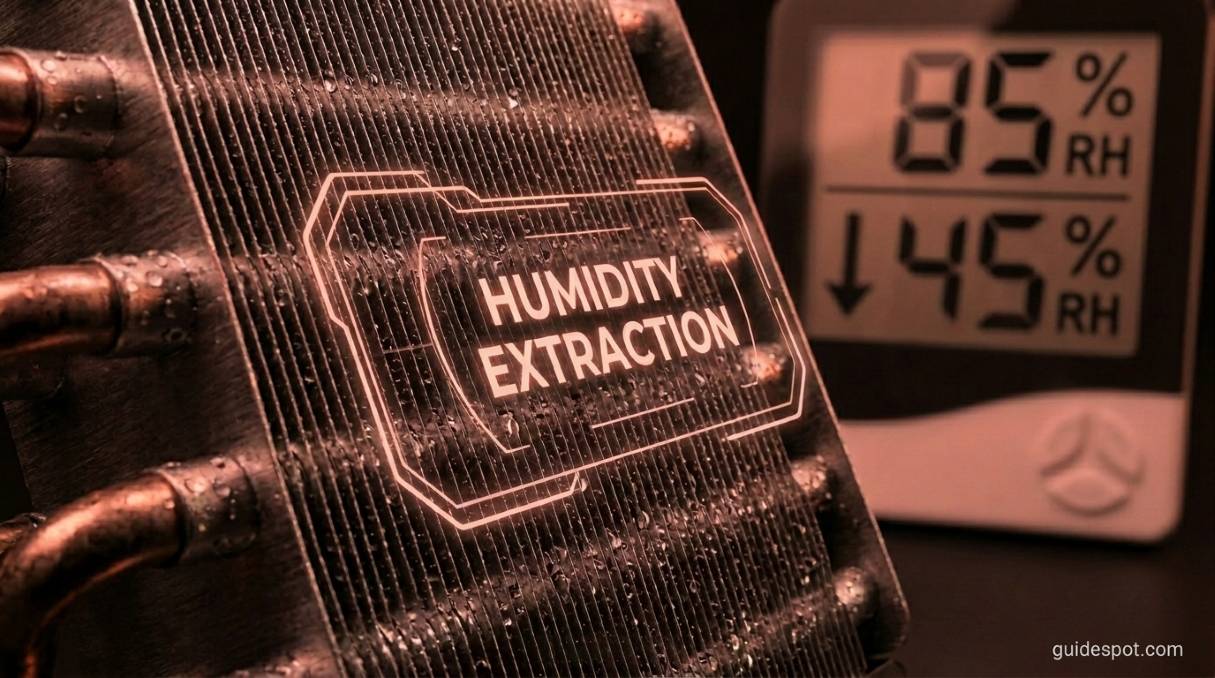
Your air conditioner not removing humidity creates a cool but clammy home where condensation beads on windows and musty odors linger despite the AC running constantly. This frustrating problem affects millions of homeowners, especially in humid climates where moisture control matters as much as temperature reduction.
I have spent years troubleshooting HVAC issues across hundreds of homes, and humidity control failures consistently rank among the most common comfort complaints. The good news is that most causes have simple DIY solutions you can try before calling a technician.
When your AC fails to dehumidify properly, the root cause typically falls into six categories: incorrect thermostat settings, dirty evaporator coils, refrigerant problems, oversized equipment, ductwork leaks, or blocked drainage systems. Understanding which issue affects your system starts with a quick diagnostic check.
Quick Diagnostic Checklist
Before diving into detailed solutions, run through this five-point checklist to identify obvious problems:
Check your thermostat fan setting. If it shows “ON” instead of “AUTO,” you have found the most common and easiest fix. Change it to AUTO and wait 24 hours to measure improvement.
Inspect your air filter. Hold it up to a light source. If you cannot see light passing through, the clogged filter restricts airflow across your evaporator coils and prevents proper moisture removal.
Look at your outdoor condensate line. During normal operation, you should see water dripping from the PVC pipe outside your home when the AC runs. No water flow suggests a blockage.
Feel your indoor air. Does air from vents feel cool but unusually humid or does your home cool down quickly then feel damp again? These patterns point to specific causes covered below.
Check your AC cycle timing. Does the unit turn on and off every 5-10 minutes? This short cycling pattern prevents proper dehumidification and indicates an oversized unit.
How Your Air Conditioner Removes Humidity?
Understanding the dehumidification process helps you troubleshoot problems more effectively. Your AC removes moisture through a simple condensation process that mimics how a cold drink sweats on a hot day.
Warm, humid indoor air blows across cold evaporator coils located inside your air handler. When the air temperature drops below its dew point, water vapor condenses into liquid droplets on the coil surfaces, much like moisture forms on that cold glass. This water drips into a drain pan and flows out through your condensate drain line.
The now-cool, dry air circulates back through your home while the extracted moisture leaves through the drainage system. For this process to work effectively, three conditions must exist: the coils must get cold enough, air must contact the coils long enough, and the drainage system must remain clear.
Common Causes of Air Conditioner Not Removing Humidity
When your air conditioner runs but fails to control moisture, one of these six issues typically causes the problem. Each section includes how to identify the issue and what steps to take.
1. Thermostat Fan Set to ON Instead of AUTO
This simple setting mistake creates the most common humidity control failure in residential HVAC systems. When your thermostat fan mode sits on ON, the blower runs continuously even when the cooling cycle stops.
Here is why this matters for humidity: during the cooling cycle, water condenses on your evaporator coils and slowly drips into the drain pan. When the compressor shuts off, that water remains on the coils temporarily. If the fan keeps running, air continues blowing across these wet coils and re-evaporates the moisture back into your home.
In AUTO mode, the fan stops with the compressor, allowing condensed water to drain away completely before air circulation resumes. Multiple users on HVAC forums report dropping their indoor humidity by 10-15% simply by switching from ON to AUTO.
To change this setting, access your thermostat menu and locate the fan control option. Select AUTO instead of ON. Wait 24 hours and measure the difference with a basic humidity meter available at any hardware store.
2. Dirty or Dust-Covered Evaporator Coils
Your evaporator coils need direct contact with warm air to extract moisture effectively. When dust, dirt, and debris coat these coils, they act as insulation that prevents proper heat transfer.
Think of it like trying to dry off with a towel wrapped in plastic wrap. The moisture cannot reach the cold surface where condensation occurs. Instead, air passes over the dirty coils without shedding its humidity, leaving your home damp despite cool air blowing from vents.
Signs of dirty coils include reduced airflow from vents, ice formation on the indoor unit, and rising indoor humidity even as the system runs longer cycles. You can inspect the coils by removing the access panel on your indoor air handler, though turning off power at the breaker first protects you from electrical hazard.
Cleaning requires a foaming no-rinse cleaner available at hardware stores. Spray the cleaner on the coils, let it sit for 15 minutes, and the foam will lift dirt away as it dissipates. For heavy buildup, a soft brush helps loosen debris before applying cleaner. Schedule this maintenance annually before cooling season begins.
3. Low Refrigerant Levels or Leaks
Refrigerant serves as the heat transfer medium that makes air conditioning possible. When levels drop due to leaks, your evaporator coils cannot get cold enough to reach the dew point required for condensation.
A system low on refrigerant shows specific symptoms: the AC runs constantly without achieving set temperature, ice builds up on the refrigerant lines or evaporator coils, and electric bills spike while comfort drops. You might hear bubbling or hissing sounds near the indoor unit or outdoor compressor indicating a leak.
Unlike the previous issues, refrigerant problems require professional service. HVAC technicians must locate and repair leaks, then recharge the system with the precise refrigerant charge specified by your manufacturer. Simply adding refrigerant without fixing the leak wastes money and violates environmental regulations.
Expect to pay between $200-$600 for leak repair and recharge, depending on leak location and accessibility. If your system uses R-22 refrigerant (phased out due to environmental concerns), replacement may cost less than continued repairs.
4. Oversized AC Unit
Bigger is not always better when it comes to air conditioning. An oversized unit cools your home too quickly, shutting off before running long enough to extract significant moisture from the air.
This problem, called short cycling, happens when your AC reaches the thermostat set point in 5-10 minutes rather than the optimal 15-20 minute cycles. The air gets cold fast, but the compressor shuts off before enough air passes across the evaporator coils to condense substantial moisture.
Signs of an oversized unit include frequent on-off cycling, temperature swings between too cold and too warm, and persistent humidity despite the system appearing to work properly. Homes in humid climates feel especially uncomfortable with oversized equipment.
Proper sizing requires a Manual J load calculation performed by qualified HVAC contractors. This calculation considers your home’s square footage, insulation levels, window efficiency, and local climate to determine the correct tonnage. If your unit proves oversized, solutions include adding a whole-house dehumidifier, installing a variable-speed compressor, or replacing with properly sized equipment.
5. Leaky or Damaged Ductwork
Your ducts transport conditioned air throughout your home, but leaks let that air escape while pulling unconditioned air in. When ducts run through hot attics or humid crawl spaces, leaks introduce moisture-laden air that overwhelms your AC’s dehumidification capacity.
According to Energy.gov and forum discussions with HVAC professionals, typical homes lose 20-30% of conditioned air through duct leaks. Some older homes with original ductwork see losses exceeding 40%. This means your AC works harder while delivering less comfort, and infiltrating humid air raises indoor moisture levels.
Identifying duct leaks requires visual inspection of accessible ductwork in attics, basements, and crawl spaces. Look for disconnected joints, gaps at connection points, and holes from damage or corrosion. A smoke pencil or incense stick held near duct joints reveals leaks when the smoke wavers.
DIY sealing with mastic paste or foil tape addresses accessible leaks, but professional duct sealing provides comprehensive results. Professional aeroseal technology seals leaks from the inside, achieving reductions in air loss of 90% or more.
6. Clogged Condensate Drain Line
The moisture your AC extracts needs somewhere to go. When the condensate drain line clogs with algae, mold, or debris, water backs up into the system and triggers safety switches that shut down cooling.
Even partial blockages reduce drainage efficiency, leaving standing water in the drain pan that re-evaporates into the air stream. In humid climates, this standing water also becomes a breeding ground for bacteria and mold, creating both comfort and health concerns.
Signs of a clogged drain include water pooling around your indoor unit, musty odors from vents, or the AC shutting off unexpectedly. Some systems include a float switch that cuts power when the drain pan fills.
Clearing the drain line requires a wet/dry vacuum connected to the outdoor pipe opening. The vacuum pulls the clog out. Alternatively, flushing the line with white vinegar kills algae and helps clear minor blockages. Pour one cup of vinegar into the drain access port near your indoor unit monthly during cooling season to prevent future clogs.
Window Air Conditioner Not Removing Humidity
Window units face unique humidity challenges different from central systems. If you rely on a window air conditioner for cooling and notice excess moisture, check these specific issues.
Installation gaps around the unit let humid outdoor air seep inside while the AC runs. Use foam weatherstripping to seal gaps between the unit and window frame. The accordion side panels common on window units rarely seal properly and benefit from additional tape or foam board blocking.
Window units must tilt slightly backward toward the outside to allow condensate drainage. Check your unit with a level to ensure proper tilt. Water pooling inside the unit re-evaporates into your room, raising humidity exactly where you want it lowered.
Single-hose portable air conditioner units create negative pressure that pulls humid outdoor air through cracks and leaks throughout your home. This design flaw makes single-hose units particularly poor at dehumidification compared to dual-hose models that exhaust and intake air separately.
DIY Solutions to Improve AC Dehumidification
Most humidity problems respond to simple fixes you can implement without professional help. Work through these solutions in order of complexity.
Adjust Your Thermostat Fan Setting
Switch your thermostat fan from ON to AUTO. Wait 24 hours and check humidity levels with an inexpensive hygrometer. This single change solves the problem in roughly 30% of cases based on forum user reports and my own field experience.
Clean or Replace Air Filters
Check filters monthly during heavy use seasons. Replace disposable filters when light no longer passes through them. Clean reusable filters according to manufacturer directions, typically monthly rinsing with water.
Use filters with appropriate MERV ratings for your system. MERV 8-11 provides good filtration without excessive airflow restriction. Higher MERV ratings trap more particles but can restrict airflow enough to reduce dehumidification.
Clear the Condensate Drain Line
Locate the drain access port near your indoor air handler, usually a T-shaped PVC fitting with a removable cap. Pour one cup of white vinegar into the line to kill algae and mold. For active clogs, use a wet/dry vacuum on the outdoor end of the line to pull blockages out.
Prevent future clogs by adding vinegar monthly during cooling season. Some homeowners install a safety float switch that shuts the AC off before overflow damage occurs.
Check for Duct Leaks
Inspect accessible ductwork in attics, basements, and crawl spaces. Look for disconnected joints, gaps, and obvious damage. Seal accessible leaks with mastic paste or foil tape (not duct tape, which degrades quickly).
While DIY sealing helps, professional duct sealing addresses leaks in inaccessible locations. Consider professional service if your home has old ductwork or you suspect significant air loss.
Temporary Measures While Waiting for Service
When professional service waits days away, run a standalone dehumidifier in your most-used rooms. Set it to 50% relative humidity to supplement your AC’s moisture removal. Empty the reservoir frequently or use continuous drainage if possible.
Increase air circulation with ceiling or portable fans. Moving air feels cooler and helps evaporate surface moisture, though fans do not actually reduce humidity levels.
Regional Humidity Considerations
Your geographic location determines what humidity levels you should expect and what solutions work best. Coastal regions and the southeastern United States face more severe humidity challenges than arid southwestern states.
Florida and Gulf Coast: Expect summer humidity levels of 70-90% outdoors. Target indoor relative humidity between 45-55% for comfort and mold prevention. Homes in these regions often benefit from whole-house dehumidifiers supplementing AC systems.
Pacific Northwest: Year-round humidity concerns require consistent ventilation and dehumidification rather than seasonal solutions. Target 40-50% relative humidity.
Southwest Deserts: While outdoor humidity stays low, evaporative cooling and swamp coolers actually add moisture. Standard compressor-based AC rarely struggles with dehumidification in these climates.
Midwest and Northeast: Seasonal humidity spikes during summer months require temporary solutions rather than permanent equipment changes. Basements in these regions often need dedicated dehumidification regardless of AC performance.
Ideal indoor relative humidity ranges from 30-50% according to EPA guidelines. Levels above 60% support mold growth, dust mite proliferation, and discomfort. Levels below 30% cause dry skin, static electricity, and respiratory irritation.
When to Call a Professional?
Some humidity problems require expert diagnosis and repair. Call a licensed HVAC technician when you encounter these situations.
Suspected refrigerant leaks: Only certified technicians can legally handle refrigerant. Signs include ice on refrigerant lines, hissing sounds, or AC running constantly without reaching temperature.
Potential oversized equipment: If your unit short cycles and professionals did not perform a Manual J load calculation during installation, you need expert assessment. Solutions range from equipment modifications to full replacement.
Electrical issues: Burning smells, tripped breakers, or flickering lights when the AC runs indicate dangerous electrical problems requiring immediate professional attention.
Widespread duct leaks: When accessible ductwork shows multiple leaks or you suspect problems in inaccessible areas, professional duct sealing provides lasting results.
The $5000 Rule for Repair vs. Replace Decisions
A common industry guideline helps homeowners decide whether to repair aging equipment or invest in replacement. Multiply your AC’s age by the estimated repair cost. If the result exceeds $5,000, replacement usually makes more financial sense.
For example, a 12-year-old unit needing an $800 repair equals $9,600 (12 x 800), well above the $5,000 threshold. Replacement offers better value. However, a 5-year-old unit needing the same $800 repair totals $4,000, suggesting repair remains reasonable.
Consider replacement if your system uses R-22 refrigerant (phased out in 2026), requires frequent repairs, or lacks the efficiency ratings of modern equipment. New 16+ SEER units with variable-speed compressors provide superior dehumidification compared to older single-speed equipment.
Why Proper Humidity Control Matters?
Beyond comfort, humidity control affects your health, home condition, and energy costs in measurable ways.
Health impacts: High humidity promotes mold growth, dust mite proliferation, and bacterial contamination. These allergens trigger respiratory issues, worsen asthma, and cause sinus problems. Yes, air conditioning can cause sinus issues when it fails to control humidity properly or when dirty systems circulate contaminants.
Home protection: Excess moisture warps wood flooring, peels paint and wallpaper, damages electronics, and corrodes metal fixtures. Basements and crawl spaces face particular risk of structural damage from sustained high humidity.
Energy costs: Humid air feels warmer than dry air at the same temperature. When humidity stays high, you lower the thermostat to compensate, increasing energy consumption by 5-15% according to Department of Energy estimates.
Sleep quality: High humidity interferes with your body’s natural cooling mechanism during sleep. The result is restless nights, even when the temperature reads as comfortable on the thermostat.
Frequently Asked Questions
Why is my AC not removing enough humidity?
The most common reasons include: 1) Thermostat fan set to ON instead of AUTO, which circulates moisture back into your home. 2) Dirty evaporator coils that prevent proper condensation. 3) Low refrigerant levels preventing coils from getting cold enough. 4) Oversized AC unit that cools too quickly without running long enough to dehumidify. 5) Leaky ductwork introducing humid air. 6) Clogged condensate drain preventing proper water removal. Start by checking your thermostat fan setting and air filter, as these fix the problem in many cases.
What is the $5000 rule for AC?
The $5000 rule helps homeowners decide between repair and replacement. Multiply your AC unit’s age by the estimated repair cost. If the total exceeds $5000, replacement usually makes more financial sense. For example, a 12-year-old unit needing a $600 repair equals $7200 (12 x 600), suggesting replacement. A 5-year-old unit needing the same repair equals $3000, making repair the better choice. This rule provides a quick guideline, though energy savings and refrigerant type also factor into decisions.
Can AC cause sinus issues?
Yes, air conditioning can cause or worsen sinus issues through several mechanisms. When AC fails to control humidity, high moisture levels promote mold growth and dust mite proliferation that trigger allergic reactions and sinus inflammation. Extremely low humidity from overcooling dries nasal passages, making them more susceptible to infection. Dirty systems circulate contaminants including mold spores and bacteria. Poor maintenance allows biofilm buildup in drain pans and coils. Proper humidity control between 30-50%, regular filter changes, and annual coil cleaning minimize these risks.
What is the 3 minute rule for air conditioners?
The 3-minute rule refers to the minimum time delay between AC cycles. When a compressor shuts off, pressures within the refrigerant lines need time to equalize before restarting. Starting too soon strains the compressor motor and can cause damage. Modern thermostats and control boards enforce this delay automatically, preventing short cycling. If you manually turn your AC off then immediately back on, the system may not respond for 3 minutes as a protective measure. This rule protects compressor longevity but has minimal direct impact on dehumidification performance.
How does HVAC humidity control work?
HVAC systems control humidity through condensation. Warm, moist indoor air passes over cold evaporator coils. When air temperature drops below the dew point, water vapor condenses into liquid on the coil surfaces. This water drips into a drain pan and exits through the condensate drain line. The now-cooled, dehumidified air circulates back through your home. Effective humidity removal requires: 1) Coils cold enough to reach dew point. 2) Air contacting coils long enough for condensation. 3) Adequate system runtime (15+ minute cycles). 4) Clear drainage to remove extracted water. 5) Proper fan settings (AUTO not ON) to prevent re-evaporation.
Can I run my AC on dry mode all day?
Running AC on dry mode all day is generally safe but may not provide optimal comfort. Dry mode prioritizes dehumidification over cooling by running the compressor at lower speeds and cycling more frequently. While effective at moisture removal, continuous dry mode operation in very hot weather may not maintain comfortable temperatures. Most homeowners achieve better results using standard cooling mode with the thermostat fan set to AUTO. Use dry mode during mild but humid weather when moisture removal matters more than temperature reduction. For persistent humidity problems, address underlying causes rather than relying solely on dry mode operation.
Why is my AC not controlling humidity?
Your AC may fail to control humidity due to operational, maintenance, or equipment issues. Operational causes include incorrect thermostat settings, particularly the fan set to ON instead of AUTO. Maintenance issues include dirty evaporator coils, clogged air filters, and blocked condensate drains that prevent proper moisture removal. Equipment problems include low refrigerant levels, leaky ductwork introducing outside air, and oversized units that short cycle. To diagnose, check your thermostat setting first, inspect and replace air filters, verify condensate drainage, and measure humidity levels with a hygrometer. If DIY steps fail, contact an HVAC professional to check refrigerant levels and equipment sizing.
Conclusion
An air conditioner not removing humidity creates uncomfortable living conditions while wasting energy and potentially damaging your home. The good news is that most causes respond to simple DIY solutions, particularly changing your thermostat fan setting from ON to AUTO and maintaining clean air filters.
Work through the diagnostic checklist and solutions in this guide systematically. Start with free and easy fixes before moving to repairs requiring professional service. Keep a simple hygrometer handy to measure your progress, targeting indoor relative humidity between 30-50%.
If DIY efforts fail to resolve high humidity, consult a licensed HVAC professional for refrigerant testing, equipment sizing assessment, and duct sealing services. The investment in proper diagnosis and repair pays dividends in comfort, health, and energy savings for years to come.
Schedule annual AC maintenance each spring before cooling season peaks. Clean coils, clear drains, and check refrigerant levels prevent most humidity control problems before they start. With proper care, your air conditioner will keep your home both cool and comfortably dry through the hottest months of 2026.
Related Air Conditioner Guides
Excess humidity is often a symptom of a larger air conditioning problem. If your AC isn’t maintaining comfortable indoor conditions, our Air Conditioner Not Cooling: Complete Troubleshooting Guide 2026 can help identify related issues. You may also benefit from adjusting your thermostat settings using the recommendations in Best Air Conditioner Settings 2026: Complete Energy-Saving Guide. For more air conditioner troubleshooting, maintenance, and buying advice, explore these related guides:
Choosing the right air conditioner and keeping it properly maintained can significantly improve both cooling performance and indoor humidity control.



![Samsung washer dryer sale [cy]](https://www.guidespot.com/wp-content/uploads/2026/06/featured-1782334501651-370x245.webp "8 Best Samsung Washer Dryer Sale Deals 2026")