Nothing feels worse than an air conditioner not cooling during a sweltering summer day. I have been there. You hear the unit running, feel air coming from the vents, but the temperature inside keeps climbing.
This troubleshooting guide walks you through exactly why your AC is running but not cooling and what you can do about it. Some fixes take five minutes. Others require a professional. I will help you figure out which category yours falls into.
If you are considering a temporary cooling solution while repairs are underway, our guide to portable air conditioners covers reliable options that can tide you over.
Quick Troubleshooting Checklist: 5 Steps to Try First
Before you call an HVAC technician, run through these five quick checks. These simple fixes solve about 60% of AC cooling problems without any professional help.
Step 1: Check Your Air Filter
A dirty air filter is the number one cause of an air conditioner not cooling properly. When dust and debris clog the filter, airflow gets restricted. Your system works harder but moves less cooled air.
Pull out your filter and hold it up to a light. If you cannot see through it clearly, replace it immediately. Most homes need filter changes every 30 to 90 days depending on usage and pets.
Step 2: Verify Thermostat Settings
Check that your thermostat is set to “Cool” mode and the temperature is set below the current room temperature. Someone may have accidentally switched it to “Fan Only” or “Heat” mode.
Replace the batteries if your thermostat is battery-powered. Weak batteries can cause erratic behavior even when the display looks normal. If you are looking to upgrade your climate control, smart thermostats offer better precision and energy savings.
Step 3: Reset the Circuit Breaker
Locate your electrical panel and check if the AC breaker has tripped. If it is in the middle position or the “Off” position, flip it fully off, then back on.
Wait three minutes before the system restarts. This brings us to an important rule every homeowner should know.
Step 4: Understand the 3-Minute Rule for AC
The 3-minute rule for AC systems is a built-in safety delay that protects your compressor from damage. When you turn your AC off and immediately back on, the compressor needs time for pressures to equalize.
Modern air conditioners have a built-in delay that prevents the compressor from restarting for 180 seconds. If you do not wait, the system will appear to run but will not actually cool. Always wait at least three minutes after shutting down before restarting your unit.
Step 5: Clear Your Outdoor Unit
Head outside and inspect your condenser unit. Remove leaves, grass clippings, and debris from the metal fins. Trim any shrubs or plants within two feet of the unit.
The condenser needs unrestricted airflow to release heat from your home. When blocked, the refrigerant cannot cool properly, and your AC blows warm air.
Why Is My Air Conditioner Not Cooling? Common DIY Causes
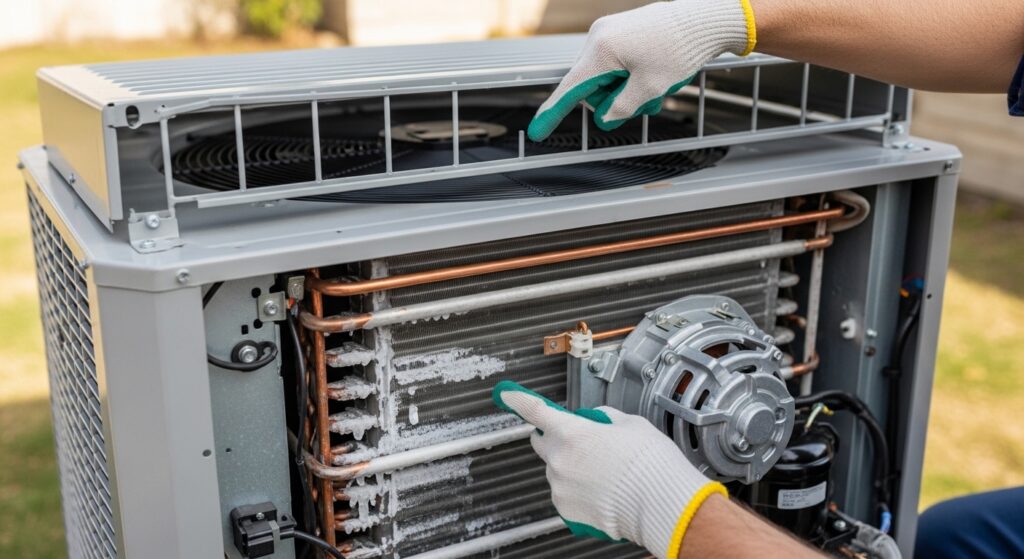
When your AC is running but not cooling, the problem usually falls into one of these categories. Let us look at each one in detail.
Clogged or Dirty Air Filter
We mentioned this in the quick checklist, but it bears repeating. A clogged air filter starves your system of airflow. Without adequate airflow across the evaporator coil, the coil can actually freeze over, making the cooling problem worse.
Signs your filter is causing problems: weak airflow from vents, ice on refrigerant lines, higher energy bills, and dust accumulation around vent grilles. Replace your filter and wait a few hours to see if cooling improves.
Incorrect Thermostat Settings or Malfunction
Beyond the basic settings check, thermostats can malfunction. If your thermostat reads 72 degrees but a separate thermometer shows 78, calibration is off. Some smart thermostats can lose calibration after power outages.
Dirty thermostat components can also cause issues. Pop off the cover and gently dust the interior with a soft brush. Check that the anticipator setting matches your system type if you have an older mechanical model.
Blocked or Closed Vents and Registers
Furniture, rugs, or curtains blocking vents restrict airflow more than people realize. Walk through your home and ensure all supply and return vents are fully open and unobstructed.
Closing vents in unused rooms actually hurts efficiency. Your AC is sized for your entire home’s airflow. Closing vents increases pressure and can cause the evaporator coil to freeze.
Tripped Circuit Breaker or Blown Fuse
Air conditioners pull significant power. If your breaker trips repeatedly, you have an underlying electrical problem. A one-time trip might be a power surge. Multiple trips signal a failing component drawing too much current.
Check both the indoor and outdoor breaker panels. Some systems have a disconnect box near the outdoor unit with fuses inside. Replace blown fuses with exact amperage matches only.
Blocked Outdoor Condenser Unit
Your outdoor unit releases heat collected from inside your home. When the condenser coils get dirty or blocked, heat cannot escape. The system overheats and shuts down on safety mode or runs continuously without cooling.
Clean the coils annually with foaming cleaner from a hardware store. Spray gently and rinse with a hose. Never use a pressure washer as the fins bend easily and restrict airflow permanently.
Frozen Evaporator Coils
When airflow is restricted or refrigerant is low, the evaporator coil can freeze into a block of ice. Ice insulates the coil and prevents heat absorption, stopping cooling entirely.
Signs of frozen coils include: visible ice on the refrigerant line where it enters the indoor unit, water pooling under the unit as ice melts, and hissing sounds from refrigerant leaks. Turn the system off and let it thaw completely before investigating further.
Professional-Level Causes: When You Need an HVAC Technician?
Some AC problems require specialized tools and EPA certification to handle legally. These issues cause your air conditioner not cooling and need professional diagnosis.
Low Refrigerant or Refrigerant Leaks
Refrigerant is the chemical that carries heat out of your home. It does not get “used up” like gas in a car. If levels are low, you have a leak.
Signs of low refrigerant include: hissing sounds near refrigerant lines, ice buildup on the outdoor refrigerant line, the system running constantly without reaching temperature, and higher than normal electric bills. Only licensed technicians can purchase and handle refrigerant legally.
A telltale sign from forum discussions: touch the larger refrigerant line where it enters the indoor unit. When properly charged, it should be cold enough to cause condensation. If it is warm or only slightly cool, refrigerant levels are likely low.
Faulty Compressor
The compressor is the heart of your AC system. It pressurizes refrigerant to release heat outdoors. When compressors fail, the outdoor unit may run but no heat transfer occurs.
Compressor replacement is expensive, often costing $1,200 to $2,500 depending on the system. For older units, full system replacement might be more economical. Your technician should test the compressor amp draw before recommending replacement.
Damaged Capacitor or Contactor
Capacitors provide the electrical boost that starts your compressor and fan motors. They fail frequently in hot climates, especially after power surges.
A bad capacitor causes the outdoor unit to hum without starting, or start briefly then shut off. Contactors are electrical switches that can weld shut or corrode. Both require electrical knowledge to replace safely.
Leaky Ductwork
Conditioned air escaping into your attic or crawlspace never reaches your living areas. Leaky ducts can reduce system efficiency by 20% or more.
Signs include: certain rooms never cool properly, high energy bills, dustier than normal air, and whistling sounds from vents. Professional duct sealing involves pressure testing and mastic sealant application.
Undersized Air Conditioner
If your AC was never able to keep up on the hottest days, it might be undersized for your home. BTU capacity must match your square footage, insulation quality, climate zone, and sun exposure.
Common signs of undersizing: the system runs constantly, cannot cool below 78-80 degrees on hot days, and worked fine in milder weather but fails during heat waves. A load calculation from a professional determines if sizing is the issue.
Window Air Conditioner Not Cooling: Specific Troubleshooting
Window units have unique issues that differ from central air systems. If your window air conditioner is not cooling, check these unit-specific problems.
Improper Installation Angle
Window AC units must tilt slightly backward toward the outside. This allows condensation to drain outdoors rather than into your home. If the unit sits perfectly level or tilts inward, water pools inside and can damage components.
Check the installation angle with a level. Most units need about 1/4 inch of backward tilt. Reinstall with proper shims if needed.
Exhaust Hose Issues (Portable Units)
Portable air conditioners use exhaust hoses to vent hot air. Kinks, blockages, or gaps in the hose window seal let hot air back into the room. Check the entire hose length for obstructions and ensure the window kit seals tightly.
Size Adequacy for the Room
An undersized window unit cannot cool a large room regardless of how long it runs. You need roughly 20 BTU per square foot of living space. A 5,000 BTU unit cannot cool a 400 square foot room effectively.
Factor in heat sources like south-facing windows, high ceilings, and kitchen appliances. These increase your BTU requirements significantly.
How to Reset Your Central AC Unit?
Sometimes a simple reset clears error codes and restores normal operation. Here is the proper way to reset different types of systems.
Resetting a Central Air System
Turn off your thermostat completely. Find the AC breaker in your electrical panel and switch it off. Wait at least five minutes for all capacitors to discharge and the system to fully power down.
Turn the breaker back on. Wait another three minutes before turning the thermostat back to “Cool.” This reset procedure resolves many minor electronic glitches.
Resetting a Window Air Conditioner
Unplug the unit from the wall outlet. Wait five minutes for the internal electronics to fully discharge. Plug it back in and press the reset button if your unit has one. Restore power and test cooling operation.
When Resetting Helps vs When It Does Not
Resetting helps with electronic errors, power surge damage, and thermostat communication issues. It will not fix mechanical problems, refrigerant leaks, dirty components, or electrical failures. If your AC fails again within 24 hours after resetting, you have a deeper problem requiring professional attention.
AC Repair Costs: DIY vs Professional Fixes
Understanding repair costs helps you decide whether to fix or replace your system. Here are typical price ranges for 2026.
DIY Fixes (Under $50)
Air filter replacement: $10-40. Cleaning supplies for coils: $15-30. These basic maintenance items solve many cooling issues for minimal investment.
Moderate Professional Repairs ($100-$500)
Capacitor replacement: $150-300. Contactor replacement: $150-250. Condenser fan motor: $300-600. Thermostat replacement: $150-400 depending on smart features. These are common repairs that restore cooling without breaking the bank.
Major Repairs ($800-$2,500+)
Compressor replacement: $1,200-2,500. Refrigerant leak repair and recharge: $500-1,500 depending on leak location. Evaporator coil replacement: $1,000-2,000. At these prices, compare repair costs against a new system, especially if your unit is over 10 years old.
When to Call a Professional?
Call an HVAC technician immediately if you hear grinding or squealing noises, smell burning, see refrigerant leaks, experience repeated breaker trips, or notice ice buildup on refrigerant lines. These symptoms indicate problems that worsen with continued operation.
Also call a professional if your DIY troubleshooting does not restore cooling within 24 hours. Running a malfunctioning AC drives up electric bills and can cause cascade failures in other components.
Preventing Future AC Problems: Maintenance Tips
Regular maintenance prevents most AC cooling failures. Follow this schedule to keep your system running efficiently through 2026 and beyond.
Monthly Tasks
Check and replace air filters. Inspect the outdoor unit for debris accumulation. Listen for unusual noises during operation. These quick checks catch problems early.
Seasonal Tasks
Clean condenser coils before the cooling season starts. Test the system in spring before you actually need it. Clear vegetation and debris from around the outdoor unit. Check that all vents are open and unobstructed.
Annual Professional Tune-Up
Schedule professional maintenance once yearly, ideally in spring. Technicians check refrigerant levels, test electrical components, clean coils thoroughly, inspect ductwork, and verify thermostat calibration. Annual service costs $75-200 but prevents costly emergency repairs.
While your AC handles cooling, maintaining indoor air quality matters too. Running ceiling fans alongside your AC improves comfort and allows higher thermostat settings that save energy.
Frequently Asked Questions About Air Conditioner Not Cooling
Why is my AC running but not cooling?
Your AC runs but does not cool due to restricted airflow, low refrigerant, incorrect thermostat settings, a frozen evaporator coil, or a malfunctioning compressor. Check your air filter first, then verify thermostat settings. If those are correct, you likely need professional diagnosis for refrigerant or component issues.
How do I reset my central AC not blowing cold air?
Turn off your thermostat completely. Switch off the AC breaker at your electrical panel and wait five minutes. Turn the breaker back on, wait three more minutes, then restore thermostat settings to Cool mode. This reset resolves many electronic errors and communication glitches.
Should I turn off AC if it is not cooling?
Yes, turn off your AC if it is running but not cooling. Continuing to run wastes electricity and can damage components. Turn the system off at the thermostat and breaker, then troubleshoot or call a professional. If you see ice on refrigerant lines, leave the system off for several hours to allow thawing.
What is the 3 minute rule for AC?
The 3 minute rule is a built-in safety delay that prevents compressor damage. After shutting down, refrigerant pressures need 180 seconds to equalize before restarting. Modern AC units enforce this delay automatically. Attempting to restart immediately can lock out the compressor or cause damage.
Can a dirty filter cause AC not to cool?
Yes, a dirty filter is the most common cause of AC cooling problems. Restricted airflow prevents the evaporator coil from absorbing heat effectively. In severe cases, the coil freezes over completely. Replace your filter every 30-90 days depending on usage and environmental factors.
How much does AC repair cost?
AC repair costs range from $150 for simple fixes like capacitor replacement to $2,500+ for compressor replacement. Most common repairs fall between $200-800. Get multiple quotes for expensive repairs and consider that federal tax credits in 2026 may offset replacement costs for high-efficiency systems.
Conclusion: Getting Your AC Cooling Again
An air conditioner not cooling is frustrating, but most problems have clear solutions. Start with the simple DIY checks: filters, thermostat settings, breakers, and outdoor unit clearance. These fix the majority of cooling issues without spending a dime.
When basic troubleshooting fails, you are likely dealing with refrigerant leaks, compressor problems, or electrical component failures. These require professional HVAC technicians with proper certification and equipment.
Remember the safety basics. Turn off power before inspecting components. Do not attempt refrigerant work yourself. And never ignore warning signs like burning smells or grinding noises.
Regular maintenance prevents most AC failures before they happen. Replace filters monthly, clean coils seasonally, and schedule professional tune-ups annually. While you wait for repairs, consider supplementing with fans or exploring air purifiers that can help circulate and clean your indoor air. Stay cool this 2026.