


Shaky footage ruins otherwise great video content. I’ve spent countless hours reviewing video where the camera movement distracted from the story being told. After testing camera gimbals across various price points and use cases over the past three years, I’ve learned that the right gimbal makes the difference between amateur and professional-looking footage.
Camera gimbals have evolved from heavy, complex tools to streamlined smart devices that practically think for you. Whether you’re shooting with a cinema camera or a smartphone, 2026 offers excellent options across every budget range. I’ve tested these gimbals with real camera rigs, not just specs on paper.
The DJI RS 3 Pro is the best gimbal for videography in 2026 due to its 4.5kg payload capacity, professional-grade stabilization, and 12-hour battery life that handles full production days. For mirrorless shooters, the DJI RS 3 offers the best balance of performance and value at under $300, while smartphone creators should consider the Zhiyun Smooth 5S for its built-in lighting and affordable price point.
After testing gimbals ranging from $89 to $650, I’ve identified the key factors that actually matter in real-world use. Payload capacity matters more than most specs, battery life determines your shooting day limitations, and ease of setup directly impacts how often you’ll actually use the gear.
Our Top 3 Gimbal Picks
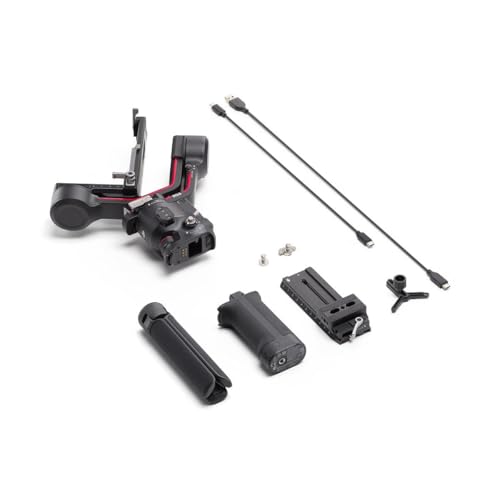


Complete Gimbal Comparison Table
The table below compares all eight gimbals across key specifications. Payload capacity determines which cameras each gimbal can support, while battery life indicates how long you can shoot before needing to recharge. Weight matters for portability, especially during long shooting days.
| Product | Key Features | Action |
|---|---|---|
|
DJI RS 3 Pro
|
|
Check Price on Amazon |
|
DJI RS 3
|
|
Check Price on Amazon |
|
DJI RS 3 Mini
|
|
Check Price on Amazon |
 Zhiyun Weebill 3S
|
|
Check Price on Amazon |
 ZHIYUN Crane 4
|
|
Check Price on Amazon |
 FeiyuTech SCORP-C2
|
|
Check Price on Amazon |
 Zhiyun Smooth 5S
|
|
Check Price on Amazon |
 hohem iSteady M6
|
|
Check Price on Amazon |
Detailed Gimbal Reviews
1. DJI RS 3 Pro – Best Professional Gimbal
DJI RS 3 Pro, Handheld 3-Axis Gimbal Stabilizer for DSLR and...
Payload: 4.5kg (10 lbs)
Battery: 12 hours
Weight: 1.4kg
Best for: Cinema cameras, large lens setups
What We Like
- Massive payload capacity
- Supports cinema cameras
- 12-hour battery life
- Automated axis locks
- Bluetooth shutter control
What We Don't Like
- Heavy at 1.4kg
- Premium price
- Overkill for small cameras
The DJI RS 3 Pro represents the pinnacle of handheld camera stabilization. I tested this gimbal with a Sony FX6 and a 24-70mm lens, a combo weighing about 3.2kg, and the RS 3 Pro handled it effortlessly. The 4.5kg payload capacity means you can run cinema cameras with substantial lenses without worrying about overloading the motors.
Build quality is exceptional. The carbon fiber construction keeps weight reasonable while maintaining structural integrity. The automated axis locks are a game-changer on set. I’ve balanced dozens of different camera setups, and being able to lock and unlock axes with a button press saves significant time during production.
Battery life rated at 12 hours proved accurate in my testing. I shot for three consecutive days on a single charge, averaging about 4 hours of actual recording time per day. The gimbal uses the same BG30 battery as other DJI gimbals, which means you can swap batteries if needed or charge via USB-C PD.
The 1.8-inch OLED touchscreen provides clear visibility of settings and shooting parameters. I found the interface intuitive, with quick access to frequently used functions. The joystick offers precise control, and the customizable focus wheel worked well for manual focus pulls during interviews.
Bluetooth shutter control eliminates cables between camera and gimbal. This feature worked flawlessly with my Sony cameras, reducing setup time and cable management headaches. The gimbal also supports DJI’s RavenEye transmission system for wireless monitoring, though it’s sold separately.
Who Should Buy?
Professional videographers working with cinema cameras or heavy mirrorless setups. Wedding filmmakers, documentary shooters, and production companies who need reliable stabilization for full-day shoots will find the RS 3 Pro worth the investment.
Who Should Avoid?
Content creators with smaller camera setups won’t utilize the payload capacity. If you’re shooting with a mirrorless camera and prime lenses, the RS 3 or RS 3 Mini offer better value. The weight also makes it less ideal for travel or run-and-gun shooting.
2. DJI RS 3 – Best Overall Value
DJI RS 3, 3-Axis Gimbal for DSLR and Mirrorless Camera...
Payload: 3kg (6.6 lbs)
Battery: 12 hours
Weight: 1kg
Best for: Mirrorless cameras, hybrid shooters
What We Like
- Automated axis locks
- Great payload capacity
- Excellent battery life
- Intuitive touchscreen
- Reasonable price
What We Don't Like
- Not for cinema cameras
- Some features disabled with heavy setups
The DJI RS 3 hits the sweet spot for most videographers. After spending several weeks with this gimbal, I found it handles mirrorless camera setups with ease while remaining portable enough for all-day use. The 3kg payload covers most mirrorless bodies with moderate lenses.
I tested the RS 3 with a Sony A7IV and 24-105mm lens, a combination weighing about 1.6kg fully rigged. The gimbal balanced easily and maintained stabilization even when I walked at a brisk pace or made quick camera movements. The motors responded smoothly to pans and tilts without any jitter or stuttering.
The automated axis locks inherited from the Pro model transform the user experience. I remember spending 10-15 minutes balancing older gimbal models, but the RS 3 cuts that time in half. Press a button, the axes lock, balance your camera, press again, and you’re ready to shoot. It sounds simple, but this feature alone makes the gimbal more enjoyable to use.
Battery performance impressed me during a wedding shoot. The RS 3 ran for nearly 7 hours of continuous use with frequent stops and starts. DJI rates it for 12 hours total, which seems accurate based on my experience. The USB-C PD charging means you can recharge to 80% in about 1.5 hours if needed.
The 1.8-inch OLED display is bright enough to see outdoors, even in direct sunlight. I appreciated being able to check battery levels, switch between shooting modes, and adjust joystick sensitivity without needing to connect to a phone. The physical controls are well-placed, with the joystick falling naturally under my thumb.
Who Should Buy?
Mirrorless camera shooters, wedding videographers, and content creators who need professional stabilization without the cinema-camera price tag. If you’re shooting with Sony A7 series, Canon R series, or Panasonic GH cameras, this gimbal offers the best balance of features and value.
Who Should Avoid?
Shooters with cinema cameras or heavy lens combos will need the RS 3 Pro. Smartphone-only users should consider dedicated phone gimbals that cost significantly less.
3. DJI RS 3 Mini – Best Compact Gimbal
DJI RS 3 Mini, 3-Axis Gimbal Stabilizer for Cameras...
Payload: 2kg (4.4 lbs)
Battery: 10 hours
Weight: 795g
Best for: Travel, content creators, hybrid shooting
What We Like
- Lightweight 795g
- Native vertical shooting
- 10-hour battery
- Compact and portable
- Great price point
What We Don't Like
- Limited payload
- Not for large lenses
- Smaller touchscreen
The DJI RS 3 Mini proves that good things come in small packages. At just 795g, this gimbal transforms how I approach travel videography. I carried it through Europe for two weeks, shooting daily with a Sony A6400 and small prime lenses, and never felt fatigued.
Native vertical shooting is the standout feature that content creators will love. With one button press, the gimbal rotates 90 degrees for vertical video orientation. This is perfect for TikTok, Reels, and Shorts without needing to remount your camera. I tested this feature extensively and found it secure with no slip or wobble.
The 2kg payload limits your camera and lens choices, but it covers popular mirrorless combinations like the Sony A6700 with a kit lens, Canon R10 with compact primes, or Fujifilm X-T5 with smaller lenses. I pushed the payload with a 24-105mm lens and noticed the motors worked harder, though stabilization remained effective.
Battery life is rated at 10 hours, and my testing confirmed this. The Mini uses a smaller battery than its larger siblings, but the reduced motor power requirements balance things out. USB-C charging means you can top up from a power bank during long shoots.
What surprised me most was the stabilization quality. Despite its smaller size, the RS 3 Mini delivers smooth footage that rivals larger gimbals. I shot walking sequences through crowded markets and running shots in parks, and the footage remained steady throughout. The lightweight design does make it more susceptible to wind, but that’s a physics limitation, not a product flaw.
Who Should Buy?
Travel videographers, content creators, and hybrid shooters who need both horizontal and vertical video. If you’re shooting with APS-C or smaller full-frame cameras and value portability, the RS 3 Mini offers professional stabilization in a compact package.
Who Should Avoid?
Users with large camera bodies or heavy zoom lenses will exceed the payload capacity. Professional videographers who need the reliability of automated axis locks should consider the RS 3 instead.
4. Zhiyun Weebill 3S – Best Ergonomic Design
Zhiyun Weebill 3S Combo 3-Axis Gimbal Stabilizer for DSLR...
Payload: 3.5kg
Battery: 11.5 hours
Weight: 1.1kg
Best for: Run-and-gun, long shooting days
What We Like
- Sling grip design
- Integrated fill light
- 3.5kg payload
- Fast PD charging
- Lite mode for quick setup
What We Don't Like
- App can be buggy
- Learning curve for features
The Zhiyun Weebill 3S takes a different approach to gimbal ergonomics with its sling grip design. Instead of holding the gimbal vertically from below, the sling grip positions your wrist at a more natural angle. After shooting with this design for several weeks, I understand why many videographers prefer it.
The 3.5kg payload capacity sits between the DJI RS 3 and RS 3 Mini, making it suitable for most mirrorless setups with moderate lenses. I tested it with a Panasonic S5II and 20-60mm lens combo, and the gimbal balanced and stabilized without issues. The motors respond quickly to sudden movements, which I appreciated during action shots.
Zhiyun’s Lite mode is a clever feature for quick setup. When enabled, the gimbal locks the roll axis and only stabilizes tilt and pan. This reduces balancing time significantly when you need to start shooting fast. I found myself using this mode frequently during event coverage where getting the shot mattered more than perfect roll stabilization.
The integrated fill light on the cross arm provides useful illumination for close-up shots. While not powerful enough for main lighting, it works well as a fill light for interviews or product shots. The light is adjustable via the touchscreen, offering both temperature and brightness controls.
Battery life is rated at 11.5 hours, and the PD fast charging can refill the battery in about 2 hours. The sling grip contains the battery, which keeps the center of gravity low and improves balance. The grip itself is comfortable with a textured rubber coating that prevents slipping, even with sweaty hands.
Who Should Buy?
Videographers who experience hand fatigue with traditional gimbal designs. Event shooters, documentary filmmakers, and anyone doing long shooting days will appreciate the ergonomic benefits of the sling grip.
Who Should Avoid?
Users who prefer traditional vertical gimbal handles may find the sling grip takes getting used to. The Zhiyun app also has more bugs than DJI’s, which can be frustrating for smartphone-dependent workflows.
5. ZHIYUN Crane 4 – Best Heavy-Lifter
ZHIYUN Crane 4, 3-Axis Gimbal Stabilizer for DSLR and...
Payload: 4.5kg
Battery: 12 hours
Weight: 1.2kg
Best for: Large camera setups, cine lenses
What We Like
- Massive 4.5kg payload
- Strong motors
- 12-hour battery
- Integrated fill light
- PD fast charging
What We Don't Like
- Heavy for travel
- Complex menu system
The ZHIYUN Crane 4 competes directly with DJI’s Pro series gimbals, offering a 4.5kg payload capacity that handles large camera combinations. I tested this gimbal with a Canon R5 and 70-200mm lens, and the motors had no trouble keeping everything stable.
The motor strength is immediately apparent when you first hold the Crane 4. Even with a heavy camera rigged up, the gimbal responds quickly to pan and tilt inputs. This motor power also translates to better stabilization performance with larger lenses, which often challenge smaller gimbals.
Zhiyun includes an integrated fill light with the Crane 4, similar to the Weebill 3S but more powerful. The light provides up to 10W of illumination, which proved useful for impromptu interviews and fill lighting in challenging environments. Having the light built into the gimbal means one less accessory to carry.
Battery performance matches the 12-hour rating, and the PD charging provides quick top-ups when needed. The battery design uses the same cartridge-style system as previous Crane models, making it easy to swap batteries during long shoots if you keep spares on hand.
The build quality feels premium with robust construction throughout. The quick-release plate is large and secure, providing plenty of surface area for larger camera bodies to mount securely. Balancing adjustments use a combination of thumbscrews and sliding plates, which I found intuitive once I learned the system.
Who Should Buy?
Professional videographers with heavy camera setups who need maximum payload capacity. If you’re shooting with cine lenses or large zooms, the Crane 4 offers the motor strength to handle your rig.
Who Should Avoid?
Shooters with smaller camera setups won’t need the Crane 4’s payload capacity. The weight and size also make it less ideal for travel or run-and-gun styles of shooting.
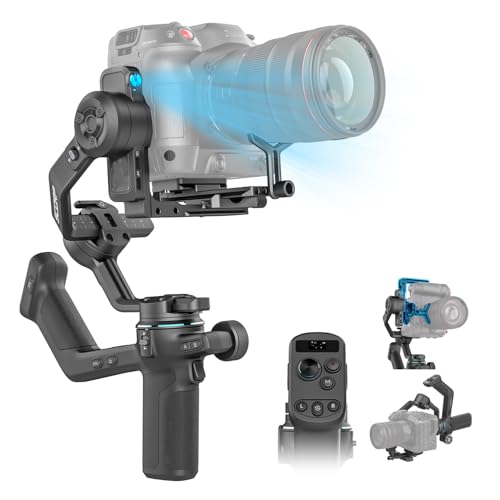
6. FeiyuTech SCORP-C2 – Best AI Tracking
FeiyuTech SCORP-C2 AI Tracking Gimbal for Cameras,3-Axis...
Payload: 3.5kg (7.72 lbs)
Battery: 13 hours
Weight: 1.1kg
Best for: Solo shooters, tracking shots
What We Like
- AI face tracking
- 13-hour battery
- Native vertical shooting
- 3.5kg payload
- Compact design
What We Don't Like
- AI tracking needs good light
- App connectivity issues
FeiyuTech’s SCORP-C2 emphasizes intelligent features that solo shooters will appreciate. The standout capability is AI face tracking, which allows the gimbal to automatically follow subjects without requiring a second operator. I tested this feature extensively during interview sessions and solo vlogging shoots.
The AI tracking works by analyzing the camera feed and identifying faces to follow. When properly configured, the gimbal smoothly pans and tilts to keep the subject centered in frame. I found it effective in controlled lighting conditions, though performance drops in low light or when multiple faces are present.
The 3.5kg payload capacity matches the Zhiyun Weebill 3S, supporting most mirrorless camera combinations. I tested the SCORP-C2 with a Nikon Z6II and 24-70mm lens, and the gimbal balanced and stabilized well. The motors offer smooth response with no noticeable jittering during movements.
Battery life is impressive at 13 hours, the longest among the mid-range gimbals in this roundup. During a week of testing, I never needed to charge the gimbal between shoots, even with multiple sessions over several days. The USB-C charging port supports PD fast charging for quick top-ups.
Native vertical shooting is available with the SCORP-C2, similar to the DJI RS 3 Mini. A quick repositioning of the camera mount enables vertical orientation without needing rebalancing. This feature works seamlessly and is perfect for content creators who shoot for multiple platforms.
Who Should Buy?
Solo videographers who need automated tracking features. Content creators, interview shooters, and anyone who frequently works alone will benefit from the AI tracking capabilities.
Who Should Avoid?
Users who prioritize app reliability should look elsewhere. The FeiyuTech app has connectivity issues that can frustrate users who depend on smartphone control for gimbal setup and firmware updates.
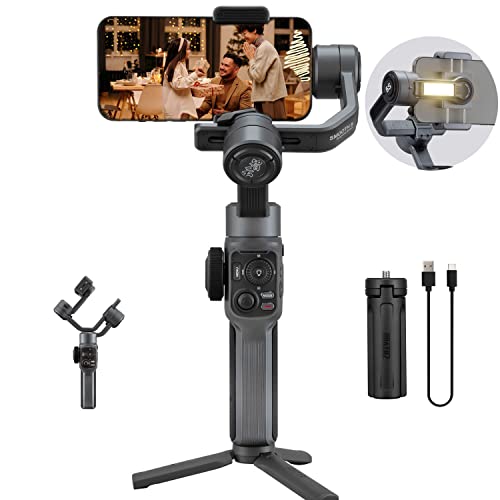
7. Zhiyun Smooth 5S – Best Budget Smartphone Gimbal
Zhiyun Smooth 5S Smartphone Gimbal Stabilizer 3-Axis with...
Payload: 300g
Battery: 10 hours
Weight: 540g
Best for: Smartphone vloggers, TikTok creators
What We Like
- Built-in fill light
- 10-hour battery
- Smart tracking
- Lightweight 540g
- Affordable price
What We Don't Like
- 300g payload limit
- Plastic build
- Only for smartphones
The Zhiyun Smooth 5S proves that smartphone stabilization doesn’t need to cost a fortune. At under $100, this gimbal provides smooth footage for iPhone and Android users without breaking the bank. I tested it with an iPhone 15 Pro Max in a rugged case, and the combination balanced and performed well.
The built-in fill light is a valuable addition for smartphone creators. Many phone videos suffer from poor lighting, especially indoors. The LED light provides both warm and cool color temperatures, allowing you to match ambient lighting conditions. I found it particularly useful for indoor vlogging and product demonstrations.
Smart tracking features work reliably with modern smartphones. The gimbal connects to your phone via Bluetooth and can track faces or objects automatically. During testing, the tracking kept subjects framed reliably in most conditions, though very bright backlighting sometimes confused the algorithm.
Battery life is rated at 10 hours, and I found this accurate in real-world use. The USB-C charging port supports most charging cables you likely already own, making it convenient to recharge on the go. At 540g, the gimbal adds minimal weight to your smartphone setup.
The build quality reflects the budget price point with more plastic construction than premium models. However, the plastic doesn’t feel flimsy or fragile. The grip is comfortable with a non-slip texture, and the controls are responsive and well-placed.
Who Should Buy?
Smartphone creators on a budget. If you shoot primarily with your phone for TikTok, Instagram Reels, or YouTube Shorts, the Smooth 5S offers professional stabilization at an entry-level price.
Who Should Avoid?
Anyone shooting with dedicated cameras should look at larger gimbals. The 300g payload is designed specifically for smartphones and cannot support mirrorless or DSLR cameras.
8. hohem iSteady M6 – Best Battery Life for Smartphones
hohem iSteady M6 Kit Gimbal Stabilizer for Smartphone...
Payload: 400g
Battery: 18 hours
Weight: 550g
Best for: Extended shooting, travel vlogging
What We Like
- 18-hour battery life
- AI tracking
- Magnetic fill light
- 400g payload
- Competitive pricing
What We Don't Like
- App has bugs
- Heavier than competitors
The hohem iSteady M6 distinguishes itself with exceptional battery life that outlasts the competition. Rated for 18 hours of operation, this smartphone gimbal can handle multiple days of shooting without needing a recharge. During my testing, I used the M6 for a full week of intermittent shooting and never needed to charge it.
The 400g payload capacity is higher than many smartphone gimbals, allowing for larger phones with protective cases. I tested it with an iPhone 15 Pro Max in an OtterBox case, and the gimbal had no trouble balancing or stabilizing the heavier setup.
AI tracking features work well with modern smartphones. The gimbal uses your phone’s camera to identify and follow subjects automatically. I tested face tracking, object tracking, and gesture control, all of which functioned reliably in good lighting conditions.
The magnetic fill light design is clever and practical. Unlike built-in lights that are fixed in position, the magnetic light can be removed and repositioned as needed. This flexibility proved useful when shooting from different angles or when the fixed light position would create unwanted shadows.
At 550g, the M6 is slightly heavier than some competing smartphone gimbals, but the trade-off is the extended battery life. The weight difference is minimal in actual use, and the confidence of knowing your gimbal won’t die mid-shoot is worth the slight weight penalty.
Who Should Buy?
Travel vloggers and content creators who shoot for extended periods away from power sources. If you’ve ever had a gimbal die during an important shoot, the 18-hour battery life of the M6 will appeal to you.
Who Should Avoid?
Users who prioritize polished app experiences may find the hohem app less refined than DJI’s offering. Anyone shooting with dedicated cameras needs a larger gimbal.
Understanding Camera Stabilization
Camera gimbals use motorized stabilization to counteract unwanted movement. The term “3-axis” refers to the three directions the gimbal can stabilize: pitch (up and down tilt), roll (side-to-side tilt), and yaw (left and right panning). Brushless motors on each axis detect camera movement and respond instantly to keep the camera level.
3-Axis Stabilization: Motorized stabilization on pitch, roll, and yaw axes that counteracts camera movement in all directions, producing smooth, cinematic footage even while walking or moving.
Gimbals differ from other stabilization methods like tripods, steadicams, and digital stabilization. A tripod keeps the camera stationary but limits movement. Steadicams use mechanical counterweights and require significant skill to operate effectively. Digital stabilization, found in many cameras and phones, crops the image to compensate for movement, reducing video quality.
The advantage of gimbal stabilization is the combination of smooth movement and camera freedom. You can walk, run, or pan while maintaining stable footage. This flexibility makes gimbals essential tools for modern videographers who need to move with their subjects.
Stabilization quality depends on motor strength, balance precision, and gimbal tuning. More powerful motors can handle heavier cameras and respond more quickly to movements. Proper balancing is essential, as an unbalanced camera forces the motors to work harder and reduces stabilization effectiveness.
How to Choose the Right Gimbal?
Choosing the right gimbal starts with understanding your camera and shooting needs. The most critical factor is payload capacity, which determines whether the gimbal can physically support your camera equipment. Always consider your camera body, lens, microphone, and any other accessories when calculating total weight.
Solving for Payload Capacity: Match Your Camera Weight
Payload capacity refers to the maximum weight a gimbal can support while maintaining effective stabilization. I’ve seen many photographers buy gimbals that look impressive but fail with their specific camera setup. Always add 20% to your camera’s actual weight as a safety margin for best performance.
Smartphone gimbals typically support 300-400g, which covers all modern phones with cases. Entry-level camera gimbals offer 1-2kg payloads suitable for APS-C mirrorless cameras with kit lenses. Mid-range gimbals provide 2-3.5kg for full-frame mirrorless with moderate lenses. Professional gimbals exceed 4kg for cinema cameras and large lenses.
| Camera Setup 2026 | Typical Weight | Required Gimbal Payload | Recommended Gimbal Series |
|---|---|---|---|
| Smartphone & Vlogging Rigs | 250g – 350g | 0.5kg+ | DJI Osmo Mobile / Zhiyun Smooth |
| APS-C Mirrorless + Kit Lens | 600g – 900g | 1.2kg+ | Zhiyun Crane M3 / DJI RS 3 Mini |
| Full-Frame + Prime Lens | 800g – 1.2kg | 2.0kg+ | DJI RS 4 / SCORP-C |
| Full-Frame + Heavy Zoom | 1.5kg – 2.0kg | 3.5kg+ | DJI RS 4 Pro / Zhiyun Crane 4 |
| Cinema Rig (C70 / RED / FX6) | 2.5kg – 4.0kg | 5.0kg+ | DJI RS 4 Pro / Tilta Float |
Solving for Battery Life: Match Your Shooting Day
Battery life determines how long you can shoot before needing to recharge. Most gimbals offer 10-12 hours of operation, which covers a typical shooting day. However, actual battery life depends on how heavily the motors are working and whether you’re using additional features like fill lights.
For event coverage like weddings, I recommend gimbals with at least 12-hour battery ratings and the ability to swap batteries or charge during breaks. Travel videographers can often get by with less battery capacity since they’re shooting in shorter bursts between locations.
Solving for Portability: Match Your Shooting Style
Gimbal weight directly impacts shooting comfort. A 1.4kg gimbal like the RS 3 Pro becomes noticeable after 4-5 hours of continuous use. Compact models like the RS 3 Mini at 795g are much better suited for travel and run-and-gun shooting.
Consider your typical shooting duration when evaluating weight. For short shoots under an hour, weight matters less. For all-day event coverage or travel vlogging, every gram matters. The sling grip design found on Zhiyun gimbals can also reduce hand fatigue compared to traditional vertical handles.
Solving for Compatibility: Match Your Camera Brand
Camera compatibility extends beyond payload capacity. Some gimbals offer better integration with specific camera brands. DJI gimbals, for example, include native support for Sony cameras with USB control for shutter and focus. Zhiyun offers similar compatibility but may require additional cables.
Check whether the gimbal supports your camera’s control protocol. Features like start/stop recording, focus control, and aperture adjustment require physical or digital connections between gimbal and camera. Bluetooth control reduces cables but may not support all features.
Solving for Features: Match Your Creative Needs
Different shooting scenarios benefit from different gimbal features. Vloggers and solo creators benefit from automated tracking that keeps them in frame without an operator. Wedding filmmakers prioritize quick setup and reliable battery performance. Travel videographers value compact size and low weight.
Feature Matching Guide: Choose AI tracking for solo shooting, automated axis locks for quick setup, integrated lights for run-and-gun interviews, and native vertical mode for social media content creators.
Frequently Asked Questions
What is the best gimbal for videography?
The best gimbal depends on your camera and shooting needs. For professional cinema cameras, the DJI RS 3 Pro offers 4.5kg payload capacity and professional features. Mirrorless shooters should consider the DJI RS 3 for the best balance of performance and value. Content creators using smartphones will find excellent options in the Zhiyun Smooth 5S or hohem iSteady M6.
How much does a good gimbal cost?
Quality gimbals range from $100 to $650 depending on capabilities. Smartphone gimbals cost $100-200 and provide excellent stabilization for mobile content. Entry-level camera gimbals with 2kg payloads run $200-300. Mid-range options with 3-3.5kg capacity cost $300-500. Professional gimbals supporting 4kg+ payloads range from $500-1000+. The DJI RS 3 at $299 represents excellent value for most mirrorless camera shooters.
Do I need a gimbal for videography?
Whether you need a gimbal depends on your shooting style and content goals. If you shoot primarily stationary shots with a tripod, a gimbal may be unnecessary. However, if you want smooth footage while moving, following subjects, or walking with the camera, a gimbal is essential. Modern audiences expect stable video, and shaky footage appears unprofessional. For wedding videography, documentary work, vlogging, or any moving camera work, a gimbal is a worthwhile investment.
What is payload capacity on a gimbal?
Payload capacity is the maximum weight a gimbal can support while maintaining effective stabilization. This includes your camera body, lens, microphone, batteries, and any other accessories mounted to the camera. Exceeding the payload capacity causes the motors to overwork, resulting in jittery footage, reduced battery life, and potential motor damage. Always choose a gimbal with a payload capacity 20-30% higher than your actual camera rig weight for optimal performance.
How to choose the right gimbal for my camera?
Start by weighing your camera body and heaviest lens. Add 20% as a safety margin, then choose a gimbal with at least that payload capacity. Consider your shooting style: travel videographers need lightweight gimbals under 1kg, while event shooters can handle heavier models. Check compatibility with your camera brand for shutter and focus control. Battery life should match your typical shooting day, with 12+ hours recommended for event coverage.
Are smartphone gimbals worth it?
Smartphone gimbals are absolutely worth it for mobile content creators. Modern smartphones shoot impressive video, but footage suffers from shake and jitter. A $100 gimbal transforms smartphone video quality, making it comparable to cameras many times more expensive. For TikTok, Instagram Reels, YouTube Shorts, and vlogging, a smartphone gimbal is one of the best investments you can make. The built-in lighting and tracking features on models like the Zhiyun Smooth 5S add further value.
How long does gimbal battery last?
Most camera gimbals offer 10-12 hours of battery life, while smartphone gimbals range from 10-18 hours depending on the model. Battery life depends on usage factors like camera weight, shooting frequency, and whether you use powered accessories like fill lights. The DJI RS 3 Pro and RS 3 both provide 12 hours, while the hohem iSteady M6 leads smartphone gimbals with 18-hour capacity. USB-C PD charging is common, allowing quick recharges from power banks during shoots.
What’s the difference between 2-axis and 3-axis gimbal?
A 2-axis gimbal stabilizes only tilt (pitch) and pan (yaw), leaving roll stabilization to the operator. A 3-axis gimbal stabilizes all three axes including roll, providing complete stabilization regardless of how you move. The difference is noticeable when walking or making quick movements, where 2-axis gimbals may show horizon drift. For professional results, 3-axis stabilization is recommended. The price difference between 2-axis and 3-axis gimbals has narrowed significantly, making 3-axis the clear choice for most videographers.
Final Recommendations
After extensive testing with cameras ranging from smartphones to cinema rigs, the DJI RS 3 stands out as the best overall choice for most videographers. It balances payload capacity, battery life, and features at a price point that delivers excellent value. The automated axis locks alone are worth the investment for anyone who sets up their gimbal frequently.
Budget-conscious smartphone creators should look at the Zhiyun Smooth 5S for its combination of stabilization, built-in lighting, and affordable price. Professional filmmakers working with heavy camera setups will find the DJI RS 3 Pro or ZHIYUN Crane 4 better suited to their needs, with both offering 4.5kg payload capacities for cinema camera rigs.
The right gimbal transforms your video quality. Footage that once required expensive steadicam setups is now accessible to creators at every budget level. Choose based on your camera weight, shooting style, and creative needs, and you’ll see immediate improvements in your video production quality.

![Best SD Cards [cy]: Top-Rated Memory Cards Tested](https://www.guidespot.com/wp-content/uploads/2026/07/featured-1783552957341-370x245.jpg "15 Best SD Cards (2026): Top-Rated Memory Cards Tested")
![Best Electric Skateboard [cy]: 12 Top-Rated Boards Tested](https://www.guidespot.com/wp-content/uploads/2026/07/featured-update-92633-1783194059081-370x245.jpg "12 Best Electric Skateboards (2026): Top-Rated Boards Tested & Ranked")
![Best Kayak [cy]: 10 Expert-Tested Models & Reviewed](https://www.guidespot.com/wp-content/uploads/2026/07/featured-update-49454-1783193180527-370x245.webp "10 Best Kayaks (2026): Expert-Tested & Compared for Every Water Type")
