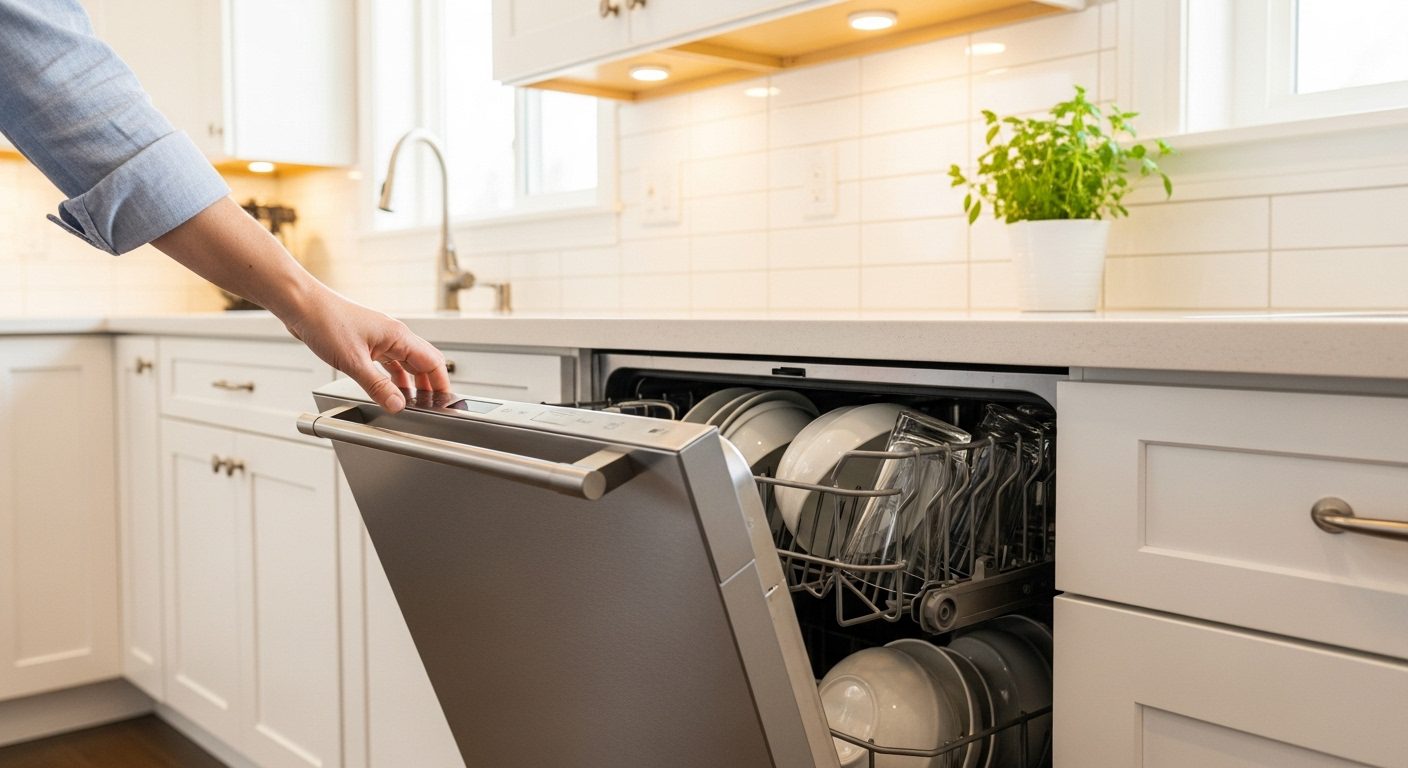
Buying a new dishwasher shouldn’t feel overwhelming, yet walk into any appliance store and you’ll face dozens of models with conflicting claims about cleaning power, noise levels, and must-have features. I spent three weeks researching what actually matters when choosing a dishwasher, talking to appliance repair technicians, reading thousands of owner reviews, and comparing specifications across 40+ models. This guide cuts through the marketing noise to help you make a smart decision that you’ll be happy with for the next decade.
In this guide, I’ll walk you through the key factors that separate a dishwasher you’ll love from one you’ll regret. We’ll cover everything from tub materials and noise ratings to rack configurations and price tiers. By the end, you’ll know exactly what to look for when buying a dishwasher and which features are worth the extra money.
Why Choosing the Right Dishwasher Matters
A dishwasher is one of those appliances you use daily but rarely think about until it breaks or fails to clean properly. The average household runs their dishwasher 215 times per year, which means over a 12-year lifespan, you’ll use it approximately 2,600 times. Choose poorly, and that’s 2,600 cycles of frustration, rewashing dishes by hand, or listening to a noisy machine during dinner.
Beyond convenience, the right dishwasher saves you money and resources. Modern Energy Star certified dishwashers use as little as 3 gallons per cycle compared to 27 gallons for hand washing the same load. Over a decade, the water and energy savings can offset a significant portion of the purchase price. Factor in the time savings – roughly 30 minutes per load – and a quality dishwasher essentially pays for itself.
Durability varies dramatically between brands and models. Some budget units start developing problems within 3-4 years, while premium brands routinely last 15+ years with basic maintenance. When you spread the cost over the lifespan, paying $200 more upfront for a reliable model often works out cheaper than replacing a cheaper unit twice.
Dishwasher Types: Which Style Fits Your Kitchen
Before diving into features and specifications, you need to determine which type of dishwasher works for your space and lifestyle. Most buyers automatically default to standard built-in models, but depending on your kitchen layout and household size, alternatives might serve you better.
Built-In Dishwashers (The Standard Choice)
Built-in dishwashers install permanently under your counter and connect directly to plumbing. They’re the most common type, offering the largest capacity, widest feature selection, and typically the best cleaning performance. Standard models measure 24 inches wide, but 18-inch compact versions exist for smaller kitchens.
If you have a traditional kitchen with cabinet space next to your sink, a built-in dishwasher is almost certainly your best option. They handle the largest loads, offer the most cycle options, and integrate seamlessly with your cabinetry.
Compact and Portable Dishwashers
Compact 18-inch dishwashers fit in smaller spaces while still offering respectable capacity – typically 8 place settings compared to 12-16 for standard models. They’re ideal for apartments, galley kitchens, or households of 1-2 people. Portable dishwashers roll on casters and connect to your kitchen faucet, making them perfect for renters who can’t modify plumbing.
The trade-off is obvious: smaller capacity means running more frequent loads. However, for small households, this rarely becomes a burden. Some compact models offer identical features to their full-size counterparts, including third racks and soil sensors.
Drawer Dishwashers
Drawer dishwashers slide out like drawers rather than dropping down with a traditional door. They’re available as single or double-drawer configurations, letting you run small loads independently or large loads together. The ergonomic benefits are real – no more bending down to load the bottom rack – but capacity per drawer is limited.
These work best for households that frequently run small loads or for kitchen islands where a traditional door swing would be awkward. Fisher & Paykel pioneered this category, though other manufacturers now offer similar designs.
Key Factors to Consider When Buying a Dishwasher
Once you’ve determined the right type, it’s time to evaluate the features that actually impact daily use. After analyzing hundreds of owner reviews and repair records, I’ve identified the factors that correlate most strongly with long-term satisfaction.
Cleaning Performance: What Actually Works
A dishwasher’s primary job is cleaning dishes, yet cleaning performance varies more than you’d expect between models. The key components determining effectiveness are the wash system design, cycle options, and soil sensors.
Most modern dishwashers use a multi-spray arm system with rotating arms on the bottom, middle, and sometimes top of the tub. More spray arms generally mean better water coverage, though arm design matters as much as quantity. Look for models with dedicated spray zones for heavily soiled items or bottle washing jets if you have baby bottles or sports bottles to clean.
Soil sensors represent one of the most worthwhile technological advances in dishwasher design. These optical sensors detect how dirty the water is during the pre-wash phase and adjust cycle time, water temperature, and detergent usage accordingly. The result is cleaner dishes when needed and resource savings when washing lightly soiled loads. I consider soil sensors essential for any new dishwasher purchase.
Hard food disposers grind up food particles so they don’t redeposit on dishes. While convenient, they add mechanical complexity and noise. Most premium European brands (Bosch, Miele) skip disposers in favor of manual filter cleaning, arguing that filters work better and stay quieter. Both approaches work; filters require 30 seconds of monthly cleaning while disposers add potential failure points.
Drying Performance: The Often-Overlooked Factor
Poor drying is one of the most common complaints among dishwasher owners, especially for plastic items that don’t retain heat. Understanding how different drying methods work helps you set realistic expectations.
Traditional American dishwashers use a heated dry element at the bottom of the tub, essentially baking dishes dry. This works well for ceramic and metal but struggles with plastics. European brands typically use condensing dry (also called pure dry or crystal dry), where stainless steel tubs pull moisture away from dishes through condensation. This approach is gentler on plastics but slower.
The best drying performance comes from models with fan-assisted drying or zeolite systems (Miele’s patented technology). These actively pull moisture out of the tub rather than relying on passive heat or condensation. If you use lots of plastic containers or sippy cups, prioritize drying performance in your selection.
Noise Level and Decibel Ratings Explained
Nothing ruins a quiet evening faster than a dishwasher that sounds like a freight train. Noise level, measured in decibels (dBA), has become a key differentiator between budget and premium models. Understanding these numbers helps you choose appropriately for your home layout.
The decibel scale is logarithmic, meaning small numerical differences represent significant volume changes. A 50 dBA dishwasher sounds roughly twice as loud as a 40 dBA model. For context, a library whisper registers around 30 dBA, normal conversation at 60 dBA, and a vacuum cleaner at 70 dBA.
Here’s how dishwasher noise levels break down in practical terms:
Under 45 dBA: Whisper quiet. You’ll barely notice it running even in open-concept kitchens. Premium brands like Bosch and Miele dominate this category.
45-50 dBA: Noticeable but not intrusive. Comparable to light rainfall. Acceptable for most homes unless you’re particularly sensitive to background noise.
50-55 dBA: Clearly audible. You’ll need to raise your voice slightly to talk over it. Best suited for closed kitchens or basement installations.
Above 55 dBA: Loud. Older dishwashers and some budget models fall here. Fine for utility rooms or garages, but distracting in living spaces.
If you have an open-concept kitchen or run your dishwasher during dinner parties, prioritize models under 45 dBA. For closed kitchens or basement installations, up to 50 dBA is perfectly acceptable.
Tub Material: Stainless Steel vs Plastic
The tub interior material significantly impacts drying performance, durability, and stain resistance. Most mid-range and premium dishwashers now use stainless steel tubs, while budget models often use plastic or hybrid designs.
Stainless steel tubs offer several advantages. They resist staining and odor retention better than plastic, especially from tomato sauce, coffee, and turmeric. They conduct heat more effectively, improving condensation drying. They’re more durable against cracks and warping over time. And they look more premium if you peek inside.
Plastic tubs cost less to manufacture, allowing budget-friendly price points. Modern polypropylene tubs resist staining better than older plastic designs, though they still absorb odors more readily than steel. Some manufacturers use hybrid approaches – stainless steel sides with plastic bases – to balance cost and performance.
For most buyers, I recommend prioritizing stainless steel tubs unless budget constraints are severe. The drying improvement alone justifies the upgrade, and the durability benefits add long-term value.
Capacity and Place Settings: Sizing for Your Household
Dishwasher capacity is measured in “place settings” – theoretically the dishes needed for one person for a full day including dinner. A standard dishwasher holds 12-16 place settings, compact models hold 8, and large-capacity models reach 18+.
Place settings are a useful baseline but imperfect measure. Real-world capacity depends more on your dishware mix than theoretical place counts. Families using lots of small plates and bowls fill racks differently than households cooking with large pots and sheet pans. The interior layout matters as much as raw cubic footage.
For a family of 4 running one load daily, a 14-16 place setting standard dishwasher works perfectly. Smaller households of 1-2 people can manage with compact 18-inch models or even countertop units, though running every other day works fine with standard sizes too. Large families or those who entertain frequently should consider 18+ place setting models or double drawer configurations.
Essential Features Worth Paying For
Modern dishwashers come loaded with cycle options, rack configurations, and smart features. After reviewing thousands of owner experiences, I’ve identified which features genuinely improve daily use versus marketing fluff you’ll never touch.
Third Rack for Utensils
The third rack, positioned at the very top of the dishwasher tub, dedicates a full-width space to silverware and utensils. This seemingly minor feature significantly impacts loading flexibility and cleaning performance.
Without a third rack, silverware occupies the front section of the bottom rack in a basket or caddy. This consumes roughly 20% of your bottom rack capacity and can block water spray to dishes behind it. The third rack frees this space entirely for dishes, effectively increasing usable capacity by nearly two place settings.
Third rack designs vary in quality. Premium models offer adjustable or removable sections to accommodate taller items below. Some include dedicated washing jets for thorough silverware cleaning. The best designs let you lay long utensils flat rather than standing them in baskets, preventing nesting and improving cleaning.
For households with lots of utensils, cooking tools, or baby bottles, the third rack transforms from nice-to-have to essential. It’s consistently mentioned in owner reviews as a feature people didn’t know they needed until they had it.
Adjustable Racks and Fold-Down Tines
Standard rack configurations assume you wash identical dishes every load. Reality is messier – tall wine glasses one day, stock pots and cookie sheets the next. Adjustable racks accommodate this variability.
The upper rack should adjust up or down to accommodate tall items in either rack. Some models offer multiple height positions or even a middle setting for flexibility. Stemware holders or clips secure wine glasses and prevent tip-over. Fold-down tines create flat zones for large items or casserole dishes.
Look for racks that adjust smoothly without requiring tools or removal. Cheap racks bind, squeak, or require excessive force to move. Good racks glide effortlessly and lock securely in position. This is an area where premium brands genuinely outperform budget options.
Wash Cycles and Options
Most owners use three cycles regularly: Heavy for pots and pans, Normal for everyday loads, and Quick Wash for lightly soiled items. Beyond these basics, additional cycles offer convenience but rarely get used.
Heavy/Pots & Pans: Higher temperature, longer duration, more aggressive spray patterns for baked-on food.
Normal/Auto: The standard cycle you’ll use 80% of the time. Should include soil sensor adjustment.
Light/China: Gentler spray for delicate glassware and lightly soiled items.
Quick Wash: 30-60 minute cycle for when you need dishes fast. Accepts lightly soiled items only.
Sanitize: NSF-certified high-temperature rinse (155°F+) for baby bottles, cutting boards, and immunocompromised household members.
Rinse/Hold: Pre-rinses dishes if you won’t run a full cycle immediately. Useful for preventing odors in summer months.
Beyond these basics, manufacturers pile on specialty cycles – Auto, Chef, Party, Steam Pre-Wash – that sound impressive but rarely see use. Don’t pay extra for cycle variety you won’t touch.
Control Panel and Display Options
Control location matters more than you’d expect. Front controls sit visibly on the door edge, always accessible but potentially bumped by hips in tight kitchens. Hidden (top-edge) controls provide a cleaner look and prevent accidental button presses, though you must open the door to check cycle status.
Indicator lights show cycle progress and which options are selected. The most useful is a clean/dirty indicator – a simple light showing whether dishes inside are clean or dirty, preventing accidental rewashing or dirty dishes being put away.
Delay start lets you schedule cycles during off-peak energy hours or to finish just as you return home. Child locks prevent little ones from starting or interrupting cycles. These convenience features add little cost but meaningful daily utility.
Smart Features and WiFi Connectivity
WiFi-connected dishwashers let you start cycles remotely, receive notifications when loads finish, and track usage statistics through smartphone apps. They sound appealing but earn mixed reviews from actual owners.
The fundamental problem: you still need to load dishes and add detergent manually. Remote start helps only if you pre-load and forget to start before leaving home. Notifications when cycles finish are genuinely useful – no more forgetting wet dishes for hours – but hardly essential.
Smart features add cost and complexity without improving core cleaning performance. If the price difference is minimal, they’re nice to have. But I wouldn’t prioritize WiFi over cleaning performance, noise level, or rack quality.
Energy Efficiency and Operating Costs
Energy efficiency has improved dramatically over the past decade. Modern dishwashers use approximately half the water and energy of models from the early 2000s. Understanding these ratings helps you calculate true ownership costs beyond the purchase price.
Energy Star certification indicates a dishwasher meets EPA efficiency standards, using at least 12% less energy and 30% less water than federal minimums. Most models on the market today carry this certification, making it a baseline rather than a differentiator.
The EnergyGuide label shows estimated annual operating costs based on national average utility rates and usage patterns. Typical estimates range from $25-45 per year for electricity and water combined. However, your actual costs depend on local utility rates, water temperature, and how frequently you run loads.
Water consumption per cycle varies from 3 gallons for efficient models to 6+ gallons for older or less efficient designs. Over 250 cycles annually, that’s 750-1,500 gallons per year – a meaningful difference in water bills and environmental impact. Energy consumption similarly ranges from 199-270 kWh annually for Energy Star models.
While efficiency differences between modern dishwashers are relatively modest, upgrading from a 15-year-old unit typically yields substantial savings. Old dishwashers often use 10+ gallons per cycle and lack soil sensors that optimize water usage. The energy and water savings from replacement often pay for the new unit over its lifespan.
How to Measure for Your New Dishwasher
Nothing derails a dishwasher purchase faster than discovering your chosen model doesn’t fit the allocated space. Standard dimensions exist, but variations in height, depth, and surrounding cabinetry create installation challenges.
Standard built-in dishwashers measure 24 inches wide, 35 inches tall, and 24 inches deep. However, these are nominal dimensions – actual units vary slightly. Some “standard” models run 23.5-24.5 inches wide, 33.5-35 inches tall (adjustable legs), and 24-25 inches deep with handle protrusion.
Height is the most common installation issue. Standard cabinets allow 34.5-35 inches of clearance, but flooring variations, countertop thickness, and uneven surfaces affect fit. If your kitchen has tile flooring installed after cabinets, or thick granite countertops, measure the actual opening height at multiple points.
Depth matters for door swing and adjacent cabinetry. The dishwasher door typically swings down 90+ degrees for loading. Ensure 21+ inches of clearance in front of the unit when the door is open. Handle depth adds 1-3 inches to overall depth – critical for islands or tight galley kitchens.
Step-by-step measuring process:
Measure the width at top, middle, and bottom of the opening. Use the narrowest measurement.
Measure height from floor to underside of countertop on both sides and center. Use the shortest measurement.
Measure depth from back wall to front edge of cabinets. Subtract 0.25 inches for door/drawer clearance.
Check for obstructions: water lines, electrical outlets, or gas lines that might interfere with installation.
Confirm electrical requirements: 120V grounded outlet within 4 feet, or hardwired connection capability.
Most retailers accept returns for fit issues, but measuring carefully prevents the hassle entirely. Bring your measurements when shopping and verify against specification sheets.
Price Range Guide: What You Get at Each Tier
Dishwasher prices range from under $400 to over $3,000, with meaningful differences in performance, features, and longevity at each tier. Understanding what each price bracket offers helps you allocate budget effectively.
Budget Tier: $400-600
Budget dishwashers clean dishes adequately but make compromises on noise, durability, and features. Expect plastic tubs, noise levels of 50-55 dBA, basic racks without adjustability, and 5-6 cycle options. Brands like Frigidaire, Whirlpool, and GE dominate this segment.
These models work fine for closed kitchens, rental properties, or households that run loads overnight when noise doesn’t matter. Don’t expect 15-year lifespans – 7-10 years is more realistic before repairs become uneconomical. For budget buyers, prioritize Energy Star certification and basic reliability over extra features.
Mid-Range Tier: $700-1,000
The sweet spot for most buyers offers significant upgrades without luxury pricing. Expect stainless steel tubs, noise levels of 44-48 dBA, adjustable racks with fold-down tines, third racks on upper-end models, and soil sensors. Bosch 100 series, KitchenAid, and LG populate this range.
This tier delivers the features that genuinely improve daily use: quiet operation for open kitchens, better drying with steel tubs, flexible rack configurations, and reliable cleaning. Most buyers find everything they need here without paying for marginal improvements.
Premium Tier: $1,000-1,500
Premium dishwashers push noise levels below 44 dBA, offer superior drying systems (including zeolite or fan-assisted), and include premium rack systems with extensive adjustability. Bosch 300/500 series, Miele entry-level, and higher-end KitchenAid models sit here.
The improvements over mid-range are incremental rather than revolutionary – slightly quieter, slightly better drying, slightly more rack positions. For most buyers, the extra $300-500 is hard to justify. But if you have an open-concept kitchen, use lots of plasticware, or simply want the best, this tier delivers.
Luxury Tier: $1,500+
Miele, high-end Bosch, and specialty brands like Fisher & Paykel dominate this segment. You get sub-40 dBA operation, exceptional drying, premium materials throughout, and often custom panel integration for hidden appearances. Some include unique features like auto-dispensing detergent systems.
The target buyer here is someone building a luxury kitchen where the dishwasher must match high-end aesthetics and performance expectations. For pure functionality, diminishing returns set in heavily above $1,500.
Brand Reliability and What to Know
Brand reputation matters in dishwashers more than many appliance categories because repair costs quickly approach replacement prices for budget models. After analyzing Consumer Reports reliability data, service technician opinions, and thousands of owner reviews, clear patterns emerge.
Bosch: The Quiet Reliability Leader
Bosch consistently ranks at the top of reliability surveys and owner satisfaction metrics. Their dishwashers offer exceptional quiet operation (many under 44 dBA), efficient cleaning, and 10-15 year lifespans with basic care. The 100 series provides entry-level access around $700-800, while the 300, 500, and 800 series add features and refinement at higher price points.
Bosch’s main weakness is drying performance on plastic items, as they use condensation drying rather than heated elements. Their rack designs, while durable, offer less adjustability than some competitors. And availability can be spotty during supply chain disruptions.
Miele: The Premium Benchmark
Miele dishwashers occupy the ultra-premium segment starting around $1,200 and reaching $3,000+. They offer the best drying performance in the industry (using zeolite mineral systems), exceptional build quality, and 20-year lifespans are common. If budget is unlimited, Miele is objectively the best.
The price premium is substantial – often 2-3x competitors for marginal functional improvements. Miele also has a smaller service network than mainstream brands, potentially creating repair challenges in rural areas. For most buyers, the extra cost over Bosch is difficult to justify.
Whirlpool and Maytag: Solid Mid-Range Value
Whirlpool Corporation manufactures dishwashers under the Whirlpool, Maytag, Amana, and KitchenAid brands (though KitchenAid operates semi-independently with different designs). They offer good reliability at competitive prices, with wide service networks and readily available parts.
Whirlpool-branded models compete in the budget to mid-range segment with straightforward designs and reasonable durability. Maytag emphasizes a 10-year limited parts warranty on some models. Neither matches Bosch for refinement or noise levels, but they deliver solid value for money.
LG and Samsung: Feature-Rich with Caveats
Korean brands LG and Samsung load their dishwashers with innovative features – WiFi connectivity, unique rack designs, and quiet operation at competitive prices. However, reliability data shows more variable long-term durability compared to Bosch and Whirlpool.
Service network availability varies significantly by region. In major cities, finding repair technicians is easy. In rural areas, you may face challenges. Parts availability has improved but still lags domestic brands. These are fine choices if you value features and quiet operation, but approach with realistic expectations about 10-year reliability.
Brands with Noted Issues
Bosch’s 100 series (specifically the SHE3AY and SGE53X models) has documented issues with hybrid tub designs leaking at the plastic/steel seams. While Bosch generally makes excellent products, these specific entry-level models have problematic track records. Consider the 300 series or other brands at similar price points.
Frigidaire and budget GE models rank lower in reliability surveys, with more frequent pump, rack, and seal failures. They’re not necessarily brands to avoid entirely – they offer affordable options that work fine for many buyers – but approach with realistic lifespan expectations of 5-8 years rather than 12-15.
Installation and Maintenance Tips
Proper installation and basic maintenance significantly impact dishwasher performance and longevity. A poorly installed unit leaks, vibrates excessively, or fails to drain properly regardless of quality.
Professional installation typically costs $150-300 including basic plumbing and electrical connections. It’s worth the expense unless you’re experienced with appliance installation. Improper leveling causes door seal problems and poor drainage. Incorrect water line connections create leak risks. And electrical mistakes are dangerous.
If you do install yourself, pay special attention to leveling – use a bubble level on the door frame and adjust legs until perfectly horizontal. Connect to hot water supply only (not cold). Ensure the drain hose has a high loop or air gap to prevent backflow. And verify electrical grounding.
Basic maintenance keeps your dishwasher running efficiently for years. Clean the filter monthly – most modern dishwashers have accessible filters that twist out for rinsing. Check and clean spray arm nozzles if you notice cleaning degradation. Run a cleaner cycle monthly using dishwasher cleaner or white vinegar to remove mineral buildup and odors.
Every six months, inspect the door seal for cracks or food buildup that could cause leaks. Check that the unit remains level – houses settle and vibrations can loosen leveling legs over time. And if you have hard water, consider a water softener or more frequent descaling to prevent mineral deposits on heating elements and spray arms.
What should I look at when buying a dishwasher?
Focus on these key factors: stainless steel tub for better drying and durability, noise level under 50 dBA (quieter for open kitchens), adjustable racks with a third rack for utensils, soil sensors for efficient cleaning, and Energy Star certification for lower operating costs. Cleaning and drying performance matter more than extra cycle options you’ll rarely use.
What’s the difference between a $500 dishwasher and $1000 dishwasher?
A $500 dishwasher typically has a plastic tub, 50-55 dBA noise level, basic non-adjustable racks, and 7-10 year expected lifespan. A $1000 model adds stainless steel construction, 44-48 dBA operation, adjustable racks with third rack, soil sensors, and typically lasts 12-15 years. The extra investment pays off in daily convenience, quieter operation, and longevity.
What brand dishwasher to stay away from?
Avoid Bosch 100 series models with hybrid plastic/steel tubs (SHE3AY and SGE53X variants) due to documented leaking issues at the tub seams. Budget Frigidaire models rank lower in reliability surveys. However, no major brand is universally bad – even budget options work fine with realistic expectations about lifespan and noise levels.
What size dishwasher for family of 4?
A standard 24-inch dishwasher with 14-16 place settings works perfectly for a family of 4. This capacity handles daily dishes plus pots and pans in a single load. If you entertain frequently or cook elaborate meals requiring multiple large pots, consider a large-capacity 16+ place setting model or running a separate pots cycle.
What is a good decibel rating for a dishwasher?
Under 45 dBA is excellent and barely noticeable even in open kitchens. 45-50 dBA is good and acceptable for most homes. 50-55 dBA is noticeable and best suited for closed kitchens. Above 55 dBA is loud and distracting. For comparison, normal conversation is 60 dBA and a library is 30 dBA.
How long do dishwashers typically last?
Quality dishwashers last 10-15 years with proper maintenance. Budget models typically last 7-10 years, while premium brands like Bosch and Miele often reach 15-20 years. Factors affecting lifespan include water hardness, frequency of use, filter maintenance, and brand build quality. Regular cleaning and addressing minor issues promptly extends longevity.
Final Thoughts
Choosing the right dishwasher comes down to matching your specific needs with the right combination of features at a reasonable price. For most buyers, a mid-range model around $700-1,000 from Bosch, KitchenAid, or Whirlpool hits the sweet spot. You get stainless steel construction, quiet operation under 48 dBA, adjustable racks with third rack, and 12-15 year reliability.
If you’re outfitting a rental property or have a closed kitchen where noise doesn’t matter, budget models around $500 clean dishes perfectly well. Just enter with realistic expectations about lifespan and noise levels. For open-concept homes or those who want the absolute best drying and quietest operation, premium models from Bosch’s 500 series or Miele deliver – at a price.
The most important advice I can offer: prioritize the fundamentals over flashy features. A dishwasher with excellent cleaning, quiet operation, durable racks, and straightforward controls will serve you better than one with WiFi connectivity but poor drying or a noisy motor. Measure your space carefully, read recent reviews for the specific model you’re considering, and buy from a retailer with a reasonable return policy just in case.
Take time to learn how to choose a dishwasher that fits your lifestyle, and you’ll enjoy hassle-free dish cleaning for the next decade or more. The 30 minutes you spend loading dishes each day should be the only time you think about your dishwasher – not when it’s running, not when you’re wondering if dishes are clean, and definitely not when you’re writing repair checks.

![Best Electric Skateboard [cy]: 12 Top-Rated Boards Tested](https://www.guidespot.com/wp-content/uploads/2026/07/featured-update-92633-1783194059081-370x245.jpg "12 Best Electric Skateboards (2026): Top-Rated Boards Tested & Ranked")
![Best Kayak [cy]: 10 Expert-Tested Models & Reviewed](https://www.guidespot.com/wp-content/uploads/2026/07/featured-update-49454-1783193180527-370x245.webp "10 Best Kayaks (2026): Expert-Tested & Compared for Every Water Type")