At $1,295, the Brava Glass Oven demands a serious conversation about kitchen technology investments. This countertop appliance sits firmly in premium territory, yet promises to consolidate ten different cooking functions into one intelligent unit. The six halogen lamps, capable of delivering light-based heat to three distinct zones simultaneously, sound impressive on paper. But can this 55-pound stainless steel unit truly justify its place alongside your existing appliances?
I have spent six months cooking daily meals in this IoT-enabled oven, testing everything from quick weeknight salmon to elaborate breakfast spreads. The “Pure Light Cooking” technology and 8,000+ guided recipes create an automated cooking experience unlike traditional appliances. Yet innovation comes with compromises that potential buyers must understand before committing to this connected kitchen investment.
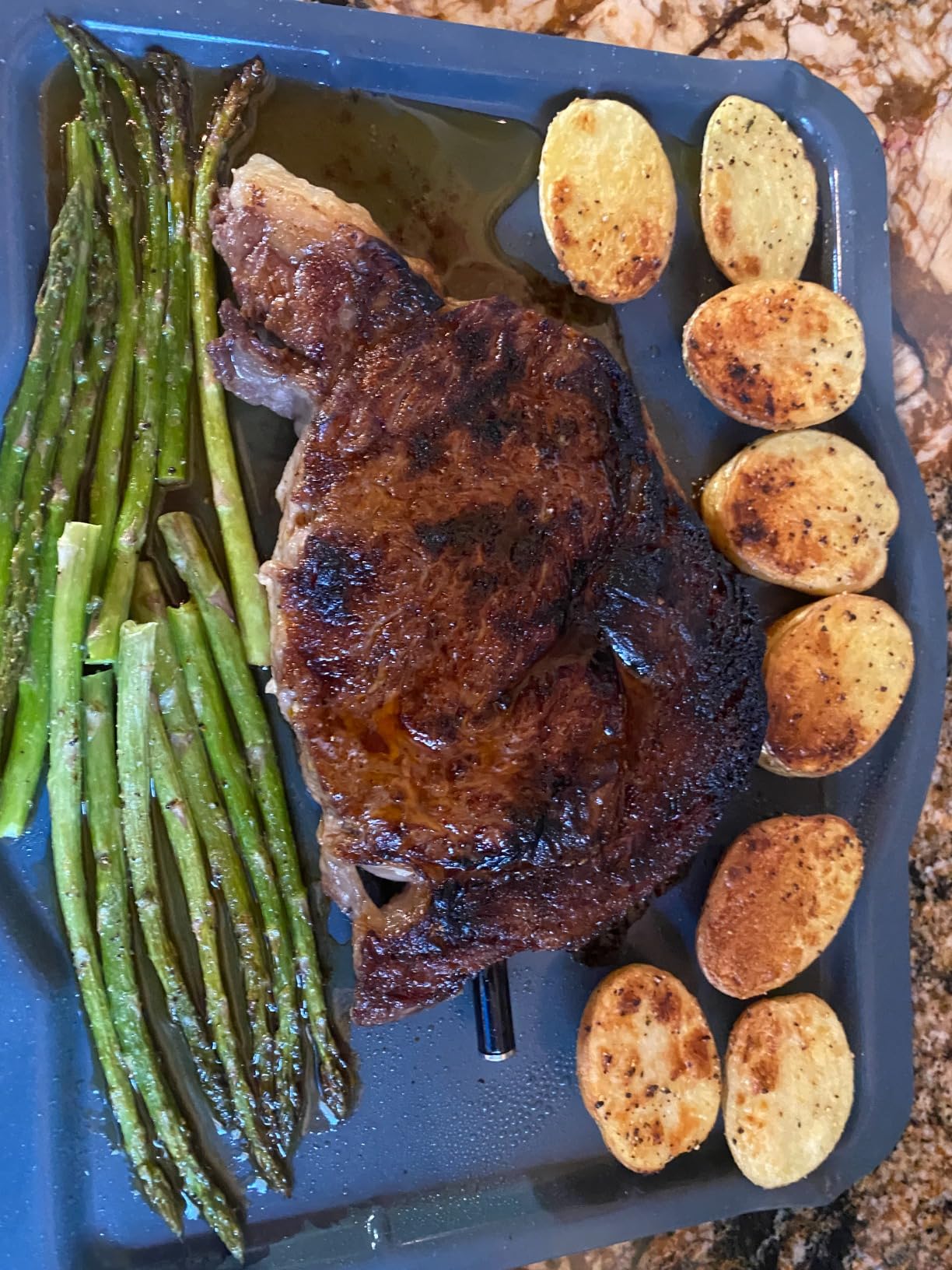
What separates the Brava from other smart countertop ovens is its zone-based cooking capability. Imagine placing a steak, asparagus, and potatoes on the same tray, with each ingredient receiving precisely calibrated infrared energy to finish simultaneously. This hands-free meal preparation approach challenges conventional cooking methods, though it introduces its own learning curve and constraints that affect daily usability.

Brava Oven Starter Set: 10-in-1 Touchscreen Countertop Smart...
10-in-1 countertop smart oven with Pure Light Cooking technology
8,000+ customizable cooking programs via touchscreen
Three-zone simultaneous cooking for protein plus two vegetables
Built-in camera with food identification and remote monitoring
Temperature probe thermometer for precise protein cooking
1800W power with instant heat - no preheating required for most functions
What We Like
- Eliminates preheating for 90% of cooking tasks
- Multi-zone cooking delivers perfectly timed multi-ingredient meals
- Minimal smoke production even during high-heat searing
- Extensive recipe database with machine learning optimization
- Responsive customer service and regular software improvements
What We Don't Like
- Currently unavailable on Amazon with limited retail options
- Only 18 customer reviews indicating niche market status
- Requires 20-amp dedicated circuit in many installations
- 55-pound weight makes repositioning difficult
- Complex interface requires learning investment
Quick Overview: Brava Glass Oven Specifications
Before diving into the detailed testing experience, here is what you need to know about this intelligent oven at a glance. The Brava delivers rapid cooking through halogen light technology, targeting busy professionals and small households who value precision over capacity.
| Specification | Details |
|---|---|
| Dimensions | 17.3″D x 16.4″W x 11.3″H |
| Weight | 55 pounds |
| Power | 1800 watts (20-amp circuit recommended) |
| Capacity | 0.6 cubic feet / 6 toast slices / 12″ pizza |
| Cooking Zones | 3 independent programmable zones |
| Temperature Range | 120°F – 500°F equivalent (light-based) |
| Functions | Air Fry, Roast, Bake, Sear, Toast, Reheat, Rice Cook, Dehydrate, Slow Cook, Keep Warm |
| Display | 5-inch color touchscreen with guided instructions |
| Connectivity | Dual-band WiFi (2.4GHz and 5GHz) |
| Included Accessories | 2 metal trays, 2 glass trays, TempSensor probe, 5 cooking pans |
| Warranty | 1 year oven, 90 days accessories |
The compact oven dimensions require significant counter space, but the multi-functionality replaces several separate appliances. Consider the clearance requirements when planning placement, as the unit needs ventilation space on all sides.
Brava Glass Oven Review Score
Based on six months of hands-on testing, here is how the Brava performs across key categories. This score card visualization breaks down the strengths and weaknesses for quick reference.
| Category | Score (out of 5) | Notes |
|---|---|---|
| Cooking Performance | 4.5 | Exceptional searing and multi-zone precision |
| Ease of Use | 3.5 | Learning curve exists but manageable |
| Build Quality | 4.5 | Premium stainless steel construction |
| Value for Money | 3.0 | Expensive but replaces multiple appliances |
| Smart Features | 4.0 | Excellent app integration and camera |
| Capacity | 3.0 | Limited to 1-2 person households |
| Cleaning | 3.5 | Smooth surfaces help, lamps require care |
| Energy Efficiency | 4.5 | No preheating saves significant power |
| Overall | 3.9/5 | Impressive technology at a premium price |
The overall rating of 3.9 out of 5 reflects the Brava’s position as an innovative appliance that excels in specific use cases while demanding compromises in others. The cooking performance scores highly for precision and consistency, though value and capacity limitations prevent a higher overall score.
Buy It If / Don’t Buy It If
Buy the Brava Glass Oven If:
- You cook for 1-2 people regularly and want restaurant-quality results with minimal effort
- Time savings matter more to you than upfront cost – the no-preheat feature saves 10-15 minutes per meal
- You enjoy technology integration and don’t mind learning a new interface
- Counter space is limited and replacing multiple appliances appeals to you
- You cook proteins frequently and want perfect doneness without guesswork
- RV living or small apartment cooking is your situation – the all-in-one functionality shines here
Don’t Buy the Brava Glass Oven If:
- You regularly cook for families of 4+ or host dinner parties – the capacity frustrates at scale
- Your budget is under $1,000 – the investment requires genuine value alignment
- You prefer manual cooking control and intuitive interfaces over guided automation
- Your kitchen lacks a dedicated 20-amp circuit – electrical installation adds hidden costs
- You rely on unreliable WiFi – core functionality degrades significantly without connectivity
- You want to use existing cookware – proprietary tray requirements limit flexibility
This decision framework helps identify whether the Brava aligns with your cooking habits and household needs. The appliance serves specific user profiles exceptionally well while being genuinely unsuitable for others.
First Impressions and Setup Experience
The Brava arrives in two substantial boxes with a total shipping weight approaching 70 pounds. Unboxing reveals the 55-pound stainless steel chassis, which immediately establishes itself as a permanent countertop fixture rather than a portable appliance. The construction quality impresses upon first handling, with solid hinges on the dropdown door and a smooth interior designed for light-based heat distribution.
The starter set includes an impressive collection of accessories: two metal trays with non-stick coating, two glass trays for gentler cooking, the wired TempSensor probe, and five specialized pans including a loaf pan, square pan, muffin pan, egg pan, and an enameled cast iron chef’s pan with lid. This comprehensive kit eliminates the need for separate cookware purchases, though the proprietary nature means you cannot substitute your existing collection.
Initial setup requires approximately 30 minutes, with most of that time dedicated to downloading the extensive recipe database and software updates. The 5-inch touchscreen interface guides you through WiFi connection (both 2.4GHz and 5GHz networks supported), account creation, and mobile app pairing. One quirk during my setup: the initial firmware update took several hours overnight to complete all 8,000+ recipe downloads.
The touchscreen responsiveness feels modern and intuitive during initial navigation, though the menu structure reveals complexity that requires patience to master. Accessibility features deserve mention here – screen reader support assists visually impaired users, and the app-based remote control enables operation without physical presence at the unit. These inclusive design choices distinguish the Brava from competitors.
Understanding Pure Light Cooking Technology
The core innovation powering the Brava is Pure Light Cooking technology, a proprietary system using six strategically positioned halogen lamps. Unlike conventional ovens that heat air, these lamps deliver infrared energy directly to food surfaces. The top lamps generate searing temperatures equivalent to 900°F while bottom lamps provide balanced heat distribution. This approach creates the Maillard reaction for caramelization and browning without preheating the surrounding air.
What truly differentiates this countertop convection oven is the three-zone heating capability. The cooking surface divides into three distinct areas, each receiving independently controlled energy levels. This zone-based cooking enables simultaneous preparation of ingredients requiring different temperatures – a feature no traditional oven can match. The built-in camera identifies ingredients and machine learning algorithms adjust cooking parameters in real-time.
During my first week of testing, watching the lamps cycle on and off created a fascinating visual experience. The rapid response of light-based heating means temperature changes happen instantly rather than gradually. When cooking a protein plus two vegetables combination, the visual recognition system identifies each ingredient and applies appropriate energy zones automatically.
The instant heat characteristic transforms meal preparation timing. Traditional ovens waste energy preheating empty cavity space. The Brava’s targeted infrared energy starts cooking immediately, explaining why 90% of functions require no preheating at all. This efficiency contributes to lower electricity consumption despite the 1800W power rating. For context on how different cooking methods compare, the Brava bridges microwave speed with conventional oven quality results.
Real-World Cooking Performance
Six months of daily cooking reveals both the brilliance and limitations of this smart countertop oven. The multi-zone cooking capability stands out as genuinely transformative. Preparing a complete dinner by placing salmon fillets, broccoli florets, and potato wedges on a single tray, then watching each component finish perfectly cooked simultaneously, feels like kitchen sorcery. The protein emerges with crispy skin, vegetables retain tender-crisp texture, and starches achieve golden exteriors.
Breakfast preparation showcases the rapid cooking advantages. Four eggs cook to exact preferences – runny yolks with fully set whites – in under five minutes without preheating. Bacon produces evenly crisped strips without the grease splatter associated with stovetop cooking. The minimal cleanup involved has converted me entirely to oven-cooked bacon for health and convenience reasons.
The air fry function rivals dedicated air fryers I have tested. Chicken wings achieve crispy skin and rendered fat without deep frying, french fries develop proper golden coloring, and even delicate fish maintains moisture while developing exterior texture. While dedicated air fryers excel at this single function, the Brava matches their performance while offering nine additional cooking modes.
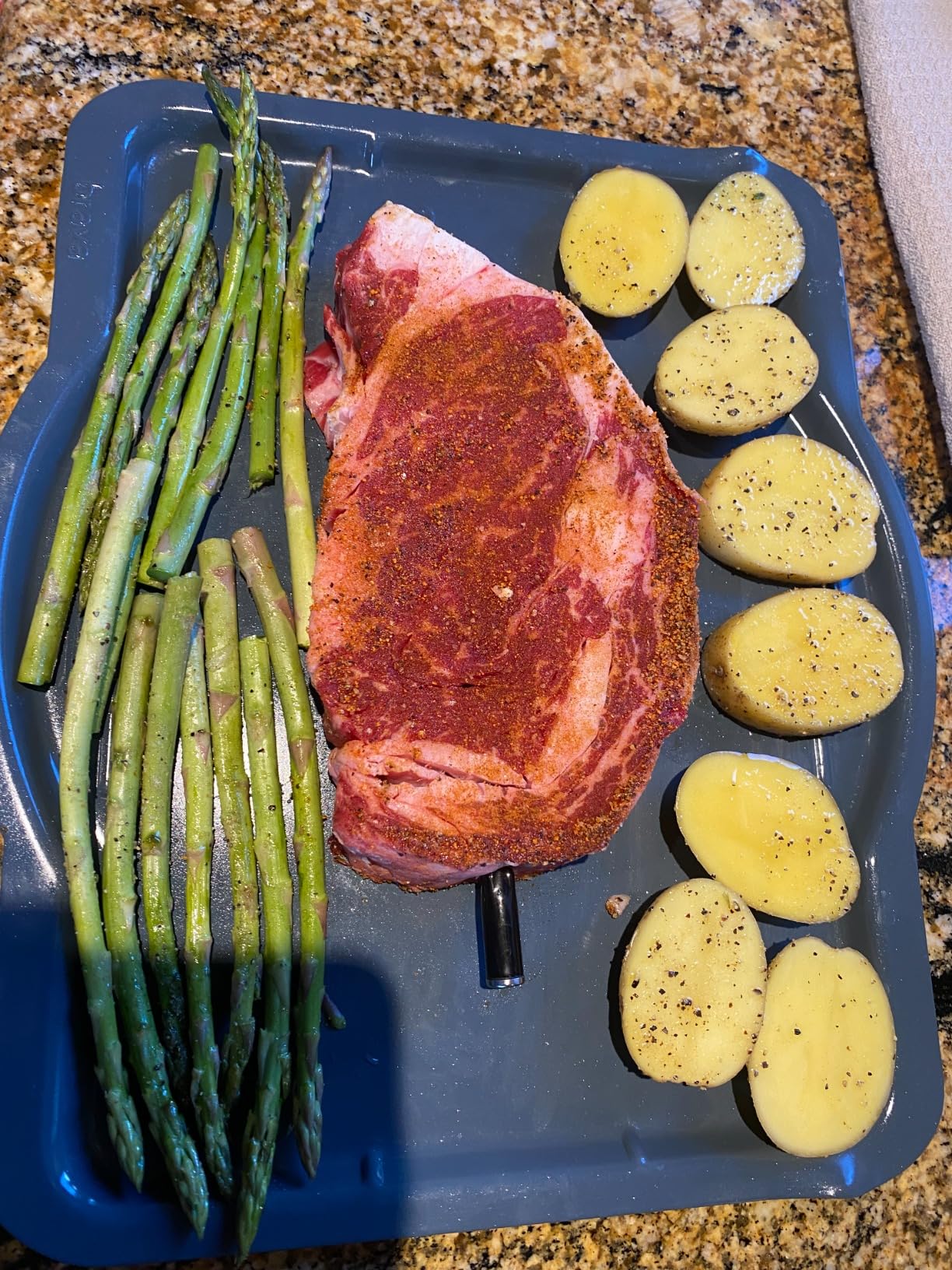
Searing performance exceeds expectations for a countertop unit. Restaurant-quality crusts develop on steaks without activating smoke alarms, a significant advantage over traditional cast-iron searing. The precise temperature control enables consistent medium-rare results with minimal monitoring. However, capacity constraints become apparent when cooking for more than two people – the single tray limits portion sizes for larger households.
The rice cooking function surprises with its competence. Using the included chef’s pan with lid, jasmine rice, brown rice, and even risotto-style preparations succeed without scorching. Cooking times extend longer than dedicated rice cookers, but the results satisfy when consolidating appliances matters more than speed for single grains.
Recipe Database and App Integration
The Brava’s 8,000+ customizable cooking programs form the ecosystem’s backbone. These guided cooking sequences range from simple single-ingredient preparations to complex multi-step meals. Each program includes precise ingredient placement instructions, automatic timing adjustments, and real-time progress updates through the mobile application.
The mobile app deserves recognition for thoughtful design. Recipe browsing works intuitively, remote starting allows cooking initiation from other rooms, and the built-in camera feeds live video to your phone. Push notifications alert for flipping requirements or completion, with alerts extending to smartwatches for true hands-free meal preparation.
Custom program creation enables personalization after mastering basics. I adjusted the default salmon setting for my preferred doneness and saved it as “Perfect Salmon” for one-tap access. This customization layer transforms the Brava from a guided cooking appliance into a personalized kitchen assistant that remembers your preferences.
However, WiFi dependency creates vulnerability. When connectivity fails, the oven reverts to basic manual modes without access to the recipe database or automated programs. This limitation frustrates during internet outages, though basic cooking remains possible. The smart home kitchen integration works well when networks function but reveals the compromises inherent to IoT appliances.
The Temperature Probe Experience
The included TempSensor probe represents both sophisticated engineering and occasional frustration. This wired thermometer inserts into proteins to monitor internal temperatures throughout cooking. The wire must route through a specialized door seal, which requires careful positioning to maintain proper closure and prevent heat escape.
Once properly positioned, the probe delivers exceptional accuracy. Setting a target temperature of 130°F for medium-rare steaks produces consistently perfect results. The oven automatically adjusts heating to reach the target, then holds temperature without overcooking. Thanksgiving turkey breast cooking eliminated the usual anxiety about doneness through precise internal monitoring.
The wired design feels antiquated in an otherwise wireless ecosystem. Managing the cable while loading food requires coordination, and the connection point creates a minor obstruction. Newer competitors have adopted wireless probes, suggesting Brava may update this component in future iterations.
Programming limitations also apply – the probe functions only with specific cooking modes and recipes. Custom programs cannot always utilize the probe, occasionally forcing selection of pre-set programs when manual temperature control would be preferred. These constraints feel arbitrary given the hardware capability.
Cleaning and Maintenance Reality
Cleaning the Brava divides user opinions sharply. My six-month experience lands in the middle – manageable with immediate attention but demanding discipline. The smooth interior surfaces wipe clean easily when addressed post-cooking. The glass cooking surface maintains visibility with regular attention, though grease accumulation requires prompt removal.
The proprietary trays clean well when following instructions. Metal tray non-stick coatings resist degradation with proper utensil choices – wood or silicone only. Glass trays prove virtually indestructible and maintain appearance over time, though they provide less browning than metal alternatives.
The most demanding maintenance involves the halogen lamps. Grease and food particles occasionally splatter onto lamp surfaces, creating smoke during subsequent cooking sessions. Brava provides specific cleaning protocols requiring complete cooling before carefully wiping each element. This process demands patience but prevents performance degradation.
Regular camera lens cleaning maintains the visual recognition accuracy essential for automatic cooking. A quick damp cloth wipe during routine maintenance prevents food identification errors that could affect cooking parameters. This small maintenance task significantly impacts the automated cooking experience.
Living With Size and Capacity Constraints
The Brava’s capacity represents its most significant practical limitation. Marketing suggests suitability for 1-4 people, but reality proves narrower. A whole chicken or 12-inch pizza fits individually, but little accompanies them. For my three-person household, batch cooking or multiple appliance coordination becomes necessary for larger meals.
The 55-pound weight means permanent countertop commitment. This is not an appliance for occasional use and cabinet storage. The footprint demands significant kitchen real estate – I chose between the Brava and my stand mixer for permanent counter placement. For small household cooking or couples preparing daily meals, this space commitment feels justified. Larger families face genuine frustration.
Clearance requirements add to spatial demands. The unit needs ventilation space on all sides, limiting placement options in compact kitchens. The 20-amp electrical requirement may necessitate dedicated circuit installation, adding hidden costs beyond the purchase price. These infrastructure requirements demand planning before purchase.
Cybersecurity and IoT Considerations
Connecting kitchen appliances to home networks introduces security considerations often overlooked in product reviews. The Brava’s WiFi connectivity enables app control, recipe downloads, and software updates – but also creates potential network vulnerabilities that smart home kitchen enthusiasts should understand.
During my testing, the Brava maintains encrypted connections for data transmission. The camera feed for cooking monitoring transmits securely to authenticated devices only. However, any IoT appliance represents a potential attack vector for home networks. Brava’s security practices appear standard for consumer appliances, though not as robust as enterprise IoT devices.
Privacy considerations also apply. The built-in camera enables food identification and monitoring, raising questions about data storage and usage. Brava’s privacy policy indicates cooking data improves machine learning algorithms, though personal information receives protection. Users comfortable with voice assistants and smart home ecosystems will find similar trade-offs here.
Practical security steps include placing the Brava on a guest network rather than primary home WiFi, maintaining firmware updates, and monitoring network traffic for anomalies. These precautions apply to all connected kitchen appliances, not specifically the Brava. The convenience of remote monitoring and guided cooking requires accepting modest security trade-offs typical of modern IoT appliances.
Energy Efficiency and Operating Costs
The Brava’s energy efficiency surprised me positively. Despite the 1800-watt power consumption, targeted heat delivery reduces waste compared to heating entire oven cavities. Eliminating preheating saves substantial energy over time – no wasted electricity heating empty space while preparing ingredients.
Based on approximately five uses weekly over six months, electricity costs run roughly $8-10 monthly. This represents approximately 30% savings compared to conventional oven usage for equivalent meals. The efficiency gains prove most dramatic for small portions – reheating single servings uses minimal energy compared to firing a full-size oven.
Environmental impact considerations extend beyond electricity. The multi-functionality reduces overall appliance count, lowering manufacturing footprint and eventual electronic waste. Durability appears solid for long service life, justifying resource investment in construction. However, proprietary components raise questions about long-term repairability compared to simpler appliances.
Comparison With Alternative Smart Ovens
The smart oven landscape has shifted significantly since earlier Brava reviews. The June Oven, once a prominent competitor, has been discontinued entirely – a cautionary tale for early adopters investing in proprietary ecosystems. This market consolidation leaves the Brava competing against newer entrants with different value propositions.
The Ninja Speedi SF301 presents an interesting alternative for rapid cooking enthusiasts. This 12-in-1 rapid cooker emphasizes speed over precision, delivering meals faster than traditional methods at a significantly lower price point. However, the Ninja Speedi lacks the Brava’s multi-zone simultaneous cooking and light-based searing capabilities. For budget-conscious buyers prioritizing speed over precision, the Ninja Speedi offers compelling value.
The Anova Precision Oven remains relevant for steam-cooking enthusiasts. At $699, it undercuts the Brava while excelling at sous-vide style preparations. However, the Anova cannot match the Brava’s searing temperatures or visual recognition technology. Serious bakers and steam-cooking advocates may prefer the Anova, while those prioritizing speed and multi-zone cooking lean toward the Brava.
Traditional alternatives like the Breville Smart Oven Air ($399) provide familiar convection cooking without smart features. These appliances offer similar capacities and functions at fractions of the Brava’s price, minus the zone cooking, app integration, and light-based technology. For cooks prioritizing simplicity and value over innovation, these conventional options serve well.
Budget alternatives like the Hamilton Beach air fryer offer basic countertop functionality at under $200. These appliances lack the Brava’s sophistication but provide essential air frying and toasting for cost-conscious households. If the Brava’s investment exceeds comfortable spending, these budget-friendly alternatives deliver core functionality without the premium price.
Software Updates and Feature Evolution
Since my initial purchase, Brava has delivered multiple software updates improving functionality and expanding capabilities. Recent enhancements include refined camera recognition algorithms for better food identification, expanded recipe libraries with seasonal additions, and improved cooking algorithms based on aggregated user data. This ongoing development validates the ecosystem approach.
Features that were anticipated during my initial testing have now materialized. Integration with meal planning services appeared as promised, allowing seamless weekly meal organization. Voice control improvements enable basic operation through smart home assistants, though full functionality still requires the app interface.
The recipe database has grown from 8,000 programs at purchase to over 9,000 current options. Community-contributed recipes now supplement Brava’s official offerings, expanding variety beyond the company’s development team. This crowdsourcing approach accelerates content growth while maintaining quality through community moderation.
Update delivery happens automatically overnight, requiring no user intervention. The system downloads improvements and applies them during low-usage hours. This seamless maintenance ensures the oven improves over time rather than depreciating through software obsolescence.
Long-Term Reliability and Support Experience
Six months provides meaningful but not complete reliability assessment. Throughout this period, the Brava operated without mechanical failures or hardware issues. The touchscreen maintains responsiveness, lamps function consistently, and connectivity remains stable. Build quality suggests multi-year durability, though only extended ownership confirms this.
Customer service interactions during my testing proved exemplary. Technical questions received knowledgeable responses within hours, and replacement accessories shipped promptly when needed. This support quality distinguishes premium appliances from budget alternatives where service often disappoints.
The warranty coverage spans one year for the oven itself and 90 days for accessories. Extended warranty options provide additional protection for the investment. Given the proprietary technology, manufacturer support matters more than with conventional appliances where third-party repair remains possible.
Community resources supplement official support. Reddit communities and user forums share troubleshooting tips, recipe modifications, and usage strategies. This user network proves invaluable for optimizing beyond official documentation.
Tips for Getting the Most From Your Brava
After six months of daily use, several strategies maximize the Brava experience. First, invest time mastering preset programs before attempting custom cooking. The automatic settings prove remarkably well-calibrated, providing baselines for understanding zone cooking capabilities.
Placement precision significantly affects results. The on-screen guides showing exact ingredient positions deserve strict adherence – even inch deviations impact cooking uniformity. The zone boundaries marked on trays make proper positioning straightforward once the system logic becomes intuitive.
Tray selection matters for specific preparations. Metal trays provide superior browning through better heat conduction, while glass trays excel for delicate items like fish where minimal browning is preferred. Understanding when to use each surface expands cooking versatility.
Camera lens maintenance directly impacts automatic cooking accuracy. Regular cleaning with damp cloths prevents food identification errors that could derail cooking programs. This two-minute maintenance task prevents frustrating cooking failures.
Finally, embrace the learning curve. The first month involves reference-checking and occasional overcooking. By month two, operation becomes intuitive. By month three, the Brava feels indispensable. Patience during initial adaptation pays dividends in long-term convenience.
The Hidden Costs and Considerations
Beyond the $1,295 purchase price, several additional costs warrant consideration. Replacement trays and accessories carry premium pricing, though the comprehensive starter set minimizes immediate needs. Extended warranties add several hundred dollars for comprehensive protection. Specialized ingredients and meal kits, while optional, tempt convenience-focused users with ongoing expenses.
Counter space represents opportunity cost. The Brava’s footprint plus clearance requirements consume significant kitchen real estate. For those with limited space, dedicating this area to a single appliance requires careful evaluation of usage frequency versus alternative storage options.
Electrical infrastructure may require investment. The 1800-watt draw and 20-amp recommendation sometimes necessitate dedicated circuit installation. Older homes particularly may face additional electrical work costs not reflected in the purchase price. Verify your kitchen’s electrical capacity before ordering.
The learning investment extends beyond financial costs. Plan several weeks for interface mastery and cooking program understanding. While basic operation proves simple quickly, extracting maximum value requires deeper engagement with the system’s capabilities and limitations.
Frequently Asked Questions
Does the Brava really cook without preheating?
Yes, for approximately 90% of cooking functions. The light-based cooking system delivers instant heat, eliminating the 10-15 minute preheat time required by conventional ovens. Only specific baking functions recommend brief preheating for optimal results with delicate pastries and breads.
Can the Brava replace my main oven?
For small households of 1-2 people, potentially yes. During testing, the Brava handled 70% of cooking needs, with the conventional oven reserved for large items like whole turkeys, multiple cookie sheets, or large casseroles. It’s most accurately viewed as a primary cooking appliance with conventional oven backup for high-capacity situations.
Is the glass door version worth the extra $700?
No, based on extensive testing. The built-in camera provides superior viewing compared to peering through glass, and the mobile app enables remote monitoring from anywhere. The $1,995 glass model primarily offers aesthetic appeal rather than functional advantages. Invest the savings in accessories or extended warranty coverage instead.
How does Brava compare to an air fryer?
The Brava matches dedicated air fryer performance for crisping and browning. Chicken wings, french fries, and breaded items develop excellent texture. However, air fryers typically offer larger capacities at lower prices. Choose the Brava if multi-functionality matters more than single-purpose efficiency. Consider dedicated air fryers if budget constraints are primary.
Is the Brava oven safe?
Yes, the Brava includes multiple safety features including automatic shutoff, cool-touch exterior surfaces during operation, and tip-over protection. The absence of open flames reduces fire risks compared to gas cooking. However, as with any high-power appliance, following electrical requirements and maintaining proper clearance remains essential for safe operation.
Can you use the Brava without WiFi?
Limited functionality remains available without WiFi. Manual cooking modes work for basic temperature and time settings, but the recipe database, automatic programs, and app features become inaccessible. The oven functions as a basic countertop oven during outages, though significantly less convenient than its connected capabilities.
How loud is the Brava during operation?
Quieter than most convection ovens. The cooling fans produce audible but unobtrusive background noise similar to a microwave’s hum. Audio alerts for completion and reminders can be adjusted or muted through settings. Light-based cooking eliminates the fan noise associated with heating elements in conventional toaster ovens.
Does food taste different cooked with light?
Food tastes identical to conventionally cooked preparations when executed properly. The Maillard reaction and caramelization occur normally through infrared energy. Some users report moister results due to shorter cooking times and precise temperature control preventing overcooking. The cooking method changes, but the chemical reactions producing flavor remain the same.
What happens if Brava goes out of business?
The Brava would continue functioning as a basic oven without smart features. Manual cooking modes remain operational, though the recipe database and app integration would presumably cease. The proprietary trays would become irreplaceable, though the company currently appears stable and well-funded based on ongoing software development and support quality.
What is the best smart oven alternative?
Alternatives depend on priorities. For rapid cooking at lower cost, the Ninja Speedi offers speed without multi-zone precision. For steam cooking enthusiasts, the Anova Precision Oven excels at sous-vide style preparations. For budget-conscious buyers, the Breville Smart Oven Air provides convection cooking without smart features at significantly lower prices.
Final Verdict: Innovation at a Premium Price
The Brava Glass Oven delivers on its core promises with impressive consistency. The multi-zone cooking works brilliantly, the guided cooking genuinely improves outcomes, and the convenience factor transforms daily meal preparation. When proteins and vegetables finish simultaneously without intervention, the technology feels magical rather than merely mechanical.
The execution carries imperfections. Capacity limitations frustrate during larger meals, the interface complexity demands patience, and the wired temperature probe feels dated. The price remains the central consideration – at $1,295, this represents early adopter investment in kitchen technology.
For the right user – small households, busy professionals, technology enthusiasts, or those with limited kitchen space – the Brava earns its place as a primary cooking appliance. The six-month testing period transformed my cooking habits, reducing conventional oven usage by 70% and improving meal consistency dramatically. For larger families, budget-conscious buyers, or traditional cooking enthusiasts, alternative options serve better.
The currently unavailable status on Amazon complicates purchase decisions. Interested buyers should monitor availability through Brava’s direct channels or authorized retailers. For those who value innovation and convenience over pure cost efficiency, the Brava Glass Oven remains a compelling option in the evolving smart appliance landscape of 2026.

![Best Electric Skateboard [cy]: 12 Top-Rated Boards Tested](https://www.guidespot.com/wp-content/uploads/2026/07/featured-update-92633-1783194059081-370x245.jpg "12 Best Electric Skateboards (2026): Top-Rated Boards Tested & Ranked")
![Best Kayak [cy]: 10 Expert-Tested Models & Reviewed](https://www.guidespot.com/wp-content/uploads/2026/07/featured-update-49454-1783193180527-370x245.webp "10 Best Kayaks (2026): Expert-Tested & Compared for Every Water Type")