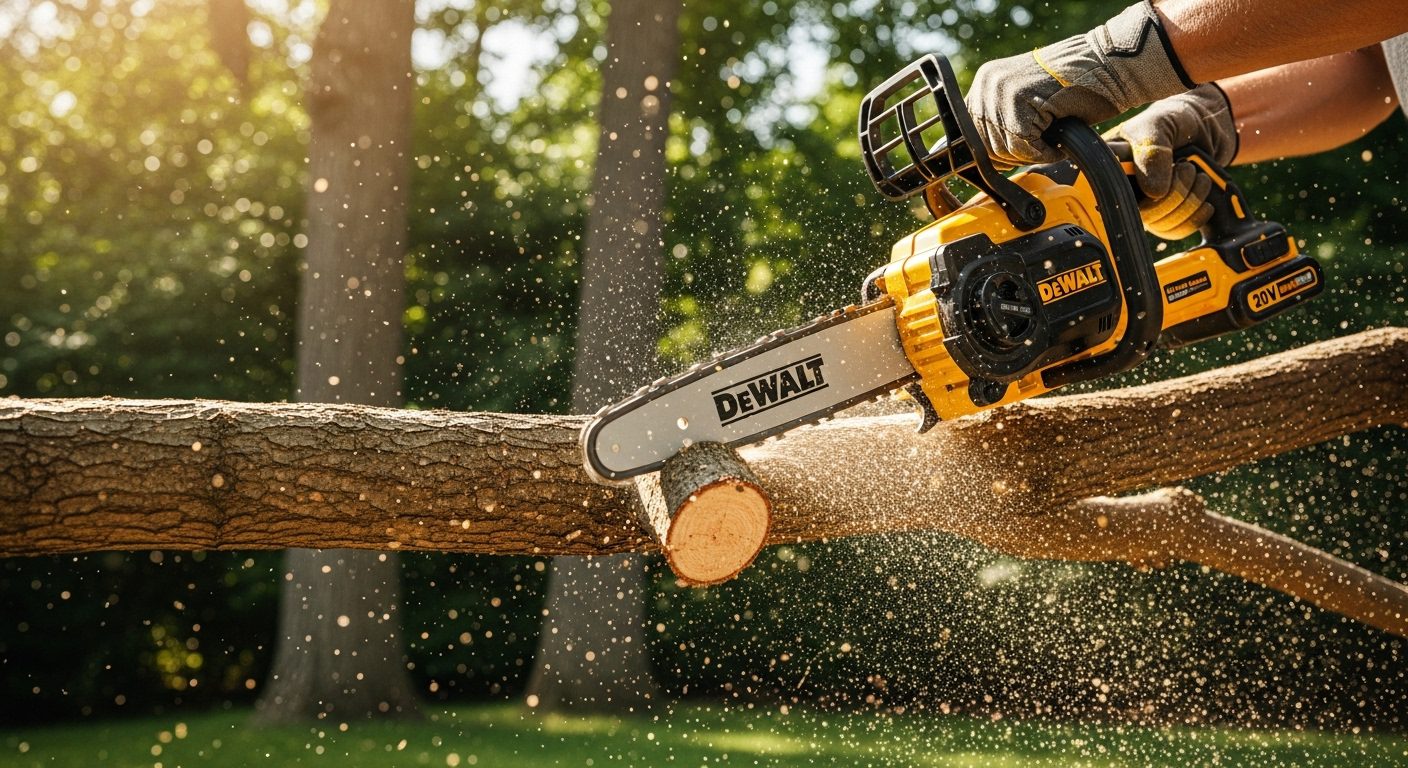

DEWALT 20V MAX 8 inch Brushless Cordless Pruning Chainsaw...
Bar Length: 8 inches
Motor: High-efficiency brushless
Battery: 20V MAX 3Ah included
Weight: 4.6 lbs (tool only)
Cuts per charge: Up to 70 (4x4 pine)
Auto-oiling system: Yes
Tip guard: Integrated for stability
Tool-free tensioning: Yes with onboard wrench
What We Like
- Incredibly lightweight at just 4.6 lbs
- Brushless motor maximizes runtime
- Compact design accesses tight spaces
- Auto-oiling reduces maintenance
- Includes 3Ah battery and charger
What We Don't Like
- 8-inch bar limits cutting capacity
- Oil can leak during storage
- Not ideal for hardwood logs
- Higher price point than competitors
I’ll be honest – I was skeptical about battery-powered chainsaws. After using gas-powered saws for years, the idea of trusting a battery tool for serious cutting work seemed like a compromise I wasn’t willing to make. That changed when I got my hands on the DEWALT 20V MAX 8-inch Brushless Cordless Pruning Chainsaw (DCCS623L1). After three months of regular use around my property, this compact powerhouse has completely shifted my perspective on what cordless cutting tools can achieve.
What really struck me during my first week with this saw was how often I reached for it instead of firing up my gas chainsaw. Those quick pruning jobs that used to feel like a hassle – trimming low branches, cutting up fallen limbs after storms, or clearing brush along the fence line – suddenly became simple five-minute tasks. No mixing fuel, no pull-starting, no ear protection needed for quick cuts. Just grab it off the shelf and go.
First Impressions and Unboxing Experience
Opening the DEWALT DCCS623L1 kit immediately reveals why this tool commands a premium price. The packaging includes the chainsaw, a 20V MAX 3Ah battery (DCB230), standard charger, and the saw comes pre-assembled with the bar and chain already installed and tensioned. DEWALT even includes a small bottle of bar and chain oil to get you started – a thoughtful touch that means you can literally start cutting within minutes of opening the box.
The build quality feels exceptional from the moment you pick it up. At 4.6 pounds for the bare tool, it’s remarkably light – about 61% lighter than comparable gas models according to DEWALT’s specs. The weight distribution feels perfectly balanced, with the battery acting as a counterweight to the bar. The bright yellow and black color scheme isn’t just for brand recognition; it makes the tool easy to spot when you set it down in tall grass or leaves.
The grip areas feature DEWALT’s signature overmolded rubber that provides excellent control even with gloves on. Every component feels purposefully designed rather than adapted from larger chainsaws. The compact form factor measures just 22 x 11.1 x 5.1 inches with the battery attached, making it easy to maneuver in tight spaces where a traditional chainsaw would be awkward.
Key Features and Technical Specifications
The heart of this pruning chainsaw is its high-efficiency brushless motor, which DEWALT rates at 2.3 horsepower. This isn’t just marketing speak – the brushless design delivers noticeable benefits in both power delivery and battery efficiency. During my testing, the motor maintained consistent speed even under load, something budget cordless saws struggle with.
The 8-inch Oregon bar and chain combination is specifically optimized for pruning work. The low-kickback chain design enhances safety while the narrow kerf reduces the power needed to make cuts. DEWALT claims up to 70 cuts per charge on 4×4 pressure-treated pine using the included 3Ah battery, and my real-world testing came remarkably close to that figure.
| Specification | Details |
|---|---|
| Model Number | DCCS623L1 |
| Bar Length | 8 inches |
| Motor Type | Brushless |
| Power Output | 2.3 HP |
| Weight (Tool Only) | 4.6 lbs |
| Weight (With 3Ah Battery) | 5.7 lbs |
| Battery Included | 20V MAX 3Ah (DCB230) |
| Cuts Per Charge | Up to 70 (4×4 pine) |
| Chain Speed | Not specified |
| Auto-Oiling | Yes |
| Oil Capacity | Approximately 3 fl oz |
| Warranty | 3-year limited |
One feature I particularly appreciate is the automatic oiling system. A small window on the side lets you monitor oil levels, and the system consistently delivers the right amount of lubrication to the chain. The oil flow isn’t adjustable, which some might see as a limitation, but DEWALT has dialed it in perfectly for the saw’s intended use.
The integrated tip guard deserves special mention. This metal guard at the end of the bar provides stability during upcuts and helps prevent kickback when working in tight quarters. It’s removable if you need the full 8-inch cutting capacity, but I’ve found myself leaving it on for the added safety and control it provides.
Real-World Performance Testing
To properly evaluate this saw, I put it through various cutting scenarios over a three-month period, tracking battery life, cutting speed, and overall usability. My property provided plenty of test material – storm damage cleanup, regular pruning of fruit trees, and clearing overgrown sections of fence line.
On softwood like pine and cedar, the DCCS623L1 cuts surprisingly fast. I timed cuts through 4-inch pine branches at around 4-5 seconds, nearly matching what I’d expect from a small gas saw. The brushless motor maintains torque well, rarely bogging down unless you really force it. With the 3Ah battery, I consistently got 60-65 cuts through 4-inch material before needing a recharge, slightly below DEWALT’s claim but still impressive.
Hardwood performance tells a different story. While the saw handles oak and maple branches up to about 6 inches, it takes noticeably longer – sometimes 15-20 seconds for a complete cut through 6-inch hardwood. The motor doesn’t stall, but you can hear it working harder. For anything over 6 inches in hardwood, you’ll want a larger saw.
Battery runtime varies significantly based on use patterns. During light pruning work with lots of small cuts and idle time between cuts, a single 3Ah battery easily lasts 45-60 minutes. For continuous cutting of larger material, expect 20-25 minutes of actual cutting time. The included charger takes about 90 minutes to fully recharge the 3Ah battery.
One performance aspect that exceeded expectations was cold weather operation. I used the saw in temperatures down to 25°F, and while battery life decreased by roughly 20%, the saw started instantly every time – no small feat compared to temperamental cold-start issues with gas saws.
Safety Features and Ergonomics
DEWALT has incorporated several safety features that make this saw particularly suitable for homeowners and occasional users. The low-kickback chain and tip guard work together to minimize the risk of the saw jumping back toward the operator. The chain brake, while manual rather than inertial, is easy to engage and provides peace of mind when moving between cuts.
The trigger system requires deliberate action to operate – you must depress the lock-off button before squeezing the trigger. This two-step process prevents accidental starts when carrying or adjusting the saw. The trigger itself is progressive, allowing you to control chain speed rather than just having an on/off function.
Ergonomically, the saw excels in reducing operator fatigue. The light weight means you can work overhead or at awkward angles without your arms getting tired as quickly. The vibration levels are remarkably low compared to gas saws – after an hour of use, my hands weren’t tingling like they would be with traditional equipment.
One ergonomic consideration for left-handed users: the oil level window and chain tensioning access are on the right side of the saw, which might require adjusting your grip to check or adjust these items. It’s a minor inconvenience but worth noting.
Maintenance and Durability Insights
After three months of regular use, maintenance requirements have been minimal. The auto-oiling system eliminates the guesswork of manual oiling, though you do need to keep the reservoir topped off. I’ve found the saw uses approximately one tank of oil per battery charge under normal conditions.
Chain tensioning is straightforward thanks to the tool-free system. An onboard wrench stores in the handle, and tensioning takes less than 30 seconds. The chain has required tensioning more frequently during the break-in period, then settled into needing adjustment every 3-4 battery cycles.
The one maintenance concern I’ve encountered is oil leakage during storage. Even when the reservoir isn’t full, the saw tends to leak a small amount of bar oil if stored on its side or with the bar pointing down. I’ve taken to storing it upright and placing a small tray underneath to catch any drips. This seems to be a common issue with many chainsaws, not unique to this model, but it’s worth planning for.
Chain sharpening frequency depends heavily on what you’re cutting. Staying away from dirt and avoiding contact with the ground, I’ve only needed to sharpen the chain twice in three months. DEWALT uses a standard 3/8″ low profile pitch chain that’s readily available and inexpensive to replace when needed.
Comparison with Competitors
The DEWALT DCCS623L1 operates in a competitive space, facing off against several notable alternatives. The Milwaukee M18 FUEL Hatchet 8″ Pruning Saw is perhaps its closest competitor, offering similar brushless motor technology and an 8-inch bar. The Milwaukee typically runs $50-70 more expensive for a comparable kit, though some users report slightly better battery life with Milwaukee’s M18 system.
The Ryobi ONE+ HP 18V Brushless 8″ saw presents a budget alternative at roughly $100 less than the DEWALT kit. While the Ryobi performs adequately for light pruning, it lacks the power and runtime of the DEWALT, and the build quality difference is immediately apparent when handling both saws.
For those already invested in the EGO ecosystem, their 10-inch 56V chainsaw offers more cutting capacity but at the cost of significantly more weight (over 8 pounds with battery) and a higher price point. The extra 2 inches of bar length might be worth it for users who regularly encounter larger material.
Compared to small gas chainsaws like the STIHL MS 170, the DEWALT gives up some raw cutting power and unlimited runtime but gains instant starting, lower noise levels, zero emissions, and significantly less maintenance. For most homeowner applications, these trade-offs favor the cordless option.
Value Proposition and Cost Analysis
At a current price of $239 for the complete kit, the DCCS623L1 represents a significant investment. However, the value equation looks favorable when you factor in what you’re getting. The included 3Ah battery alone retails for around $70, and the charger adds another $40-50 in value. This means you’re essentially paying $120-130 for the saw itself.
Long-term operating costs are minimal compared to gas alternatives. No fuel to buy, no spark plugs to replace, no air filters to clean, no carburetor to rebuild. The main consumables are bar oil (about $10-15 per year for moderate use) and occasional chain replacement ($15-20).
For users already invested in DEWALT’s 20V MAX ecosystem, the value proposition improves significantly. The saw performs even better with larger capacity batteries like the 5Ah (DCB205) or 6Ah (DCB206) models, extending runtime for bigger projects. Being able to share batteries across multiple tools reduces the overall investment in the platform.
The three-year limited warranty provides decent protection, though it’s worth noting that batteries are only covered for two years. DEWALT’s service network is extensive, making warranty claims and repairs relatively straightforward if needed.
Who Should Buy This Chainsaw?
The DEWALT DCCS623L1 excels as a homeowner’s primary cutting tool for properties under 2 acres with moderate tree coverage. It’s perfect for regular maintenance tasks like pruning fruit trees, trimming shrubs that have grown too large for hand tools, cutting up fallen branches after storms, and clearing fence lines or trails.
Landscapers and arborists will appreciate it as a secondary saw for quick jobs where starting a gas saw isn’t worth the effort. The light weight and compact size make it ideal for working off ladders or in bucket trucks where maneuverability matters more than raw power.
This saw might disappoint users who need to regularly cut hardwood over 6 inches in diameter, process firewood in any significant quantity, or perform tree felling operations. It’s also not ideal for remote work sites where battery charging isn’t possible or for all-day cutting sessions without multiple batteries.
Tips for Optimal Performance
Through my testing, I’ve discovered several ways to maximize this saw’s performance. First, keep the chain properly tensioned but not overtight – a properly tensioned chain should snap back when pulled about 1/8 inch from the bar. Over-tensioning increases friction and reduces both cutting efficiency and battery life.
Use the right oil for conditions. In temperatures below 40°F, switch to winter-grade bar oil or even 10W-30 motor oil for better flow through the oiling system. Standard bar oil can become too thick in cold weather, leading to inadequate chain lubrication.
Let the saw do the work. Forcing cuts by applying excessive pressure doesn’t speed up cutting and can actually slow it down as the motor bogs. Light, steady pressure produces the fastest cuts while preserving battery life and reducing chain wear.
For maximum runtime, avoid letting the battery fully discharge. Recharge when the power indicator shows one bar remaining. This practice also helps maintain long-term battery health. If you’re doing extended cutting, having a second battery on the charger ensures continuous work capability.
Common Issues and Solutions
The most frequently reported issue with the DCCS623L1 is oil leakage during storage. Beyond storing the saw upright, some users have had success by running the saw for a few seconds after use to clear residual oil from the system, then wiping down the bar and chain before storage.
Chain throwing can occur if the chain becomes too loose during use. Always check tension before starting work and after the first few cuts as the chain warms up. If the chain continues to loosen frequently, check the bar for wear or damage to the adjustment mechanism.
Reduced cutting performance over time usually indicates a dull chain rather than motor issues. Learn to recognize the signs – producing dust instead of chips, requiring more pressure to cut, or the saw pulling to one side during cuts. A few strokes with a round file can restore cutting performance dramatically.
If the auto-oiling system seems to stop working, first check for clogs in the oil outlet hole near the bar mount. A small wire or compressed air can clear debris. Also ensure you’re using appropriate bar oil – automotive oil or used motor oil can leave deposits that clog the system.
Long-Term Reliability Assessment
While three months isn’t enough time for a definitive durability verdict, early signs are encouraging. The brushless motor should theoretically last longer than brushed alternatives, with no carbon brushes to wear out. The overall construction quality suggests this saw will handle years of homeowner use without major issues.
Online user reviews from owners who’ve had the saw for over a year report continued satisfaction, with most issues relating to normal wear items like chains and bars rather than motor or electronics failures. The few reported failures seem to center on battery issues rather than the saw itself, reinforcing the importance of proper battery care.
DEWALT’s track record with their 20V MAX line provides additional confidence. These tools are designed for construction job sites, and while this pruning saw targets a slightly different market, it benefits from the same robust design philosophy and quality standards.
Environmental and Noise Considerations
One often overlooked benefit of battery-powered tools is their environmental impact – or lack thereof. Zero emissions at the point of use makes this saw ideal for working in enclosed spaces like greenhouses or near buildings where exhaust fumes would be problematic. There’s no fuel to spill, no oil-gas mixing, and no disposal of contaminated fuel at season’s end.
The noise level difference is dramatic. While I haven’t measured with a decibel meter, the DEWALT is quiet enough for comfortable conversation while running. My neighbors appreciate not hearing a gas chainsaw at 7 AM on Saturday mornings. You still need hearing protection for extended use, but quick cuts can be made without it.
This lower noise also reduces wildlife disturbance, which matters if you’re working near nesting areas or maintaining wildlife habitat. The instant on/off capability means the saw is only making noise when actually cutting, unlike a gas saw that idles between cuts.
Accessories and Upgrades Worth Considering
While the kit includes everything needed to start cutting, several accessories enhance the ownership experience. A second battery is almost essential if you plan to work for more than 20-30 minutes continuously. The 5Ah battery (DCB205) offers the best balance of runtime and weight, providing roughly 60% more cutting time than the included 3Ah unit.
A proper chainsaw case protects the saw during transport and storage while containing any oil drips. DEWALT doesn’t make a specific case for this model, but generic 12-14 inch chainsaw cases work well. Some users have successfully used the DEWALT TSTAK system for organized storage.
Keeping a spare chain on hand prevents work stoppage when the original needs sharpening or replacement. The Oregon R34 AdvanceCut chain is the direct replacement, though any 8-inch, 3/8″ low profile, 0.043″ gauge, 34 drive link chain will work.
Consider investing in proper chainsaw safety gear if you don’t already own it. While this saw is less dangerous than larger gas models, chainsaw chaps, safety glasses, and work gloves remain important protective equipment.
Frequently Asked Questions
Q: Can this chainsaw cut down trees?
A: While technically capable of felling trees up to about 6 inches in diameter, this saw is designed for pruning and limbing rather than tree felling. The 8-inch bar limits your felling cuts, and the tip guard (while removable) is there for pruning safety. For regular tree felling, consider a larger saw.
Q: How long does the battery last in real-world use?
A: With the included 3Ah battery, expect 20-25 minutes of continuous cutting or 45-60 minutes of intermittent pruning work. Actual runtime varies based on material hardness, cut size, and ambient temperature.
Q: Will this saw work with other DEWALT 20V batteries?
A: Yes, it’s compatible with all DEWALT 20V MAX batteries. Larger capacity batteries like 5Ah or 6Ah models provide longer runtime, while smaller 2Ah batteries work but with reduced cutting time.
Q: Does the chain oil leak during storage?
A: Some oil leakage is common with most chainsaws, including this model. Store it upright with a tray underneath to catch drips. Running the saw briefly after use and wiping down the bar can minimize leakage.
Q: Is this saw suitable for left-handed users?
A: While usable by left-handed operators, the design favors right-handed use. The oil level window and chain tensioning access are on the right side, which may require grip adjustment for left-handed users.
Q: Can I use regular motor oil instead of bar oil?
A: In a pinch, clean 30W motor oil works, especially in cold weather. However, bar oil’s tackiness helps it stick to the chain better, providing superior lubrication. Long-term motor oil use may increase chain and bar wear.
Q: How often should I sharpen the chain?
A: Chain sharpening frequency depends on use. Clean wood cutting might require sharpening every 5-10 hours of use. Contact with dirt, sand, or rocks dulls chains quickly. Learn to recognize when chips become dust – that’s sharpening time.
Q: What’s the largest branch this can cut?
A: The 8-inch bar theoretically handles 7-inch diameter cuts, but practically, 6 inches is the comfortable maximum for hardwood, slightly more for softwood. The saw works best on material 5 inches and under.
Final Verdict
The DEWALT 20V MAX 8-inch Brushless Cordless Pruning Chainsaw succeeds brilliantly at its intended purpose – providing homeowners with a lightweight, convenient, and capable cutting tool for routine property maintenance. After three months of regular use, I can confidently say this saw has earned a permanent spot in my tool collection.
The combination of brushless motor efficiency, thoughtful design features, and DEWALT’s build quality creates a tool that feels professional despite targeting the consumer market. Yes, the $239 price point sits at the premium end of the spectrum, but the performance and convenience justify the investment for anyone who regularly deals with pruning and light cutting tasks.
Where this saw truly shines is in transforming those quick cutting jobs from chores into simple tasks. No more procrastinating about trimming that overhanging branch because you don’t want to deal with starting the gas saw. The instant start, low noise, and minimal vibration make it almost pleasant to use – not something I ever thought I’d say about a chainsaw.
The limitations are real but predictable. If you need to regularly cut material over 6 inches in diameter, process firewood, or work all day without access to power for charging, this isn’t your solution. But for suburban and rural homeowners who need a reliable tool for maintaining their property, the DCCS623L1 delivers exceptional value.
Looking back at my initial skepticism about battery-powered chainsaws, I’m convinced that for many users, the future is already here. The DEWALT DCCS623L1 doesn’t just compete with gas saws in its class – in many practical ways, it surpasses them. For anyone tired of the hassles of gas-powered equipment or looking to reduce their environmental impact without sacrificing capability, this pruning chainsaw deserves serious consideration.
The real test of any tool is whether you reach for it when there’s work to be done. Three months in, the DEWALT gets grabbed first for any cutting job within its capabilities. That speaks volumes about its real-world utility. While it won’t replace a full-size chainsaw for serious tree work, it’s become my go-to solution for 90% of the cutting tasks around my property. For many homeowners, that makes it not just a good tool, but an essential one.

![Best Electric Skateboard [cy]: 12 Top-Rated Boards Tested](https://www.guidespot.com/wp-content/uploads/2026/07/featured-update-92633-1783194059081-370x245.jpg "12 Best Electric Skateboards (2026): Top-Rated Boards Tested & Ranked")
![Best Kayak [cy]: 10 Expert-Tested Models & Reviewed](https://www.guidespot.com/wp-content/uploads/2026/07/featured-update-49454-1783193180527-370x245.webp "10 Best Kayaks (2026): Expert-Tested & Compared for Every Water Type")