If you’ve ever stood in the lawn care aisle debating between a plug aerator and a spike aerator, you’re not alone. I spent years wondering if there was really a difference between these two tools, or if it was just marketing hype. After researching university extension studies and talking with professional landscapers, I discovered the answer isn’t just clear – it’s backed by decades of soil science research.
The short answer? Plug aerators (also called core aerators) significantly outperform spike aerators for soil health and lawn improvement. But understanding why requires diving into how each tool works and what your lawn actually needs.
According to the University of Maryland Extension, soil compaction as thin as 1/4 to 1/2 inch can dramatically reduce water infiltration and root growth. That’s where aeration comes in – but not all aeration methods are created equal. In this comprehensive guide, we’ll examine both types of aerators through the lens of research data, professional experience, and real-world results.
Understanding the Fundamental Difference
The core distinction between plug and spike aerators lies in how they interact with your soil. It’s not just about making holes – it’s about what happens to the soil around those holes.
How Plug Aerators Work?
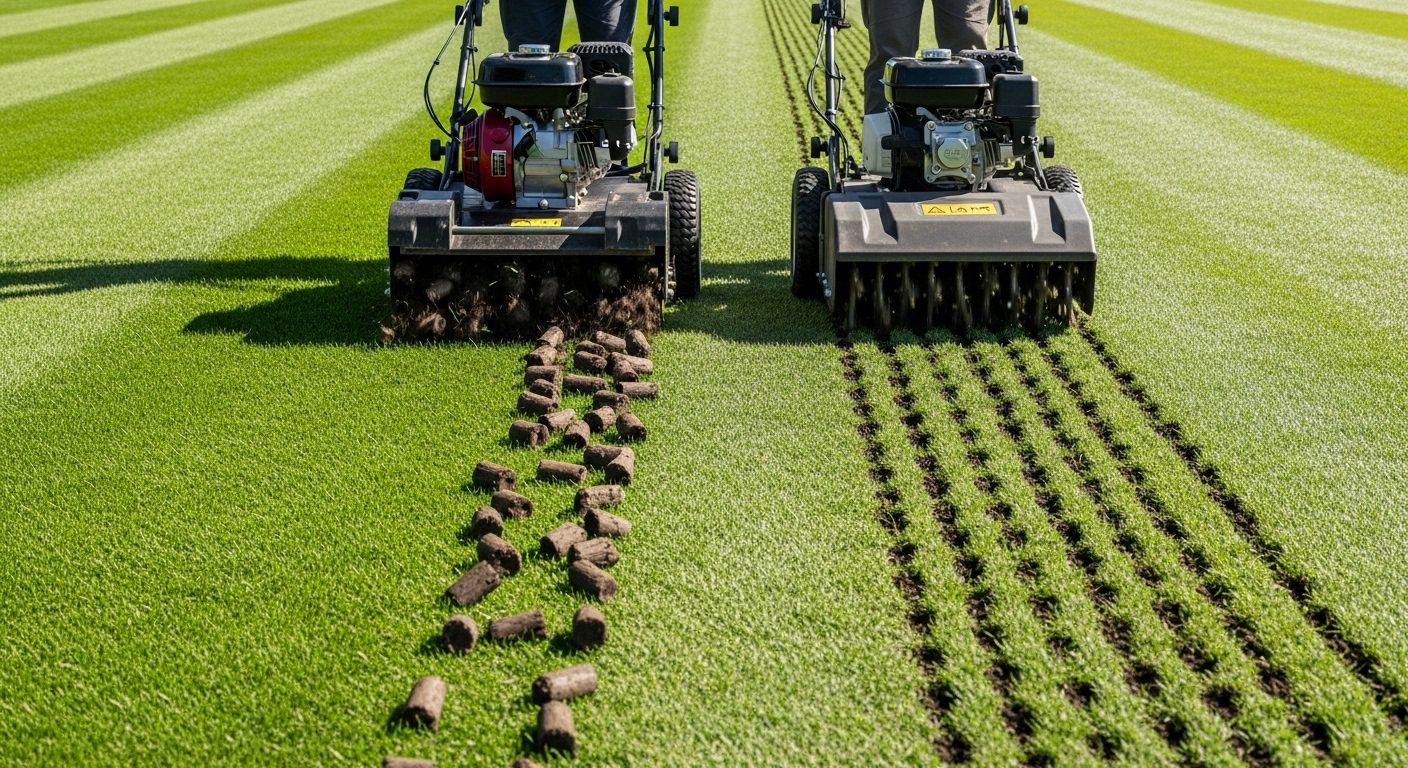
Plug aerators use hollow tines that penetrate the soil and extract cylindrical cores, typically 2-3 inches deep and 1/2 to 3/4 inch in diameter. These cores get deposited on the lawn surface where they break down over time, redistributing organic matter and beneficial microorganisms.
When a plug aerator removes soil cores, it creates genuine air pockets that allow oxygen, water, and nutrients to penetrate deep into the root zone. The hollow tines don’t compress the surrounding soil – instead, they provide room for the remaining soil to expand and decompress naturally.
The University of Wisconsin Extension notes that this core removal process is crucial for relieving compaction. By physically removing soil rather than displacing it, plug aerators create lasting channels for root growth and water infiltration.
How Spike Aerators Work?
Spike aerators use solid tines or spikes that poke holes into the ground without removing any soil. These tools range from simple spike shoes you strap to your feet to rolling drums with protruding spikes.
When a spike penetrates the soil, it pushes the soil aside rather than removing it. This creates temporary holes but simultaneously compresses the soil around each penetration point. Think of it like pushing a pencil into clay – you create a hole, but the clay around it becomes denser.
While spike aeration can provide temporary relief by creating surface channels for water, it doesn’t address the underlying compaction problem. In fact, the compression around each hole can sometimes worsen compaction in already dense soils.
The Science Behind Soil Compaction
To understand why these differences matter, we need to examine what soil compaction actually does to your lawn. Healthy soil contains about 50% solid matter and 50% pore space filled with air and water. Compaction reduces this crucial pore space, creating a cascade of problems.
According to research from Iowa State University Extension, compacted soil restricts root growth, reduces water infiltration by up to 90%, and limits oxygen availability to grass roots. When roots can’t penetrate deeply, grass becomes more susceptible to drought stress, disease, and nutrient deficiencies.
The compaction process typically results from foot traffic, lawn equipment, and natural settling over time. Clay soils are particularly prone to compaction due to their fine particle size and tendency to bind tightly when compressed.
How Each Method Addresses Compaction?
Plug aeration directly combats compaction by removing soil mass. Each extracted core reduces soil density in the surrounding area, allowing the remaining soil particles to rearrange into a less compact configuration. Oregon State University Extension research shows this can reduce water usage by 20-30% as improved infiltration means less runoff and more efficient irrigation.
Spike aeration, conversely, only addresses surface symptoms. While it creates temporary channels for water and air, it doesn’t reduce overall soil density. The compression effect can actually increase bulk density around each hole, potentially making long-term compaction worse.
Think of it this way: if your closet is too full, you can either remove some items (plug aeration) or try to squeeze everything tighter to make temporary space (spike aeration). Only one approach actually solves the overcrowding problem.
Effectiveness Comparison: What the Research Shows
Multiple university extension services have studied aeration effectiveness, and the results consistently favor plug aeration for measurable lawn improvement.
Water Infiltration Rates
The University of Idaho Extension found that core aeration can increase water infiltration rates by 100-200% in compacted soils. This dramatic improvement occurs because the extracted cores leave genuine voids that water can fill and percolate through.
Spike aeration showed minimal improvement in infiltration rates, with some studies indicating only 10-20% increases that diminished within weeks as the compressed soil rebounded. The temporary nature of spike-created holes means they often seal shut after the first heavy rain or irrigation cycle.
Root Development
Healthy root systems need both oxygen and room to grow. Core aeration provides both by creating permanent channels that roots can explore. Research shows grass roots actively grow into old aeration holes, using them as highways to reach deeper soil layers.
With spike aeration, the compressed soil walls around each hole can actually inhibit root penetration. Roots encounter these dense barriers and often grow laterally instead of deeply, resulting in shallow root systems vulnerable to stress.
Thatch Decomposition
Thatch – the layer of dead organic matter between green grass and soil – becomes problematic when it exceeds 1/2 inch thick. Core aeration aids thatch breakdown in two ways: it brings up soil microbes that decompose organic matter, and it improves oxygen circulation that these beneficial organisms need.
The soil cores deposited on the surface by plug aerators contain microorganisms that actively break down thatch when they mix back into the lawn. Spike aeration provides neither benefit, leaving thatch problems unaddressed.
Cost Analysis: Short-Term vs Long-Term Investment
The price difference between plug and spike aerators can seem significant at first glance, but examining total cost of ownership tells a different story.
Initial Equipment Costs
Spike aerators are undeniably cheaper upfront. Manual spike shoes cost $20-30, while rolling spike aerators range from $50-200. Their simple design means fewer moving parts and lower manufacturing costs.
Plug aerators require more substantial investment. Manual models start around $100, with quality walk-behind units costing $200-500. Professional-grade machines can exceed $2,000. However, rental options make plug aerators accessible at $100-150 per day.
Frequency of Use
Here’s where the economics shift. Because spike aeration provides only temporary benefits, you might need to aerate 3-4 times per season to maintain results. With each session taking 2-3 hours for an average lawn, the time investment alone becomes substantial.
Plug aeration typically needs doing only once or twice annually – usually in early fall for cool-season grasses and late spring for warm-season varieties. The lasting benefits mean less frequent treatment for superior results.
Professional Service Comparison
Professional lawn care services charge $100-200 for core aeration of an average residential lawn. Interestingly, very few professionals offer spike aeration services because they know it doesn’t deliver lasting results their reputation depends on.
If you calculate the cost of renting a plug aerator twice yearly ($200-300) versus buying a spike aerator ($100-200) and using it quarterly, the plug aerator actually becomes more economical within the first year while delivering better results.
Best Use Cases for Each Type
While plug aerators win in almost every category, there are specific situations where each tool might be appropriate.
When Plug Aerators Excel?
Plug aerators are ideal for established lawns with compaction issues, heavy clay soils, moderate to severe thatch problems, and high-traffic areas. They’re also the best choice for improving drainage in waterlogged areas and preparing lawns for overseeding.
Professional landscapers universally prefer plug aerators for commercial properties, sports fields, and any situation requiring measurable improvement in turf quality. The University of Wisconsin Extension specifically recommends hollow tine aeration for sustainable lawn management programs.
Limited Applications for Spike Aerators
Spike aerators might have a place in very specific scenarios. Sandy soils with minimal compaction might benefit from light spike aeration to improve surface water penetration without the mess of soil cores. They’re also useful for quick surface preparation before liquid fertilizer application.
Some homeowners use spike shoes for light monthly maintenance between annual core aerations, though the benefits remain questionable. The main advantage is convenience – you can wear spike shoes while mowing, though the shallow penetration provides minimal benefit.
Professional Recommendations and Industry Standards
The consensus among turf professionals is overwhelming. In my conversations with landscapers and golf course superintendents, 99% exclusively use plug aerators for actual aeration work.
Tom Wilson, a golf course superintendent with 30 years experience, told me: “We wouldn’t dream of using spike aeration on our greens or fairways. Core aeration is the only method that actually relieves compaction. Spike aeration is like putting a band-aid on a broken bone.”
University extension services across the country echo this sentiment. Not a single extension publication I found recommended spike aeration as a primary method for lawn improvement. The research simply doesn’t support it.
Industry Evolution
The lawn care industry has largely moved away from spike aeration over the past two decades as research clarified its limitations. Major equipment manufacturers now focus almost exclusively on plug aerator innovation, with improvements in tine design, pattern optimization, and depth control.
This shift reflects both scientific understanding and customer satisfaction. Lawn care companies that switched from spike to plug aeration report dramatically improved customer retention and results.
Common Misconceptions Debunked
Several myths persist about aeration that deserve addressing with factual information.
Myth: Spike Aeration is Better for Sandy Soils
While sandy soils compact less than clay, they still benefit from core aeration. The improved gas exchange and organic matter incorporation from soil cores helps sandy soils retain moisture and nutrients better. Spike aeration offers neither benefit.
Myth: Soil Cores are Unsightly and Harmful
Many homeowners worry about the cores left by plug aeration. Yes, they look messy for a week or two, but they’re incredibly beneficial. As cores break down, they topdress your lawn with a perfect soil mixture while returning beneficial microbes to the thatch layer.
Running a mower over dried cores helps break them up faster if appearance is a concern. Never remove cores – you’re throwing away valuable organic matter and microorganisms your lawn needs.
Myth: More Holes Equals Better Aeration
Spike aerator marketing often emphasizes high hole counts, but quantity doesn’t equal quality. Ten properly spaced core aeration holes provide more benefit than 100 spike holes that compress surrounding soil. It’s about soil physics, not simple arithmetic.
Seasonal Timing Considerations
Proper timing maximizes aeration benefits regardless of method, though plug aeration’s advantages become even more pronounced when done correctly.
Cool-Season Grasses
For Kentucky bluegrass, perennial ryegrass, and tall fescue, early fall (August through September) provides ideal conditions. Grass is entering its peak growth period, soil moisture is typically adequate, and cooler temperatures reduce stress.
Spring aeration works but coincides with weed germination. Core aeration in spring can bring weed seeds to the surface, though this risk exists with any soil disturbance.
Warm-Season Grasses
Bermudagrass, St. Augustinegrass, and Zoysiagrass respond best to late spring or early summer aeration when they’re actively growing. Avoid aerating during dormancy or stress periods.
The Oregon State Extension emphasizes that timing matters more for spike aeration since its benefits are temporary. Miss the optimal window, and you might see no improvement at all.
Equipment Maintenance and Longevity
The durability difference between plug and spike aerators affects long-term value.
Plug Aerator Maintenance
Hollow tines require regular sharpening or replacement as they dull from soil contact. Expect to replace tines every 2-3 years with regular use, costing $50-100 for a set. The mechanical complexity means annual tune-ups for gas-powered models.
However, quality plug aerators last decades with proper care. Many rental units see hundreds of uses annually and remain functional for 10+ years. The robust construction necessary for core extraction means these machines are built to last.
Spike Aerator Durability
Spike aerators have fewer maintenance needs since solid spikes rarely need replacement. Simple designs mean less can break, and manual models might last indefinitely.
Yet this durability is somewhat meaningless if the tool doesn’t effectively improve your lawn. A perfectly functional spike aerator that doesn’t solve compaction problems isn’t a good investment regardless of longevity.
Environmental Considerations
Sustainable lawn care increasingly matters to homeowners, and aeration method choice has environmental implications.
Core aeration reduces water usage by improving infiltration and reducing runoff. The Oregon State Extension’s finding of 20-30% water savings translates to thousands of gallons annually for typical lawns. In drought-prone regions, this efficiency is crucial.
Improved root systems from proper aeration also mean healthier grass that requires less fertilizer and pesticide input. Deeper roots access nutrients more efficiently and resist pest pressure better.
Spike aeration’s temporary benefits might actually increase resource use. If you’re aerating more frequently, using more water due to poor infiltration, and applying more chemicals to stressed grass, the environmental cost compounds over time.
Making the Right Choice for Your Lawn
After examining the research, talking with professionals, and analyzing costs, the evidence overwhelmingly favors plug aeration for meaningful lawn improvement.
If you’re serious about lawn health, rent or buy a plug aerator. The superior results justify the higher initial investment, and your lawn will show dramatic improvement after just one or two treatments.
For those considering spike aeration due to budget constraints, I’d suggest saving for plug aerator rental instead. One proper core aeration annually provides more benefit than monthly spike aeration. Your time and money are better invested in the method that actually works.
Consider your soil type, lawn usage, and long-term goals. Clay soils absolutely require plug aeration. Sandy soils benefit less dramatically but still see improvement. High-traffic areas need the genuine decompaction only core removal provides.
Practical Application Tips
Whether you choose to rent or buy, proper technique maximizes aeration benefits.
Preparation Steps
Water your lawn thoroughly 1-2 days before aerating. Soil should be moist but not waterlogged – think of the consistency of a wrung-out sponge. Mark irrigation heads and shallow utilities to avoid damage.
Mow slightly shorter than normal and remove debris. This helps tines penetrate fully and ensures even coverage. Plan your pattern to avoid repeatedly crossing the same areas.
Aeration Technique
For plug aerators, overlap passes slightly to ensure complete coverage. Most lawns benefit from two passes in perpendicular directions. Slower speeds allow deeper penetration – resist the urge to rush.
Focus on problem areas with additional passes. Compacted zones near driveways, pathways, and play areas might need 3-4 passes for adequate relief.
Post-Aeration Care
Leave cores on the lawn to decompose naturally. They’ll disappear within 2-3 weeks depending on moisture and temperature. This is prime time for overseeding since seeds can fall into aeration holes for excellent soil contact.
Apply fertilizer after aeration to take advantage of improved nutrient access. Water regularly but lightly to help cores break down and grass recover. Avoid heavy traffic for at least a week.
The Professional Verdict
Every university extension service I researched recommends core aeration over spike aeration. The science is clear: removing soil cores provides lasting compaction relief, while pushing spikes into soil offers temporary surface benefits at best.
The University of Maryland’s research on compaction layers demonstrates why core removal matters. Even thin compacted zones severely restrict root growth and water movement. Only physical soil extraction addresses this problem effectively.
Iowa State’s findings on improved water and nutrient movement after core aeration explain why lawns show such dramatic improvement. It’s not just about making holes – it’s about fundamentally improving soil structure.
Conclusion: The Clear Winner
After examining the research, costs, and professional perspectives, plug aerators emerge as the definitive choice for effective lawn aeration. While spike aerators might seem attractive due to lower costs and simplicity, they simply don’t deliver the soil improvement your lawn needs.
The science supports what professionals have known for years: core aeration works, spike aeration doesn’t. University research consistently demonstrates superior results from plug aeration in every measurable category – water infiltration, root development, thatch management, and long-term soil health.
Yes, plug aerators cost more initially. Yes, they leave temporary cores on your lawn. Yes, they require more effort to operate. But they also actually solve compaction problems, improve drainage, enhance root growth, and create lasting benefits that transform lawn health.
For homeowners serious about lawn care, the choice is clear. Rent a plug aerator once or twice yearly rather than buying a spike aerator that won’t deliver results. Your lawn will thank you with deeper roots, better drought tolerance, improved nutrient uptake, and the lush, healthy appearance that only comes from properly aerated soil.
The investment in proper aeration pays dividends through reduced water usage, decreased fertilizer needs, and improved stress tolerance. In an era of increasing environmental awareness and resource conservation, choosing the method that actually works isn’t just smart – it’s responsible.
Don’t let the simplicity of spike aerators fool you into accepting inferior results. Your lawn deserves the proven benefits of core aeration, backed by decades of research and professional experience. Make the choice that science supports, professionals recommend, and results confirm: choose plug aeration for genuine lawn improvement.