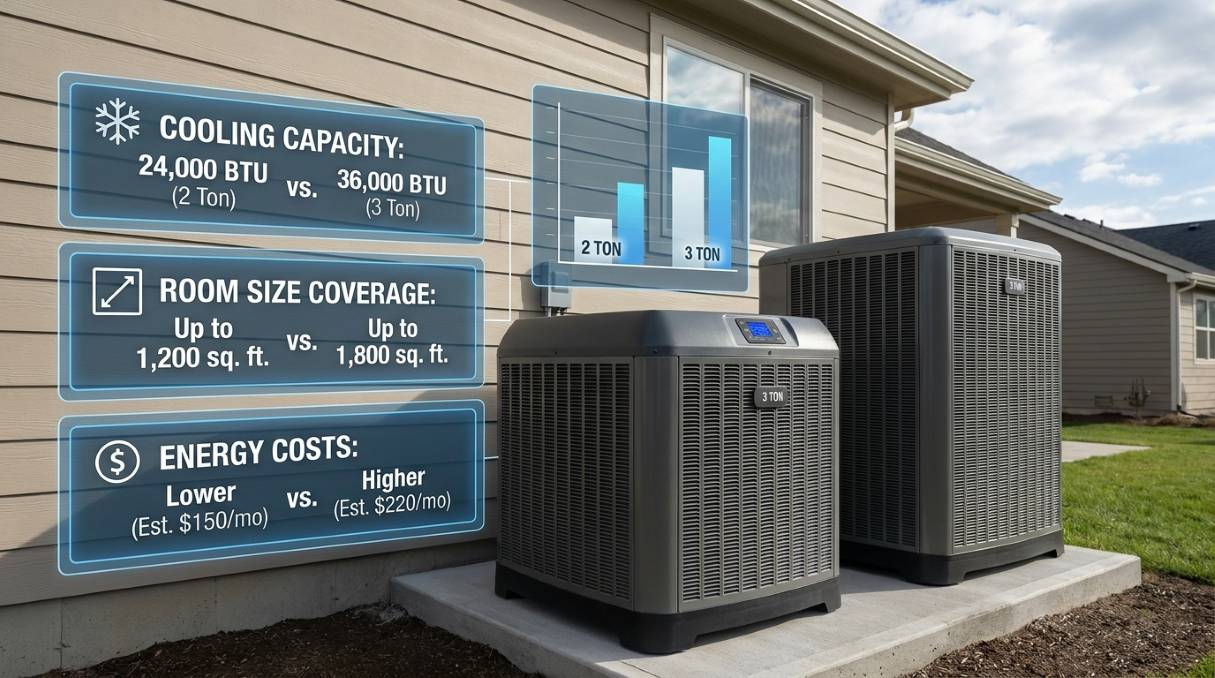
Choosing between a 2 ton vs 3 ton air conditioner can make the difference between comfortable summers and expensive energy bills. The wrong size unit will either struggle to keep up or waste electricity cycling on and off constantly. I have spent months researching HVAC systems and talking with contractors to break down exactly what you need to know before making this decision.
The quick answer is straightforward. A 2-ton AC removes 24,000 BTUs of heat per hour and typically cools homes between 1,000 and 1,400 square feet. A 3-ton unit removes 36,000 BTUs per hour and handles 1,500 to 2,100 square feet. That 50% capacity difference affects everything from your upfront cost to your monthly electric bill.
Getting the size right matters more than most homeowners realize. An oversized unit will short-cycle, wasting energy and failing to remove humidity properly. An undersized unit will run constantly, wearing out components prematurely while never quite reaching your target temperature. This guide walks through every factor you need to consider when choosing between 2 ton vs 3 ton air conditioner options for your home.
Before diving deeper, consider how smart thermostats can improve any AC system’s efficiency regardless of size. The right thermostat can reduce cooling costs by up to 26% by optimizing your system’s runtime.
What Does ‘Ton’ Mean in Air Conditioning?
When HVAC professionals talk about tons, they are not referring to the weight of the unit sitting outside your home. The term comes from a time before electric air conditioning existed, when people actually used ice to cool buildings.
1 Ton Equals 12,000 BTU Per Hour
One ton of cooling capacity represents the amount of heat required to melt one ton (2,000 pounds) of ice over a 24-hour period. That heat transfer equals 12,000 British Thermal Units (BTU) per hour. A 2-ton air conditioner removes 24,000 BTUs of heat hourly. A 3-ton unit removes 36,000 BTUs hourly.
BTU stands for British Thermal Unit, the standard measurement of heat energy. One BTU represents the heat required to raise one pound of water by one degree Fahrenheit. Your air conditioner’s job is transferring heat from inside your home to the outside, and BTUs measure how quickly it can accomplish that task.
| AC Tonnage | BTU Per Hour | Typical Coverage |
|---|---|---|
| 1.5 Ton | 18,000 BTU | 600-900 sq ft |
| 2 Ton | 24,000 BTU | 1,000-1,400 sq ft |
| 2.5 Ton | 30,000 BTU | 1,200-1,700 sq ft |
| 3 Ton | 36,000 BTU | 1,500-2,100 sq ft |
| 3.5 Ton | 42,000 BTU | 1,800-2,500 sq ft |
Why Tonnage Measurement Still Matters Today
Modern air conditioning technology has evolved dramatically since the ice-melting days, but the tonnage standard remains the industry convention. Manufacturers, contractors, and energy ratings all use this measurement system. Understanding it helps you compare quotes accurately and evaluate whether a contractor’s recommendation makes sense for your situation.
The tonnage system also creates a standardized framework for calculating energy efficiency. SEER ratings (Seasonal Energy Efficiency Ratio) measure how many BTUs of cooling an AC delivers per watt-hour of electricity. This allows fair comparisons between 2-ton and 3-ton units from different manufacturers.
2 Ton vs 3 Ton Air Conditioner: Complete Comparison
Now that you understand what tonnage means, let us compare these two popular residential sizes across all the factors that affect your comfort and wallet. The differences extend far beyond just square footage coverage.
Cooling Capacity and Power Output
A 3-ton air conditioner delivers exactly 50% more cooling power than a 2-ton unit. That 12,000 BTU per hour difference translates to removing substantially more heat from your home every minute the system runs. In practical terms, a 3-ton unit can drop the temperature faster when you first turn it on.
However, faster cooling is not always better. Air conditioners are designed to run in sustained cycles of 15-20 minutes for optimal efficiency and humidity control. A 3-ton unit in a space sized for 2 tons will reach the thermostat setpoint too quickly, then shut off before completing a proper cycle. This short-cycling behavior causes multiple problems we will cover shortly.
Square Footage Coverage by Climate Zone
The square footage each tonnage can cool varies significantly based on your local climate. Hotter regions require more cooling capacity per square foot than mild climates. The same 1,500 square foot home needs different AC sizes in Phoenix versus Portland.
| Climate Zone | 2 Ton Coverage | 3 Ton Coverage |
|---|---|---|
| Mild (Pacific Northwest, Northeast) | 1,200-1,400 sq ft | 1,800-2,100 sq ft |
| Moderate (Midwest, Mid-Atlantic) | 1,000-1,300 sq ft | 1,600-2,000 sq ft |
| Hot (South, Southwest) | 900-1,200 sq ft | 1,400-1,800 sq ft |
| Very Hot (Arizona, Nevada, Texas) | 800-1,000 sq ft | 1,200-1,600 sq ft |
These ranges assume standard 8-foot ceilings, average insulation, and typical window placement. Homes with high ceilings, poor insulation, large south-facing windows, or significant heat-generating appliances may need to size up. Well-insulated homes with shaded lots might size down within these ranges.
Humidity Control: The Hidden Factor
Removing humidity is just as important as lowering temperature for comfort. High humidity makes 72 degrees feel like 78, while proper humidity levels let you keep the thermostat higher while feeling cooler. Here lies one of the biggest differences between properly sized and oversized units.
Air conditioners remove humidity only while running. The cold evaporator coil condenses moisture from the air, which drains away. A 2-ton unit running for 20 minutes removes more total humidity than a 3-ton unit running for 8 minutes, even though both reach the same temperature.
Oversized 3-ton units in 2-ton spaces short-cycle, running for brief bursts then shutting off. The thermostat reads the target temperature, but humidity remains high because the unit never ran long enough to extract it. You end up with a cold, clammy home that feels uncomfortable despite the low temperature reading.
Energy Consumption and Operating Costs
Power consumption scales with tonnage, but not always linearly due to efficiency differences. A 3-ton unit running properly will use more electricity than a 2-ton unit, but the comparison gets complicated when you factor in SEER ratings and run times.
Higher-capacity units often come with better efficiency ratings because manufacturers prioritize their top-tier technology for popular sizes. A 3-ton unit with a 20 SEER rating might actually cost less to operate than a 2-ton unit with a 14 SEER rating. Always check the SEER rating when comparing operating costs.
Most 2-ton units draw approximately 1.8-2.2 kW when running. Most 3-ton units draw 2.7-3.3 kW. At the national average electricity rate of $0.14 per kWh, that difference adds up to roughly $200-400 per year in cooling costs depending on your climate and cooling season length.
| Location | 2 Ton (15 SEER) Annual Cost | 3 Ton (15 SEER) Annual Cost | 3 Ton (21 SEER) Annual Cost |
|---|---|---|---|
| Phoenix, AZ (Hot climate) | $890 | $1,185 | $850 |
| Kansas City, MO (Moderate) | $620 | $825 | $590 |
| San Francisco, CA (Mild) | $340 | $450 | $320 |
The table above shows why SEER ratings matter so much. A high-efficiency 3-ton unit can actually cost less to run than a standard-efficiency 2-ton unit. If you are considering a 3-ton upgrade, look at variable-speed or two-stage models with 18+ SEER ratings for the best balance of capacity and efficiency.
Installing a Google Nest Learning Thermostat can further reduce these costs by learning your schedule and optimizing cooling cycles. The energy savings typically pay for the thermostat within the first year.
Ductwork and Airflow Requirements
Air conditioning requires properly sized ducts to deliver conditioned air throughout your home. The difference between 2-ton and 3-ton units extends to your home’s infrastructure, not just the outdoor condenser.
A 2-ton unit typically requires a 16-inch return duct and supplies sized for 800 CFM (cubic feet per minute) of airflow. A 3-ton unit typically needs an 18-inch return duct and ductwork capable of handling 1,200 CFM. The 50% capacity increase requires 50% more air movement.
This matters when replacing an existing system. If your home currently has a 2-ton unit with appropriately sized ducts, upgrading to a 3-ton unit requires ductwork modifications. Undersized ducts create high static pressure, reducing efficiency and potentially damaging the compressor. Your contractor must verify your existing ductwork can handle the increased airflow.
Most reputable HVAC contractors will measure your static pressure before recommending a size increase. If they do not mention ductwork compatibility, ask directly. Installing a 3-ton unit on 2-ton ducts is a recipe for premature system failure and poor performance.
What Size AC Unit Do I Need for My Home?
Now that you understand the technical differences, let us figure out which size makes sense for your specific situation. Several factors beyond square footage affect your sizing requirements.
DIY Sizing Formula for Estimation
While professional Manual J calculations provide the most accurate sizing, you can estimate your needs using a simplified formula before calling contractors. This gives you a baseline to evaluate whether quotes seem reasonable.
The formula: (Square footage x 25) + (Number of windows x 1,000) + (Number of occupants x 400) / 12,000 = Estimated Tonnage
For a 1,400 square foot home with 12 windows and 3 occupants: (1,400 x 25) + (12 x 1,000) + (3 x 400) = 35,000 + 12,000 + 1,200 = 48,200 / 12,000 = 4.02 tons. However, this overestimates for most modern homes because it does not account for insulation quality. Apply a 0.7-0.9 multiplier based on your climate and insulation.
This DIY method provides a starting point, but treat it as an estimate only. Professional load calculations consider dozens of variables this simple formula misses. Use it to spot contractors who seem way off base, not to size your system definitively.
Factors That Adjust Your Sizing Needs
Every home is unique. The same 1,500 square feet can require different tonnage depending on these variables.
Climate Zone: A 1,500 square foot home in Miami needs more cooling capacity than the same home in Seattle. Hot, humid climates require sizing toward the upper end of coverage ranges. Mild climates allow sizing toward the lower end.
Insulation R-Value: Well-insulated attics and walls significantly reduce heat gain. Homes built after 2000 typically have better insulation than older construction. If you have upgraded your insulation, you might need less tonnage than square footage alone suggests.
Ceiling Height: Standard calculations assume 8-foot ceilings. Cathedral ceilings or rooms with 10+ foot ceilings contain significantly more air volume requiring cooling. Each foot above 8 adds roughly 12% to your cooling load.
Sun Exposure: South and west-facing windows add substantial heat gain. A home with extensive southern exposure needs more cooling capacity than a shaded lot with the same square footage. Trees, awnings, and window treatments affect this calculation.
Window Area and Quality: Windows transfer heat much faster than insulated walls. Large picture windows look great but increase cooling requirements. Single-pane windows perform poorly compared to modern double-pane or low-E glass.
Occupancy and Appliance Heat: People generate heat, roughly 400 BTU per person per hour. Homes with large families need more cooling. Heat-generating appliances like ovens, dryers, and home offices with multiple computers add to the load.
Professional Manual J Load Calculation
The ACCA (Air Conditioning Contractors of America) Manual J is the industry-standard method for determining HVAC sizing. This detailed calculation accounts for all the factors mentioned above plus many more, including orientation, construction materials, and duct location.
A proper Manual J calculation takes 2-3 hours for an experienced contractor. They measure every room, assess insulation levels, count windows, and input data into specialized software. The output provides exact BTU requirements for both heating and cooling.
Any contractor who sizes your system based solely on square footage is cutting corners. While rules of thumb work for rough estimates, proper Manual J calculations prevent the costly mistakes of under or oversizing. Expect to pay $150-300 for a standalone Manual J calculation if you are not already hiring that contractor for installation.
Reddit users on HVAC forums consistently cite Manual J as the gold standard for sizing decisions. Homeowners report that getting multiple quotes with Manual J calculations helps resolve conflicting contractor recommendations. When two contractors run proper calculations, their results should be within 10% of each other.
When 2.5 Ton Might Be the Perfect Middle Ground?
Sometimes the choice is not strictly between 2 ton and 3 ton. A 2.5-ton unit (30,000 BTU) bridges the gap and might be ideal for homes falling between standard sizing ranges.
Consider a 2.5-ton unit for 1,200-1,600 square foot homes in moderate climates, or well-insulated homes up to 1,700 square feet. This size is popular for townhomes and ranch-style homes that sit between standard coverage ranges.
The 2.5-ton size offers another advantage: availability of two-stage and variable-speed compressors. Many manufacturers offer more advanced efficiency features at this mid-size than at the smaller 2-ton capacity. A two-stage 2.5-ton unit can run at partial capacity (around 1.8 tons) during mild weather, then ramp up to full power during peak heat.
2 Ton vs 3 Ton Air Conditioner Cost Comparison
Budget plays a major role in sizing decisions. The cost difference between 2-ton and 3-ton units extends beyond just the equipment price to installation, operating costs, and long-term value.
Equipment Cost Differences
Expect to pay $500-800 more for a 3-ton unit compared to a comparable 2-ton model from the same manufacturer and efficiency tier. This price gap holds relatively constant across brands and SEER ratings.
Entry-level 2-ton units typically range from $1,200-1,800 for the outdoor condenser alone. Entry-level 3-ton units run $1,700-2,600. Premium high-efficiency models show similar proportional increases, with top-tier 3-ton units reaching $3,500-4,500 compared to $2,800-3,800 for equivalent 2-ton systems.
The indoor air handler or furnace component follows similar pricing patterns. A 3-ton compatible air handler costs $300-600 more than a 2-ton model. When replacing a complete system, the total equipment price difference typically runs $800-1,400.
Installation Cost Factors
Installation costs vary significantly by region, home configuration, and contractor. However, some general patterns apply when comparing 2-ton and 3-ton installations.
Labor costs remain fairly similar since both sizes require comparable installation time. The main installation cost differences come from electrical requirements and ductwork modifications. A 3-ton unit may require electrical service upgrades or larger circuit breakers if your existing wiring is undersized.
Ductwork modifications add the most variable cost. If your existing 16-inch return duct needs upgrading to 18 inches, expect $800-2,000 in additional materials and labor. Supply duct modifications to handle increased airflow add further expense. Homes already equipped for 3-ton capacity avoid these costs.
Total installed costs for complete replacement systems typically range from $4,500-7,500 for 2-ton units and $5,500-9,000 for 3-ton units. These ranges include equipment, labor, permits, and basic materials.
Operating Costs Over Time
The purchase price represents just a fraction of your total cost of ownership. Operating costs over 10-15 years typically exceed the initial equipment price.
Assuming average cooling seasons and electricity rates, the 3-ton unit costs approximately $200-400 more per year to operate than an equivalent 2-ton unit. Over a 15-year system lifespan, that adds $3,000-6,000 in additional electricity costs.
However, these costs flip if the 3-ton unit is properly sized and the 2-ton unit is undersized. An undersized 2-ton unit running constantly in a space requiring 3 tons will cost more to operate than the properly sized larger unit. Correct sizing matters more than raw efficiency numbers.
Smart thermostats can reduce these operating costs regardless of unit size. Features like learning schedules, geofencing, and adaptive recovery help optimize runtime and reduce waste.
Long-Term Total Cost of Ownership
Looking at the complete 15-year lifecycle provides the clearest cost comparison. Let us examine realistic total costs for a 1,600 square foot home in a moderate climate.
Scenario A: Undersized 2-ton unit ($5,500 installed, 14 SEER) running constantly to keep up. Annual operating cost $980. Two major repairs over lifespan ($1,800). Total 15-year cost: $22,400.
Scenario B: Properly sized 3-ton unit ($7,200 installed, 16 SEER) running normal cycles. Annual operating cost $720. One repair ($600). Total 15-year cost: $19,200.
The properly sized 3-ton unit actually costs less over the long term despite the higher upfront price. The undersized unit’s constant operation drives up electricity bills and causes premature wear requiring expensive repairs.
Should I Get a 2 Ton or 3 Ton AC Unit?
Now for the decision itself. Based on everything covered so far, here is a clear framework for choosing between 2 ton vs 3 ton air conditioner options.
Choose a 2 Ton AC When:
Your home measures between 1,000-1,400 square feet and you live in a mild or moderate climate zone. You have good insulation with R-30 or better in the attic. Your ceilings are standard 8-foot height. Your home sits on a shaded lot or has minimal south-facing window exposure. You have normal occupancy of 2-4 people.
A 2-ton unit also makes sense when replacing an existing properly sized system that performed adequately. If your current 2-ton unit maintained comfortable temperatures even on the hottest days, there is no need to upsize.
Choose a 3 Ton AC When:
Your home spans 1,500-2,100 square feet. You live in a hot climate like the Southwest or Deep South. Your home has high ceilings (9+ feet), poor insulation, or extensive south-facing windows. You have a large family generating significant occupancy heat loads. Your current 2-ton unit runs constantly and struggles to maintain temperature on hot days.
Consider a 3-ton unit if you are planning home additions or significant square footage increases in the next 5 years. Installing adequate capacity now prevents replacement later.
The Risks of Oversizing (Short Cycling Explained)
Short cycling is the number one problem with oversized air conditioners. When a 3-ton unit cools a space sized for 2 tons, it reaches the thermostat setpoint in 5-10 minutes then shuts off.
That sounds efficient, but it is actually terrible for your system and comfort. Air conditioners need 15-20 minute run times to reach peak efficiency and remove humidity properly. Frequent starting and stopping wastes energy (startup draws the most power) and fails to dehumidify.
Short cycling also causes excessive wear on the compressor. Starting up creates the most stress on electrical components. An oversized unit might start 50+ times per day instead of the normal 8-12 cycles. This wear leads to premature component failure and costly repairs.
Perhaps worst of all, short cycling creates uncomfortable temperature swings. You get bursts of cold air followed by stagnant warmth, with humidity remaining high throughout. Many homeowners with oversized units complain that their homes feel “cold and clammy” rather than comfortably cool.
Alternative Cooling Solutions
If you are between sizes or dealing with unique spaces, consider supplemental cooling options. A portable air conditioner can provide targeted cooling for problem rooms without upsizing your entire central system.
For smaller homes or individual rooms, window air conditioner options offer affordable cooling without the expense of central AC replacement. These work well for additions, converted garages, or homes with challenging duct layouts.
Frequently Asked Questions
What’s the difference between a 2 Ton and a 3 Ton air conditioner?
A 2-ton air conditioner removes 24,000 BTUs of heat per hour and typically cools 1,000-1,400 square feet. A 3-ton unit removes 36,000 BTUs per hour and cools 1,500-2,100 square feet. The 3-ton unit costs $500-800 more upfront and uses approximately 50% more electricity when running. However, a properly sized 3-ton unit in a larger home often costs less to operate than an undersized 2-ton unit running constantly.
What is the $5000 rule for HVAC?
The $5000 rule helps homeowners decide whether to repair or replace an aging HVAC system. Multiply the system’s age by the repair cost estimate. If the total exceeds $5,000, replacement usually makes more financial sense than repair. For example, a 10-year-old system needing $600 in repairs equals $6,000 (10 x $600), suggesting replacement is the better choice.
How many sq ft will a 3 Ton AC unit cool?
A 3-ton AC unit typically cools between 1,500 and 2,100 square feet depending on climate zone. In mild climates (Pacific Northwest, Northeast), coverage reaches up to 2,100 square feet. In hot climates (Arizona, Texas, Florida), coverage drops to 1,400-1,800 square feet. Ceiling height, insulation quality, and sun exposure can adjust these ranges by 20% or more.
What is the disadvantage of 2 stage AC?
Two-stage air conditioners cost $800-1,500 more than single-stage units upfront. They have more complex components that can require specialized repairs. In mild climates where the system rarely needs high-stage cooling, the additional expense may never pay back through energy savings. Single-stage units also have fewer components that could potentially fail over time.
Is a 3 ton AC too big for 1500 sq ft?
A 3-ton unit is not necessarily too big for 1,500 square feet, but it depends on your climate and home characteristics. In hot climates like Phoenix or Miami, 1,500 square feet often requires 3 tons. In mild climates like Seattle or Portland, 1,500 square feet typically needs only 2-2.5 tons. Poor insulation, high ceilings, or extensive south-facing windows can push 1,500 square foot homes into the 3-ton range even in moderate climates.
Can I replace a 2 ton AC with a 3 ton?
You can replace a 2-ton AC with a 3-ton unit, but you should only do so if your home actually needs the additional capacity. Installing an oversized unit causes short cycling, poor humidity control, and premature wear. You must also verify your ductwork can handle the increased airflow (typically upgrading from 16-inch to 18-inch returns). Always have a Manual J load calculation performed before upsizing to confirm the larger unit is appropriate.
What happens if my AC unit is oversized?
An oversized AC unit short cycles, turning on and off frequently without completing full cooling cycles. This wastes energy, fails to remove humidity properly, and causes uncomfortable temperature swings. The constant starting and stopping creates excessive wear on the compressor, leading to premature failure and expensive repairs. You will experience cold, clammy air and higher energy bills despite the unit’s capacity.
How many BTU is a 2 ton vs 3 ton air conditioner?
A 2-ton air conditioner produces 24,000 BTUs per hour. A 3-ton air conditioner produces 36,000 BTUs per hour. The 3-ton unit delivers 50% more cooling capacity. One ton of air conditioning equals 12,000 BTU per hour, a measurement derived from the heat required to melt one ton of ice in 24 hours.
Final Thoughts: Making the Right Choice Between 2 Ton vs 3 Ton Air Conditioner
The decision between a 2 ton vs 3 ton air conditioner comes down to matching capacity to your actual cooling load. A 2-ton unit serves 1,000-1,400 square feet in most climates, while a 3-ton unit handles 1,500-2,100 square feet. The 50% capacity difference is substantial and not something to guess at.
Start with a Manual J load calculation from a qualified HVAC contractor. This professional assessment accounts for your specific climate, insulation, windows, and occupancy. The modest cost ($150-300) prevents the expensive mistake of under or oversizing your system.
Remember that bigger is not better when it comes to air conditioning. An oversized 3-ton unit in a space requiring 2 tons will short cycle, waste energy, and fail to dehumidify properly. An undersized 2-ton unit in a 3-ton space will run constantly, wear out prematurely, and leave you uncomfortable on hot days.
Consider total cost of ownership, not just the purchase price. Over 15 years, operating costs typically exceed equipment costs by a significant margin. A properly sized, efficient unit saves money and provides better comfort than a bargain-priced wrong-size system.
Whether you choose a 2-ton or 3-ton unit, pair it with a quality smart thermostat to maximize efficiency. With proper sizing, professional installation, and smart controls, your new air conditioner will provide reliable comfort for years to come.