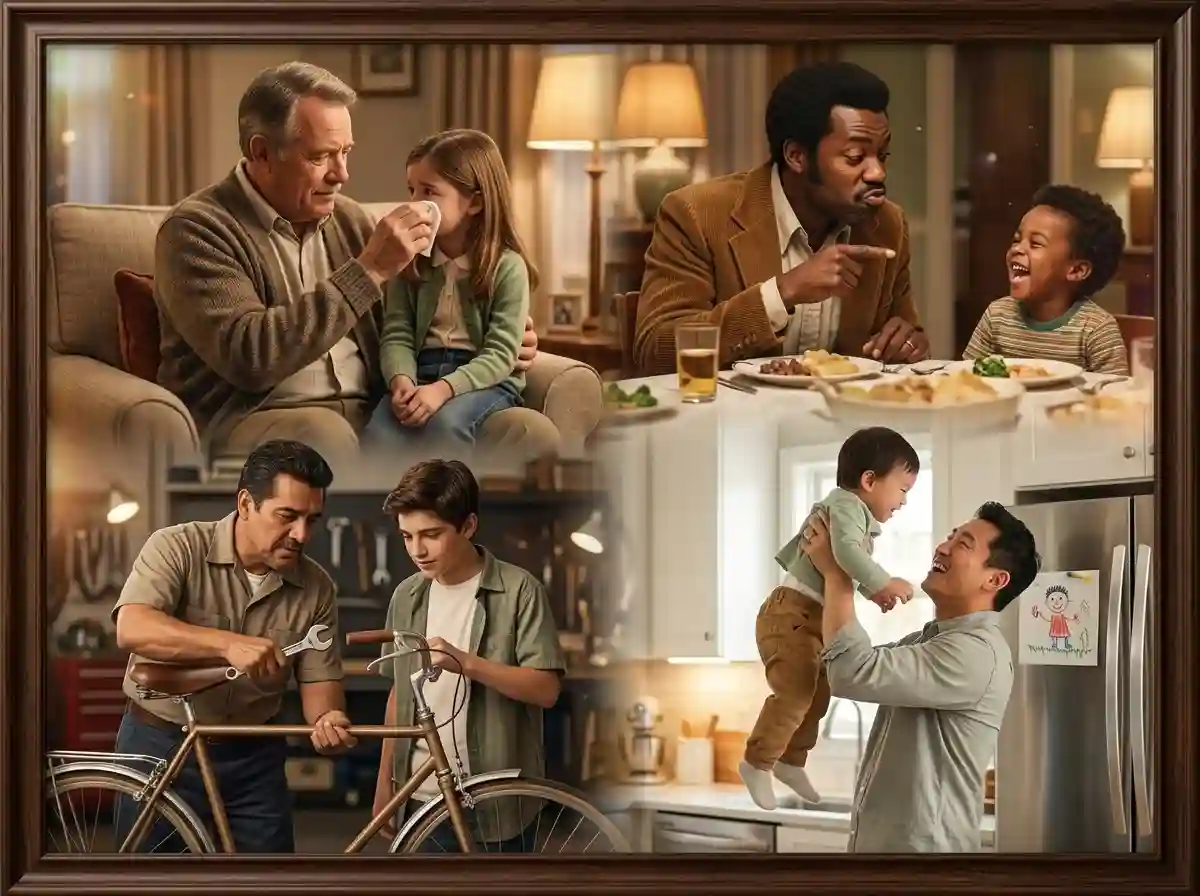
TV dads have shaped our understanding of fatherhood for over seven decades. From the wise, patient patriarchs of the 1950s to the bumbling but loving fathers of modern sitcoms, these characters have become cultural touchstones that reflect and influence how we view parenting.
The best TV dads of all time include Ward Cleaver, Andy Taylor, and Homer Simpson, who represent different eras of fatherhood while sharing core values of love, protection, and guidance for their children.
After analyzing 70+ years of television history and examining fan reactions from Reddit forums to Entertainment Weekly rankings, I’ve discovered that the most beloved TV dads share one crucial trait: authenticity. Whether they’re perfect role models or flawed-but-learning figures, audiences connect with fathers who feel real and genuinely love their kids.
In this comprehensive guide, I’ll walk you through the greatest TV dads across every decade, explaining why these characters resonated with viewers and what real fathers can learn from their fictional counterparts.
The Greatest TV Dads Ranked
Quick Summary: Our ranking includes TV dads from the 1950s to present day, with special recognition for those who broke stereotypes, taught valuable lessons, and represented authentic fatherhood despite being fictional characters.
1. Ward Cleaver – Leave It to Beaver (1957-1963)
Ward Cleaver established the template for TV fatherhood that would influence generations of shows to come. Played by Hugh Beaumont, Ward embodied the ideal 1950s father: calm, wise, always available with a gentle lesson, and never too busy for his sons.
What made Ward remarkable wasn’t his perfection but his consistent patience. Whether Beaver was stuck in a giant soup bowl or Wally was facing teenage dilemmas, Ward approached every problem with the same measured, thoughtful approach. His famous “sit-down talks” became the gold standard for TV parenting moments.
Why He’s Memorable:
Ward never raised his voice or resorted to punishment without explanation. Instead, he guided his sons through logical reasoning and moral lessons, always ending with understanding rather than anger. This approachable wisdom made him the father figure millions of Americans wished they had.
2. Andy Taylor – The Andy Griffith Show (1960-1968)
As a widowed single father raising young Opie in Mayberry, Sheriff Andy Taylor redefined what TV fatherhood could look like. Played by Andy Griffith, he combined gentle Southern charm with rock-solid moral principles, creating a father figure who taught through example rather than lectures.
Andy’s parenting genius lay in treating Opie with respect and honesty. He never talked down to his son, instead explaining complex moral concepts in ways Opie could understand. The famous episode where Opie kills a bird with his slingshot remains one of television’s most powerful father-son moments, as Andy guides his son through understanding life and death.
Cultural Impact:
Andy proved that single fathers could be just as effective as two-parent households, a revolutionary concept for early 1960s television. His relationship with Opie showed millions of viewers that love, attention, and moral guidance mattered more than family structure.
3. Philip Banks – The Fresh Prince of Bel-Air (1990-1996)
Uncle Phil, played by James Avery, revolutionized the TV dad archetype by combining wealth and success with unwavering family values. As a successful lawyer and judge, he provided Will with opportunities he never would have had in West Philadelphia, but more importantly, he gave him the discipline and love every child needs.
What made Uncle Phil extraordinary was his willingness to step up as a father figure to his nephew while raising his own children. His famous line, “I brought you into this house, and I’ll take you out,” wasn’t a threat—it was a promise of unconditional love and responsibility.
Most Memorable Moment:
The episode where Will finally meets his absentee father, only to be abandoned again, showcases Uncle Phil at his finest. His emotional speech—”Your father is your father… but I’m your dad”—still brings viewers to tears and perfectly summarizes what fatherhood really means.
4. Carl Winslow – Family Matters (1989-1997)
As a Chicago police officer and father of three, Carl Winslow, played by Reginald VelJohnson, deserves a medal for his patience. Dealing with Steve Urkel’s daily destruction of his home for nine seasons while maintaining his sanity and love for his family makes him one of TV’s most resilient fathers.
Carl represented the everyday working dad trying to do his best. He wasn’t perfect—he could be grumpy and strict—but he always put his family first. His relationship with Urkel showed his capacity for compassion, eventually treating the annoying neighbor like family.
Why Viewers Loved Him:
Carl was relatable. He struggled with bills, dealt with teenage attitudes, and balanced work and family just like real fathers. His authentic frustration mixed with genuine love made him one of TV’s most realistic dads.
5. Jack Pearson – This Is Us (2016-2022)
Jack Pearson, portrayed by Milo Ventimiglia, redefined modern TV fatherhood through his portrayal in both present-day and flashback scenes. As the father of the Big Three, Jack became the gold standard for present, engaged parenting in the 21st century.
What made Jack revolutionary was his emotional availability and willingness to challenge traditional masculinity. He wasn’t afraid to show vulnerability, cook family meals, or put his children’s needs above his own desires. His famous phrase “This is our family table” exemplified his commitment to unity and love.
Tragic Legacy:
Jack’s death from a house fire created one of TV’s most heartbreaking storylines, but his impact lived on through every episode. His parenting choices continued to influence his children into adulthood, proving that a father’s love transcends even death itself.
6. Homer Simpson – The Simpsons (1989-present)
Yes, Homer Simpson is on this list, and he deserves it. While he’s lazy, selfish, and constantly makes mistakes, Homer’s heart always belongs to his family. In 35+ seasons, he has repeatedly chosen his children over personal gain, proving that even flawed fathers can be good fathers.
Homer’s genius lies in his authenticity. He makes mistakes, admits them, and tries to do better. When Lisa felt insecure about her intelligence, Homer worked extra hours to buy her a saxophone. When Bart needed father-son time, Homer took him to the racetrack despite his own preferences.
Cultural Impact:
Homer normalized imperfect fatherhood. He showed dads everywhere that you don’t have to be perfect—you just have to love your kids and keep trying. His evolution from oafish caricature to surprisingly complex character reflects changing attitudes about fatherhood in America.
7. Tim Taylor – Home Improvement (1991-1999)
Tim “The Tool Man” Taylor, played by Tim Allen, represented the 90s dad trying to balance traditional masculinity with evolving family dynamics. A tool-obsessed TV host who constantly caused accidents, Tim learned parenting through trial and error—mostly error.
Tim’s relationship with his neighbor Wilson provided the show’s moral framework, but his interactions with his three sons revealed his genuine love despite his macho posturing. His famous “grunting” and “more power” catchphrases masked a father who cared deeply about his children’s wellbeing.
Character Growth:
Over eight seasons, Tim evolved from a stereotypical macho dad to a more emotionally available father. He learned to listen to his sons, respect their interests, and show affection—growth that mirrored real-world changes in fatherhood during the 1990s.
8. Danny Tanner – Full House (1987-1995)
As a widowed father raising three daughters with help from his brother-in-law and best friend, Danny Tanner, played by Bob Saget, pioneered the modern single dad narrative. His willingness to seek help and create a non-traditional family structure challenged 1980s norms about fatherhood.
Danny’s obsession with cleaning sometimes masked his grief, but his dedication to his daughters never wavered. From DJ’s first date to Michelle’s first words, Danny was there for every milestone, proving that fathers could be just as nurturing as mothers.
Why He Matters:
Danny showed that it’s okay for dads to need help. By creating a support system of friends and family, he demonstrated that successful parenting requires community—a revolutionary concept for its time that has influenced countless single fathers since.
9. Jay Pritchett – Modern Family (2009-2020)
Jay Pritchett, played by Ed O’Neill, represents the traditional dad adapting to modern times. Starting as a grumpy, old-fashioned father figure, Jay evolved over 11 seasons to become a more understanding, emotionally available father and grandfather.
Jay’s journey from reluctant stepfather to loving patriarch of a blended family shows that it’s never too late to grow as a parent. His subtle moments of affection—like teaching Manny to stand up to bullies or supporting Cam and Mitchell’s relationship—reveal the loving father beneath the gruff exterior.
Memorable Evolution:
Jay’s character arc mirrors the changing definition of fatherhood in America. He goes from traditional provider to involved grandparent, learning that strength includes emotional vulnerability and that family means accepting people exactly as they are.
10. Mike Brady – The Brady Bunch (1969-1974)
Mike Brady, played by Robert Reed, pioneered the blended family narrative on television. As an architect raising six children with his new wife Carol, Mike faced the unique challenge of merging two families while maintaining harmony and love.
Mike’s calm approach to parenting crises—whether it was Jan’s middle child syndrome or Bobby’s constant schemes—set a standard for stepfather representation on TV. He treated all six children as his own, never showing favoritism between his biological and stepchildren.
Cultural Significance:
Mike Brady made blended families mainstream on television, showing millions of viewers that love, not biology, defines family. His patience and wisdom navigating the complexities of step-parenting remain relevant decades later.
11. Dan Conner – Roseanne (1988-2018)
Dan Conner, played by John Goodman, brought blue-collar authenticity to TV fatherhood. Struggling to make ends meet while raising three daughters in Lanford, Illinois, Dan represented the everyday father dealing with real-world problems like unemployment, health issues, and financial stress.
What made Dan revolutionary was his vulnerability. He cried, admitted weakness, and struggled openly—rare for TV dads of his era. His relationship with Roseanne showed a true partnership where parenting was shared equally.
Realistic Representation:
Dan wasn’t a perfect father, but he was a real one. He made mistakes, lost his temper, and faced consequences, but he always loved his family. This authenticity made him relatable to millions of viewers who saw their own fathers reflected in his struggles and triumphs.
12. Phil Dunphy – Modern Family (2009-2020)
Phil Dunphy, played by Ty Burrell, redefined the “cool dad” archetype with his hip attempts to connect with his kids. While his cringe-worthy moments provided endless comedy, his genuine love for Haley, Alex, and Luke made him one of TV’s most endearing modern fathers.
Phil’s parenting philosophy—being his kids’ friend as well as their father—sometimes backfired hilariously, but his heart was always in the right place. His relationship with Luke, in particular, showed a beautiful bond of mutual understanding and acceptance.
Why He Works:
Despite his embarrassing attempts to be trendy, Phil’s sincerity shines through. He’s not afraid to be silly, admit when he’s wrong, or show affection openly. This emotional availability makes him a great example of 21st-century fatherhood.
13. Howard Cunningham – Happy Days (1974-1984)
Mr. C, played by Tom Bosley, was more than just Richie’s father—he was a father figure to the entire neighborhood, including Fonzie. Running the Cunningham family hardware store while raising two kids, Howard represented the stable, reliable 1950s-style dad even as America changed around him.
Howard’s quiet wisdom and unconditional support made him the anchor of Happy Days. Whether Richie wanted to start a band or Fonzie needed a place to feel family, Mr. C was there with guidance and love.
Legacy as Mentor:
Howard Cunningham expanded the definition of fatherhood beyond biological children. By essentially adopting Fonzie and guiding countless neighborhood kids, he showed that fatherhood is about presence and guidance, not just DNA.
14. Jason Seaver – Growing Pains (1985-1992)
Dr. Jason Seaver, played by Alan Thicke, pioneered the work-from-home dad narrative. As a psychiatrist who moved his office home to be more involved with his children, Jason balanced career ambition with active parenting—a revolutionary concept in 1980s television.
Jason’s approach to parenting combined professional psychological insight with genuine paternal love. He treated his children’s problems with seriousness and respect, never dismissing their concerns as “just kid stuff.”
Cultural Impact:
Jason made it acceptable for fathers to prioritize family over career. His choice to work from home influenced real fathers to seek better work-life balance, making him not just entertainment but a social pioneer.
15. Bob Belcher – Bob’s Burgers (2011-present)
Bob Belcher represents the modern small-business dad struggling to balance entrepreneurship with family life. Running a burger restaurant with his wife and three kids, Bob’s cynical exterior masks a deeply loving father who would do anything for his family.
What makes Bob special is his acceptance of his family’s quirks. He encourages Tina’s erotic friend fiction, supports Gene’s musical ambitions, and understands Louise’s scheming nature—all while maintaining the restaurant that keeps them all afloat.
Authentic Representation:
Bob’s famous line, “I love you guys but you’re all terrible,” perfectly captures the paradox of parenthood: frustration mixed with unconditional love. His flawed but genuine approach to fatherhood resonates with modern parents trying their best in difficult circumstances.
Honorable Mentions: Dads Who Deserve Recognition
Classic TV Dads: Charles Ingalls (Little House on the Prairie), Ben Cartwright (Bonanza), Jim Anderson (Father Knows Best)
90s Sitcom Icons: Al Bundy (Married with Children) – surprisingly protective, Frank Costanza (Seinfeld) – hilariously intense, Steven Keaton (Family Ties) – intellectual and loving
Animated Fathers: Rick Sanchez (Rick and Morty) – morally complex but protective, Randy Marsh (South Park) – trying his best, Professor Utonium (Powerpuff Girls) – created his daughters
Drama Dads Worth Mentioning:
- Ned Stark (Game of Thrones) – Honorable father who taught his children valuable lessons about integrity
- Walter White (Breaking Bad) – Despite his criminal activities, everything started with providing for his family
- John Winchester (Supernatural) – Complicated father who prepared his sons for supernatural dangers
The Evolution of TV Fathers Through the Decades
1950s-1960s: The Perfect Patriarch
Early TV dads like Ward Cleaver and Jim Anderson were idealized figures of paternal perfection. They always had the right answers, never made mistakes, and provided unwavering moral guidance. These fathers reflected post-war America’s desire for stability and traditional family values.
The hallmark of 50s dads was their emotional restraint and authority. They were respected, feared slightly, and always correct—a stark contrast to the emotionally vulnerable fathers of later decades.
1970s-1980s: The Blended Family Pioneer
As divorce rates rose and family structures changed, TV dads adapted. Mike Brady and Howard Cunningham navigated blended families and community fatherhood. This era saw fathers becoming more emotionally available while maintaining their role as family leaders.
The 70s also introduced more diversity in father figures, with shows like Good Times featuring African American fathers dealing with urban challenges and economic struggles.
1990s: The Flawed but Loving Father
The 90s revolutionized TV fatherhood by embracing imperfection. Dan Conner’s blue-collar struggles, Tim Taylor’s comedic accidents, and Carl Winslow’s daily frustrations showed that good fathers don’t have to be perfect.
This era also saw the rise of single fathers like Danny Tanner and adoptive fathers like Uncle Phil, reflecting changing family structures in real America. The 90s proved that fatherhood comes in many forms, all valid.
2000s-2010s: The Emotionally Available Dad
Modern TV dads wear their hearts on their sleeves. Jack Pearson’s vulnerability, Phil Dunphy’s open affection, and Jay Pritchett’s emotional growth represent a revolutionary shift in paternal portrayal. These fathers cry, hug, and express love openly—qualities that would have been unthinkable for earlier TV dads.
Contemporary shows also explore the complexities of fatherhood more deeply, addressing topics like postpartum depression in fathers, work-life balance struggles, and the challenges of co-parenting after divorce.
What TV Dads Taught Us About Fatherhood?
Fatherhood Lessons: Across seven decades of television, these characters have taught us that good fatherhood isn’t about perfection but about presence, love, and willingness to grow.
Lesson 1: Presence Matters More Than Perfection
From Homer Simpson to Tim Taylor, the most beloved TV dads aren’t perfect—they’re present. They show up for their children’s important moments, listen when their kids need to talk, and prioritize family above all else.
This lesson resonates with real fathers who feel pressured to be perfect. TV dads remind us that children need engaged, imperfect fathers more than distant, perfect ones.
Lesson 2: Emotional Strength Includes Vulnerability
Modern TV dads like Jack Pearson and Phil Dunphy have redefined strength to include emotional openness. They show that real fathers cry, admit fears, and express love without shame.
This evolution reflects changing understanding of masculinity and fatherhood. Today’s TV dads model emotional intelligence as strength rather than weakness.
Lesson 3: Fatherhood Is Action, Not Biology
Characters like Uncle Phil, Andy Taylor, and Howard Cunningham prove that fatherhood is about action and love, not biological connection. They stepped up for children who needed fathers, showing that real fatherhood comes from the heart.
This message has empowered stepparents, adoptive fathers, and father figures who choose to love and raise children as their own.
Lesson 4: Good Fathers Learn and Grow
From Jay Pritchett’s evolution from grumpy patriarch to loving grandfather to Tim Taylor’s journey from macho cliché to emotionally available father, TV dads show that good parenting involves continuous growth.
These character arcs reassure real fathers that it’s never too late to become a better parent. Fatherhood is a journey, not a destination, and mistakes are opportunities for growth.
Frequently Asked Questions
Who was America’s favorite TV dad?
According to various polls and rankings, Ward Cleaver from Leave It to Beaver and Andy Taylor from The Andy Griffith Show consistently rank as America’s favorite TV dads. However, modern favorites like Jack Pearson from This Is Us and Phil Dunphy from Modern Family have gained significant popularity with younger generations.
Who is the most iconic cartoon dad?
Homer Simpson from The Simpsons is arguably the most iconic cartoon dad, having appeared in over 700 episodes since 1989. Despite his flaws, Homer’s love for his family and his cultural impact make him the most recognizable animated father in television history.
What makes a good TV dad?
A good TV dad demonstrates consistent love for his children, provides moral guidance, shows growth as a character, and balances discipline with affection. The most beloved TV dads are authentic, emotionally available, and prioritize their children’s wellbeing above all else.
How have TV dads evolved over time?
TV dads have evolved from perfect, emotionally distant patriarchs in the 1950s to flawed, emotionally available fathers in recent decades. Modern TV dads show vulnerability, express affection openly, and reflect diverse family structures including single fathers, stepfathers, and adoptive dads.
Who is the best father figure on television?
While opinions vary, many critics and fans consider Uncle Phil from The Fresh Prince of Bel-Air to be one of the best father figures due to his wisdom, discipline, and unconditional love for Will. His combination of authority and compassion sets him apart as an exceptional TV father figure.
Which TV dad taught the most valuable lessons?
Andy Taylor from The Andy Griffith Show taught some of television’s most valuable lessons about morality, integrity, and gentle parenting. His ability to explain complex concepts to young Opie while maintaining respect and understanding has influenced generations of real fathers.
Final Thoughts on TV Fatherhood
After spending decades watching these characters raise their fictional children, I’ve realized that the best TV dads share one crucial quality: they keep trying. Whether they’re perfect patriarchs like Ward Cleaver or flawed fathers like Homer Simpson, they never stop loving their children and never give up on being better fathers.
These characters have influenced generations of real fathers, providing role models, comfort, and sometimes warning about what not to do. They’ve reflected our changing understanding of fatherhood while maintaining the core values that make fathers essential: love, protection, guidance, and presence.
As television continues to evolve, we’ll see new types of TV dads representing even more diverse experiences of fatherhood. But the lessons from these classic characters will remain relevant because, ultimately, good fatherhood is timeless—on screen and in real life.